
POPULATION AND ASSOCIATED ISSUES
- Sociocultural factors such as early marriage, near universality of marriage and strong male child preference also lead to more births.
- Patriarchy and the resultant lack of female sexual and reproductive autonomy to have significantly contributed towards a higher fertility rate
- Culturally, children, particularly sons, are considered an asset and a gift of God. To date, a popular blessing elders shower on a young woman is ‘Doodho nahao, Pooto phalo’ (May you be blessed with riches and many children!)
- Interestingly, our decadal population growth rate is modest.
- The problem of overpopulation can then be explained by the fact that we had a large population base to begin with
- In other words, we are the largest population in the world because we have always been one of the largest populations in the world!
Also, the reduction in death rate due to better nutrition and medical facilities and improved life expectancy since independence has added to the overall size of the population. - Overpopulation is an underlying cause of numerous other social problems. Overpopulation has significant consequences for the national economy.
- It results in massive and widespread poverty, unemployment and large-scale migration.
- It puts an immense strain on the nation’s infrastructure. No matter how much governments attempt to; they are unable to sufficiently provide for the teeming millions
- Whether it is a shortage of housing, schools and health infrastructure or the overcrowding in public transport; all of these can be traced to overpopulation. This, in turn, can lead to a crisis of governance amid citizens’ unfulfilled aspirations.
- A large population can also be socially disruptive. It can lead to the deepening of social cleavages and foment social conflicts.
- For instance, it leads to the development of slums in urban areas where the residents lead a sub-human existence. It may induce a sense of relative deprivation amongst the disprivileged; resulting in crime, protests and social movements.
- A large population is also responsible for environmental pollution, deforestation and ecological degradation.
- A large population is usually seen as a problem, but it does provide some opportunities.
A large population also means a large and cheap labour force, necessary to fuel economic growth. For the next 3 decades, we can reap the demographic dividend - A large population also means a huge market for various products and services, from mobiles to two-wheelers and FMCG products. This means that Indian firms can always access the huge domestic market, even if other economies hit a recession.
- It also makes India an attractive investment destination for global investors and attracts much-needed FDI.
- Given the large market size, firms can achieve economies of scale.
- Having the world’s largest population also provides a psychological edge to the citizenry and national leadership alike.
- It allows us to have a huge standing army, crucial for national security. For instance, it is reassuring that we have a standing army three times the size of Pakistan’s army.
- All of these- our large market, huge population, growing economy and large army, also raise the importance of India in the comity of nations and help build a case for our permanent membership in the UN Security Council
Overpopulation can have several negative effects on societies, economies, and the environment. Some of these effects include:
-
Resource Depletion: An overpopulated area can lead to the overexploitation of natural resources such as water, forests, minerals, and fisheries. This can result in resource depletion, environmental degradation, and a lack of sustainability.
-
Food Shortages: Rapid population growth can outpace the capacity of agricultural systems to produce enough food to feed everyone adequately. This can lead to food shortages, malnutrition, and hunger.
-
Water Scarcity: Overpopulation places increased demand on freshwater resources for drinking, sanitation, agriculture, and industrial processes. This can lead to water scarcity, reduced water quality, and competition for water resources.
-
Environmental Degradation: Overpopulated areas tend to experience higher levels of pollution, deforestation, and habitat destruction. This can lead to loss of biodiversity, disruption of ecosystems, and negative impacts on air and water quality.
-
Urban Congestion: Rapid population growth in urban areas can lead to overcrowding, traffic congestion, inadequate housing, and insufficient infrastructure. This can result in reduced quality of life and social tensions.
-
The strain on Healthcare Systems: Overpopulated areas may struggle to provide adequate healthcare services to all residents. This can result in limited access to medical care, increased disease transmission, and higher mortality rates.
-
Unemployment and Underemployment: An excess labour supply of available job opportunities can lead to high unemployment rates or underemployment. This can contribute to poverty and social instability.
-
Social Inequalities: Overpopulation can exacerbate existing social inequalities by intensifying competition for resources and opportunities. This can lead to increased disparities in income, education, and access to basic services.
-
Increased Energy Consumption: A growing population requires more energy for electricity, heating, transportation, and industrial processes. Increased energy consumption can contribute to higher greenhouse gas emissions and climate change.
-
Strain on Education Systems: Overpopulated areas may struggle to provide quality education to all children, leading to inadequate schooling and limited access to educational opportunities.
-
Waste Management Challenges: An increasing population generates more waste, including solid waste and wastewater. Overpopulated areas can struggle to manage and dispose of waste properly, leading to environmental pollution and health risks.
-
Loss of Cultural Heritage: Rapid population growth and urbanization can lead to the loss of traditional cultural practices and heritage as societies adapt to changing urban lifestyles.
-
Global Impact: The collective impact of overpopulated regions can have global consequences, including contributing to climate change, resource scarcity, and environmental degradation
- Administration plays a vital role in societal transformation and in managing social change. Right now, major shifts are taking place in demographic patterns.
- Future bureaucrats will be change managers in that sense.
- New policy frameworks will be required in the near and medium term. For instance, population control bills and punitive measures for population control are some ideas the bureaucrats and political leadership are toying with
- Future bureaucrats will also need to gear the administrative machinery to tackle population issues such as migration trends
- For example, during Covid-19, the administration tried to curb reverse migration from cities to villages, to prevent the spread of the virus.
- Bureaucrats must be able to understand why people migrate and what will it take to prevent them from migrating when the situation demands
- In the 1950s, India became one of the first developing nations to focus on family planning with the establishment of the Central Family Planning Board. The government aimed to set up a large number of family-planning clinics
- From 1966, a targets-based approach was adopted wherein the administration aimed to achieve fixed demographic and fertility targets
- In the 1970s, the most impactful decision to control the population was to increase the minimum legal age for marriage for boys and girls to 21 and 18 respectively.
- To encourage contraception, a “cafeteria approach” was adopted wherein people were provided choices about contraceptive methods.
- However, coercive tactics employed during the Emergency discredited the family planning programme
- After liberalization, state governments began to formulate state-level population policies. In 2000, the National Population Policy was formulated using a target-free approach; with a focus on maternal health, child survival, contraception and reproductive health care
- With time, the government’s population policy has evolved from population control to family welfare and women’s empowerment
- People are typically very critical of India’s population policy for its apparent failure to stem population growth.
- Drawing room chatter attacks the burgeoning population and governments for ‘not doing anything’. But that’s a very jaundiced assessment of India’s population policy.
- An important reason for population growth in India has been that gains in fertility reduction have been neutralized by a reduction in mortality rates.
- Also, we have witnessed significant improvements in various parameters, be it life expectancy, IMR or MMR. Of late, India has also attained below replacement-level fertility rate of 2.0
- Even as we acknowledge the hard-won successes of our population policy, much remains to be done
- For instance, there are wide regional variations in fertility. Importantly, population population-heavy states of Uttar Pradesh and Bihar continue to have very high fertility rates of 2.4 and 3 respectively
- The burden of contraceptive usage falls disproportionately on women, while condom usage remains unacceptably low at less than 10 per cent.
- The total fertility rate (TFR) is a measure of the average number of children that would be born to a woman if she were to live to the end of her reproductive period and bear children according to the current age-specific fertility rates. It is expressed as children per woman.
- A TFR of 2.1 is considered to be the replacement level, meaning that each woman would be replacing herself and one other person in the population. A TFR below 2.1 means that the population is shrinking, while a TFR above 2.1 means that the population is growing
- India’s experimentations with fertility control programs go back to the period preceding its Independence.
- In fact, it was one of the first countries to introduce an official programme of birth control intended to reduce the rate of population growth, but to this day the relative population size and fertility rates remain a contentious issue in electoral politics.
- In July 2019, a Population Regulation Bill, proposing to introduce a two-child policy per couple, was introduced in the Rajya Sabha by BJP MP Rakesh Sinha.
- However, the Bill was withdrawn earlier this year following intervention by the Union health minister Mansukh Mandaviya who argued that NHFS and census data show the positive impact of government-led awareness campaigns rather than force indicators such as the Total Fertility Rate (TFR)
- One of the earliest efforts at birth control was the formation of the Family Planning Association of India.
- Its members included pioneers such as Professor Karve, Dr A. P. Pillay, Lady Dhanvanthi Rama Rau, Mrs Vembu and Mrs A. B. Wadia, who were active in family planning programmes before the war and had shown keen interest during the All India Women’s Conference held earlier in 1935.
- The founding of the association was a milestone moment in the history of family planning in India and the world.
- In 1952, during the first five-year plan, the government assumed that rapid population growth would be a hindrance to the socio-economic development of the country.
- Accordingly, it adopted a ‘family limitation and population control programme’, arguably the first such attempt anywhere
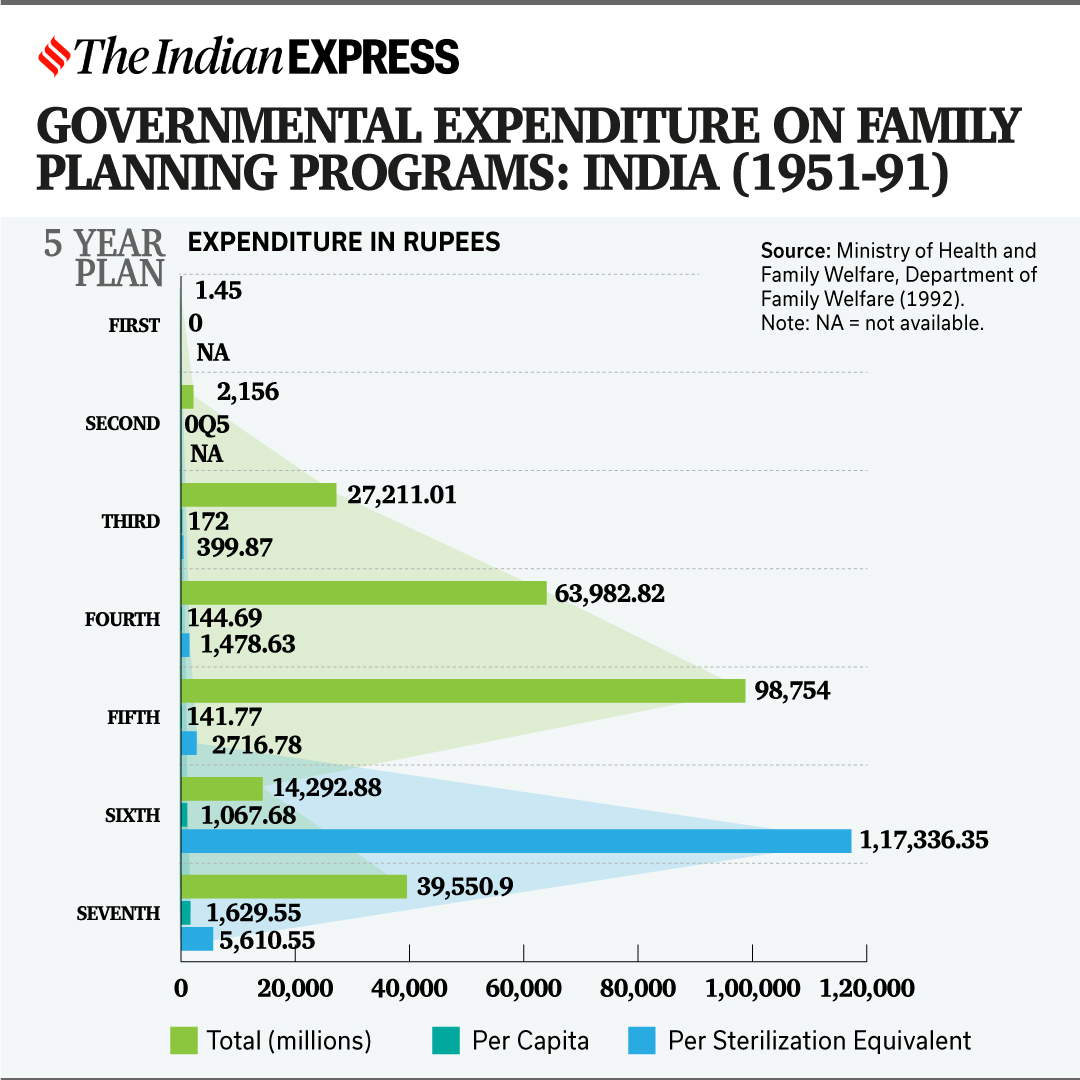
- However, the programme made negligible progress, partly because there was very little experience to draw from. Moreover, its goal was defined in rather vague terms as that of reducing the birth rate to the level necessary to stabilise the population at a level consistent with the requirements of the national economy
- The second five-year plan involved the opening of 1,430 family planning clinics and birth control services also began to be provided at private healthcare systems (PHCs)
- Family planning and health came under the jurisdiction of the states and in this regard, we see significant progress in birth control initiatives in the south
- In 1959, for instance, the Madras state government introduced a scheme by which people who were sterilised were given a small amount of money. There were restrictions on who could be sterilised though
- By 1960, the states of Mysore, Maharashtra and Kerala also introduced similar schemes.
- Influenced by the progress made by the southern states, the third five-year plan made sterilisation services available in PHCs as well.
- Several sterilisation centres were also established, mainly in the bigger cities.
- Dyson notes that the number of sterilisations carried out in India rose from 64,000 in 1960 to about 1.8 million by 1967-68
- However, the 1971 census made clear that despite the many efforts, much to the frustration of policymakers, population growth had continued unabated during the decade
- The population of the country rose from 439.2 million in 1961 to 548.2 million in 1971, which was a 24.8 per cent increase as compared to a 21.5 per cent rise in the 1951-61 period
- In the period between 1960 to 1976 the international emphasis on family planning increased significantly with funding from the United States Agency for International Development (USAID), Ford Foundation and Rockefeller Foundations
- Among all Asian and Sub-Saharan African countries, India’s family planning programme received the largest chunk of international aid
- The mass sterilisation campaign that took off during the Emergency declared by then Prime Minister Indira Gandhi needs to be seen in the context of this international pressure on India
- With the opposition behind bars and the press silenced, several atrocities were carried out during the period of Emergency that lasted from June 1975 to March 1977
- The most talked about among them was a forced sterilisation campaign, spearheaded by Gandhi’s son, Sanjay Gandhi, who held no official post in the government at that time
- A National Population Policy (NPP), the first of its kind in India, was passed in the Parliament in April 1976. Sterilisation and in particular vasectomy were to be the core of this programme
- States such as Uttar Pradesh, Bihar, Madhya Pradesh, Rajasthan, Orissa, Haryana, Punjab, and Himachal Pradesh also came up with their sterilisation policies, and all of North India came to be known as the ‘vasectomy belt’.
- Each of these states began competing with each other to achieve the highest number of sterilisations.
- Vasectomies were held in many government offices, railway stations, and schools
- Further, the government issued circulars to employees stating that their promotions and payments would be held back unless they got sterilised or got an assigned quota of people to sterilise
- Those who suffered the most were the poor and illiterate people, picked up from pavements, railway stations, or bus stops and forced to undergo the process.
- As a result, the family planning programme’s performance in India during the 1976-77 period was the best that any country had ever achieved, with 8.26 million sterilisations
- It is worth noting that it was during this period that China officially adopted the one-child policy, and one can assume that Gandhi and her son thought that a similar attitude of force might work in the case of India too
- The biggest change that took place after the 1977 general elections was that India’s population control policy shifted focus to voluntary efforts
- The name of the programme was changed from ‘family planning’ to ‘family welfare’ under the pretext that any population policy would put greater emphasis on maternal and child healthcare as well as nutrition
- A working group on population policy was set up under the Planning Commission in 1979.
- The group recommended a long-term demographic goal of reaching a net reproduction rate of one by 1996 for the entire country and the states by 2001
- The government also emphasised indirect measures such as spreading awareness through the use of media, education, giving a larger share of the central government’s assistance to states performing well and the like
- Further, states came out with policies of their own. Some states such as Assam, Odisha, Rajasthan, Maharashtra, Telangana and Andhra Pradesh, for instance, have some form of two-child policy in place to be eligible for certain government jobs.
- The Uttar Pradesh Law Commission in July 2021 submitted a proposal for barring any person with more than two children from contesting in local polls, applying for promotions in government jobs and receiving government subsidies.


