
INTEGRATED MAINS AND PRELIMS MENTORSHIP (IMPM) 2025 Daily KEY
| Exclusive for Subscribers Daily: Global Warming for the UPSC Exam? Why are topics like Unique Identification Authority of India (UIDAI) and Commission for Air Quality Management in NCR and Adjoining Areas (CAQM) important for both preliminary and main exams? Discover more insights in the UPSC Exam Notes for January 02, 2025 |
🚨 UPSC EXAM NOTES presents the January edition of our comprehensive monthly guide. Access it to enhance your preparation. We value your input - share your thoughts and recommendations in the comments section or via email at Support@upscexamnotes.com 🚨
Critical Topics and Their Significance for the UPSC CSE Examination on January 02, 2025
Daily Insights and Initiatives for UPSC Exam Notes: Comprehensive explanations and high-quality material provided regularly for students
Unique Identification Authority of India (UIDAI)
For preliminary Examination: Current events of antional and international importance
For Mains Examination: GS II - Indian Polity & Governance
Context:
Shri Bhuvnesh Kumar assumed charge as the Chief Executive Officer (CEO) of Unique Identification Authority of India (UIDAI) on Wednesday. He is an officer of the 1995 batch IAS from the Uttar Pradesh cadre
Read about:
Significance of UIDAI
Possible frauds that might happens around UIDAI
Key takeaways:
- The Unique Identification Authority of India (UIDAI) is a statutory authority established in January 2009 by the Government of India, under the Ministry of Electronics and Information Technology (MeitY). Its primary mandate is to issue a unique identification number, known as Aadhaar, to every resident of India. This 12-digit number serves as a proof of identity and address and is based on biometric and demographic data collected from individuals.
- The Aadhaar system was envisioned as a transformative initiative to streamline public service delivery, improve efficiency, and reduce fraud and corruption. By linking an individual’s Aadhaar number to government schemes and programs, benefits can be delivered directly to beneficiaries, eliminating intermediaries.
- For example, subsidies for LPG gas cylinders, pensions, and scholarships are now disbursed directly into Aadhaar-linked bank accounts, ensuring transparency and accountability.
- To create a robust and secure identity system, UIDAI relies on biometric data such as fingerprints and iris scans, as well as demographic details like name, date of birth, and address.
- This information is stored in a centralized database, making Aadhaar a digital identity that can be authenticated online. The process of obtaining an Aadhaar card is voluntary but has become integral to accessing a wide range of services, including banking, mobile connections, and government welfare programs.
- UIDAI has also implemented stringent data security measures to protect the personal information of individuals. The Aadhaar system uses encryption technologies and follows strict protocols to ensure privacy. Additionally, Aadhaar is not a citizenship document, but rather a tool to establish identity.
- Over the years, Aadhaar has emerged as one of the largest biometric identification systems in the world, covering over a billion residents. It has played a significant role in advancing India’s digital infrastructure, enabling financial inclusion, and promoting the concept of a Digital India.
- Despite its widespread adoption, the Aadhaar system has faced debates around privacy concerns and mandatory usage. Nevertheless, UIDAI continues to work on improving the system, ensuring its accessibility, security, and reliability for the residents of India
- One of the most significant challenges faced by UIDAI is ensuring the privacy and security of the vast amount of biometric and demographic data collected. Critics have raised concerns about the potential misuse of Aadhaar data, especially in the absence of a robust data protection law. Instances of data breaches and unauthorized access have amplified fears regarding the security of sensitive personal information
- Although Aadhaar aims to provide universal identity, certain marginalized groups, such as the homeless, tribal populations, and individuals without stable documentation, face difficulties in enrolling. Additionally, errors in biometric authentication, such as fingerprint mismatches for the elderly or manual laborers, can lead to exclusion from essential services linked to Aadhaar, such as subsidies and welfare programs.
- The mandatory linkage of Aadhaar with various services has been contested in courts on the grounds of privacy and individual freedom. The Supreme Court of India, in its landmark judgment in 2018, upheld Aadhaar’s constitutional validity but placed restrictions on its mandatory use, limiting it to government schemes and tax filings while disallowing it for private purposes like mobile connections or bank accounts
- The sheer scale of the Aadhaar project makes its operation challenging. Instances of delays in Aadhaar generation, errors in demographic details, and inconsistencies in data create logistical hurdles. Moreover, maintaining the quality of the biometric database over time, especially as individuals' physical attributes change, poses technical challenges
- The growing dependence on Aadhaar for accessing services and benefits has led to concerns about monopolizing identity verification. In cases of system outages, technical failures, or authentication errors, individuals may be denied access to essential services, raising questions about the reliability of Aadhaar as the sole identity mechanism
- Despite security measures, there have been instances of Aadhaar misuse, such as identity theft, fake Aadhaar cards, and unauthorized usage. Fraudulent operators have exploited loopholes in the enrollment or verification process, creating fake identities for illegal activities
- Aadhaar has been criticized for enabling a potential surveillance state. With its integration into numerous public and private databases, there is concern that Aadhaar can be used to monitor individuals’ activities, thus eroding personal freedoms and violating privacy
|
Answer (D)
|
- The Commission for Air Quality Management in NCR and Adjoining Areas (CAQM), established in 2021, has implemented a range of policy measures and on-ground initiatives to reduce air pollution in Delhi-NCR.
- These efforts, combined with consistent and collaborative actions by all stakeholders, have significantly contributed to improving air quality in 2024.
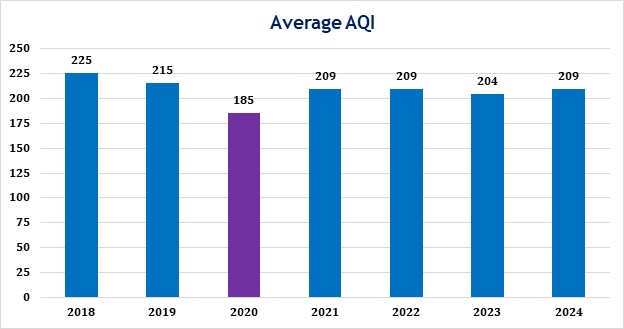
- This improvement is reflected in the record 209 days during the year when the Air Quality Index (AQI) was below 200, indicating "Good" to "Moderate" air quality.
- Excluding the exceptional year of 2020, which experienced minimal human activity due to COVID-19 lockdowns, 2024 saw the highest number of "Good to Moderate" air quality days.
- Delhi recorded its best average AQI for February and December in 2024 since 2018, along with the best average AQI for August during the same period (excluding 2020). Additionally, March and April in 2024 saw the second-best daily average AQI since 2018, again barring the impact of the pandemic year.
- However, certain adverse conditions in 2024 affected air quality. Unusually still winds in January led to an average AQI of 355, the highest for January between 2018 and 2024.
- Prolonged dry spells and strong winds from April to June, particularly in May, contributed to the transport of dust and particulate matter from nearby regions and across borders, resulting in the worst average AQI for May during this timeframe.
- Despite these challenges, 2024 achieved the highest number of "Good to Moderate" AQI days and the fewest "Poor to Severe" days since 2018 (excluding 2020).
- Farm burning incidents during the paddy harvesting season also declined significantly, with Punjab reporting 10,909 fires, Haryana 1,406, and a total of 12,750 across NCR areas, including parts of Uttar Pradesh, Rajasthan, and Delhi
Comparative AQI Category status for Delhi
|
AQI Category |
No. of days |
||||||
|
2018 |
2019 |
2020 |
2021 |
2022 |
2023 |
2024 |
|
|
Good to Moderate (<200) |
159 |
182 |
227 |
197 |
163 |
206 |
209 |
|
Poor to Severe (201 – 400+) |
206 |
183 |
139 |
168 |
202 |
159 |
157 |
- Carbon dioxide
- Carbon monoxide
- Nitrogen dioxide
- Sulfur dioxide
- Methane
Select the correct answer using the code given below:
A. 1, 2 and 3 only
B. 2, 3 and 4 only
C. 1, 4 and 5 only
D. 1, 2, 3, 4 and 5
|
Answer (B)
The Air Quality Index (AQI) in India is calculated based on the concentrations of specific pollutants that have direct impacts on human health. These pollutants are:
Analysis of the Options:
|
- The Aditya-L1 mission, India's first dedicated solar observatory, represents a significant leap in space science by the Indian Space Research Organisation (ISRO). Designed to study the Sun comprehensively, the spacecraft was launched into space with the goal of providing unprecedented insights into solar activities and their impact on space weather.
- The mission's name, Aditya (meaning "Sun" in Sanskrit), signifies its purpose of exploring our closest star. The "L1" designation refers to the Lagrange Point 1, a strategic position approximately 1.5 million kilometers from Earth, where the gravitational forces of the Earth and the Sun balance. This unique vantage point allows the spacecraft to continuously observe the Sun without any obstructions such as eclipses or atmospheric interference.
- Aditya-L1 carries seven scientific payloads, each with specialized instruments to study different aspects of the Sun. These instruments focus on the Sun's outermost layers—the photosphere, chromosphere, and corona. They are designed to monitor solar flares, study the dynamics of the solar wind, and understand the processes that cause coronal mass ejections (CMEs), which can significantly affect space weather.
- One of the mission's primary objectives is to study the Sun's corona, the outermost layer of its atmosphere. The corona is incredibly hot, with temperatures reaching millions of degrees Celsius—much hotter than the Sun's surface.
- Understanding the mechanisms behind this heating and the triggers for solar eruptions is crucial, as these phenomena can impact satellite communication, navigation systems, and even power grids on Earth.
- The mission also aims to provide critical data about solar magnetic fields and their evolution, contributing to our understanding of space weather and its implications for Earth and interplanetary missions. This data is vital for preparing against disruptions caused by solar storms, which can interfere with technology-dependent systems.
- Aditya-L1 not only enhances India's scientific capabilities but also contributes to global solar research. Its observations complement those of other solar missions, such as NASA's Parker Solar Probe and the European Space Agency's Solar Orbiter, forming part of a global effort to decode the Sun's mysteries.
- In essence, the Aditya-L1 mission underscores India's growing prowess in space exploration and its commitment to addressing fundamental scientific questions. By unveiling the secrets of the Sun, this mission not only pushes the boundaries of our understanding of the cosmos but also strengthens humanity's ability to predict and mitigate the effects of solar phenomena on modern technological systems
|
Answer (C)
Aditya L1 is a spacecraft project developed by the Indian Space Research Organisation (ISRO). It is India's first solar observatory mission, designed to study the Sun from the Lagrange Point 1 (L1), approximately 1.5 million kilometers from Earth. This mission focuses on understanding solar activities, including the solar corona, solar wind, and space weather, and does not relate to missiles, moon rockets, or combat aircraft
|
India’s road to Net Zero needs a renewable energy boost
For Preliminary Examination: Global Warming, Greenhouse gases
For Mains Examination: GS III - Environment & Ecology
Context:
Three years ago at the 26th Conference of Parties (COP26) to the United Nations Framework Convention on Climate Change in Glasgow, India declared a Net Zero emissions pathway goal by 2070
Read about:
Conference of Parties (CoP)
Net Zero Mission
Key takeaways:
- Three years ago, at the 26th Conference of Parties (COP26) to the United Nations Framework Convention on Climate Change in Glasgow, India committed to achieving Net Zero emissions by 2070.
- Achieving this ambitious target necessitates a significant reduction in coal-based power generation and a substantial increase in renewable, non-fossil energy sources by over 20% beyond current levels.
- With rising cooling demands driven by urban heating and climate change, renewable energy will play a crucial role in meeting peak electricity needs. This requires solar and wind energy to be supported by energy storage solutions, such as battery systems, to ensure consistent power supply.
- However, the ground reality is far from ideal. Coal production and coal-based power generation are on the rise, while the adoption of renewable energy has not progressed at the required pace.
- For India to achieve its goals, power distribution companies (discoms) must increase their procurement of renewable energy and align with both short- and long-term renewable purchase obligations. Currently, most discoms aim to source about 22% of their power from renewable energy sources, with this target set to rise gradually to 43% by 2035.
- This transition, however, hinges on renewable energy becoming significantly cheaper than coal-based thermal power, which currently remains a more cost-effective option
Pricing Issues & General Solutions
- India's renewable energy development faces significant challenges related to capacity constraints in the generation and transmission of power through the national grid. Many state-owned power distribution companies (discoms) are financially strained, often surviving on state government subsidies and periodic bailouts from the central government.
- These financial guarantees have allowed state discoms to enter into long-term power purchase agreements (PPAs) with private energy producers. These agreements provide fixed long-term purchase prices, ensuring stability for investors and enabling capital inflows to expand energy generation capacities, even in a sector that is not inherently profitable.
- Recently, discoms and Indian Railways reached an agreement on a competitive regulated tariff for renewable energy procurement, supported by battery-operated energy storage systems and "round-the-clock" power supply contracts. By combining daytime solar power generation with coal-based thermal power at night, these systems ensure a 24/7 power supply.
- Over the long term, discoms may need a mix of thermal power and renewable energy complemented by storage solutions to meet rising demand, which will require a significant expansion in overall generation capacity.
- Using solar energy during the day while storing thermal energy for nighttime use can maintain the plant load factor of coal-based plants, avoiding cost increases in thermal power generation.
- To meet its Net Zero emissions target by 2070, India must add 500 GW of renewable energy capacity by 2030, with solar and wind contributing the largest share, supported by other sources like hydro, biofuel, and nuclear power. Solar capacity, currently at about 89 GW, will need to increase more than fivefold, backed by adequate storage capacity and favorable regulated tariffs.
- To achieve these goals, discoms must adopt a procurement strategy based on the lowest cost. Increased competition and growing investments in energy generation are driving down generation costs for coal-based thermal power plants.
- Additionally, the reverse bidding process for renewable energy projects, where the lowest bidder sets the benchmark for subsequent bids, continues to push prices downward, making renewable energy increasingly affordable
Follow Up Question
1.With reference to India's Net Zero Mission, consider the following statements:
- India has committed to achieving Net Zero emissions by 2050.
- To achieve the Net Zero target, India aims to install 500 GW of non-fossil fuel-based energy capacity by 2030.
- Net Zero emissions imply that a country will completely eliminate greenhouse gas emissions.
Which of the statements given above is/are correct?
A. 1 and 2 only
B. 2 only
C. 1 and 3 only
D. 2 and 3 only
|
Answer (B)
|
- Following the Wayanad landslides in July, which resulted in over 400 fatalities, scientists from the World Weather Attribution, an international research initiative, attributed an 11% exacerbation of the disaster to global warming.
- However, for researchers closely observing the Western Ghats, global warming is seen as a key factor in nearly all recent landslides in the region. Landslides are increasingly occurring along the eastern slopes of the Western Ghats, spanning from Coorg district in Karnataka to Vellarimala in Kerala, according to C.K. Vishnudas, director of the Hume Centre for Ecology and Wildlife Biology in Wayanad.
- While urbanization, mining, and declining green cover typically increase vulnerability to landslides, the eastern slopes remain sparsely populated and covered in dense forests.
- Nonetheless, six forested areas in Karnataka and Kerala have been marked as "climate change hotspots" by the Forest Survey of India (FSI).
- These regions have experienced a temperature rise of over 1.5°C and rainfall variability exceeding 20% in recent decades, as noted in the FSI's 2020 report. This report also identifies other climate-sensitive areas, including parts of Arunachal Pradesh, Himachal Pradesh, Chhattisgarh, Andhra Pradesh, Tamil Nadu, Maharashtra, and Uttarakhand's Jim Corbett National Park.
- Once a small forest patch is destabilized, repeated heavy rains can set the stage for broader collapse. The threshold for landslides in the region is 145-150 mm of rainfall within 24 hours. Hazard zonation maps for the Western Ghats in Kerala are now being developed to aid in planning and decision-making for development on forested slopes.
- Despite the increasing frequency of intense rainfall events, Kerala has experienced drier-than-normal conditions during pre-monsoon and monsoon seasons over the past two years, leading to drought-like conditions and a rise in forest fires.
- These dry conditions intensify further north in Karnataka's Western Ghats. For instance, in the Anshi National Park area within Uttara Kannada's Kali Tiger Reserve, dry patches are visible as close as 8 km from the forest's entry point, highlighting the challenges faced even in semi-evergreen ecosystems
- Landslides are natural disasters that occur when masses of earth, rock, or debris move down a slope under the influence of gravity. They are often triggered by factors such as heavy rainfall, earthquakes, volcanic activity, or human interventions like deforestation and construction. While they are a natural geological process, their frequency and intensity have been exacerbated by climate change and unsustainable land use practices.
- In regions like the Western Ghats in India, landslides are increasingly becoming a cause for concern. The steep terrain, combined with high rainfall and human activities such as mining and deforestation, creates ideal conditions for such events.
- During heavy rainfall, the soil on slopes becomes saturated, weakening its structural integrity. This saturation reduces the friction holding the soil in place, leading to its collapse at the weakest points.
- Global warming has added another layer of complexity. Changes in rainfall patterns, with more intense and shorter bursts of rainfall, increase the likelihood of landslides. In some areas, even densely forested slopes, traditionally seen as more stable, have become vulnerable due to the saturation of soil during extreme rainfall events. These events can trigger cascading effects, where the destabilization of a small forest patch can lead to the collapse of a larger area over time.
- In the Western Ghats, landslides are not confined to densely populated or heavily urbanized areas. Even sparsely populated and forested regions are affected. Climate studies have identified several areas in the Ghats as "climate change hotspots," where rising temperatures and fluctuating rainfall patterns have made the landscape more prone to such disasters. For example, certain areas have recorded a temperature increase of over 1.5°C and rainfall variability exceeding 20%, making them particularly susceptible.
- The impact of landslides extends beyond the immediate destruction of infrastructure and loss of life. They disrupt ecosystems, destroy agricultural land, and lead to long-term environmental degradation. In many cases, the debris from landslides blocks rivers, creating temporary dams that can later lead to flash floods when they break.
- Efforts to mitigate landslides include hazard mapping, afforestation, and the construction of barriers or drainage systems to redirect water flow.
- In regions like Kerala's Western Ghats, preliminary hazard zonation maps have been developed to guide sustainable development and reduce risks.
- However, tackling the root causes, such as climate change and unsustainable land use, remains critical to minimizing the occurrence and impact of landslides in the long term
|
Answer (D)
Carbon sequestration refers to the process of capturing and storing carbon dioxide (CO2) to prevent its release into the atmosphere, thus helping mitigate global warming. The following sites are considered potential for carbon sequestration:
|
| Subject | Topic | Description |
| History | Modern Indian History | Important Personalities |
| History | Modern Indian History | Independence and Partition |
| History | Modern Indian History | Constitutional Development in India |
| History | Modern Indian History | Peasants, Tribal and other movements |
|
UPSC EXAM NOTES will be conducting both Prelims and Mains exams every Sunday as part of the Integrated Mains and Prelims (IMPM) Program. This program provides a comprehensive approach to UPSC exam preparation, ensuring that candidates are well-prepared for both stages of the exam. Program Highlights:
Duration: The IMPM plan is a one-year program, ensuring continuous and structured preparation over 12 months. With regular testing and consistent study guidance, this program is designed to maximize your chances of success in the UPSC exams |
