
INTEGRATED MAINS AND PRELIMS MENTORSHIP (IMPM) 2025 Daily KEY
| Exclusive for Subscribers Daily: Houthis and Mini Moon 20024 pt5 for the UPSC Exam? Why are topics like Mahatma Gandhi and Small Modular Reactors(SMR) important for both preliminary and main exams? Discover more insights in the UPSC Exam Notes for October 02, 2024 |
🚨 UPSC EXAM NOTES presents the July edition of our comprehensive monthly guide. Access it to enhance your preparation. We value your input - share your thoughts and recommendations in the comments section or via email at Support@upscexamnotes.com 🚨
Critical Topics and Their Significance for the UPSC CSE Examination on October 02, 2024
Daily Insights and Initiatives for UPSC Exam Notes: Comprehensive explanations and high-quality material provided regularly for students
For Prelims Examination: Current events of national and international importance
For Mains Examination: GS III - Science & Technology
Context:
An asteroid named 2024 PT5 has been captured by Earth’s gravitational pull and will revolve around the planet between September 29 and November 25. It was discovered by a team of scientists on August 7, and their findings were published in the journal “Research Notes of the American Astronomical Society” in September.
Read about:
What is Mini Moon 2024 pt5?
What are Mini Moon events?
Key takeaways:
- In late September 2024, Earth is expected to temporarily capture a small asteroid, designated 2024 PT5, as a "mini-moon." This celestial body, about 10 meters wide, will orbit Earth for a brief period, from September 29 to November 25, before being pulled away by the Sun’s gravity. This phenomenon occurs when a Near-Earth Object (NEO) gets caught by Earth's gravitational field, creating a temporary satellite.
- 2024 PT5 originated from the Arjuna asteroid belt, and this is not the first time such an event has happened. Similar temporary moons have been documented in the past, like in 2022 with asteroid 2022 NX1.
- Although the mini-moon is too small and dim to be easily observed by amateur astronomers, professionals with larger telescopes can track its orbit. After its temporary stay, 2024 PT5 is expected to return to a solar orbit and could potentially be recaptured in the future, with astronomers predicting possible reappearances in 2025 and 2055.
- This fascinating event underscores how Earth's gravitational pull occasionally interacts with nearby objects, giving us temporary companions in space. Despite initial concerns, 2024 PT5 poses no risk of impacting Earth.
Mini Moon Events
A "mini-moon" event occurs when a small Near-Earth Object (NEO) or asteroid is temporarily captured by Earth's gravitational field, becoming a short-term natural satellite. These mini-moons are typically small in size—often just a few meters wide—and they orbit Earth for a limited time, ranging from a few months to a couple of years, before being pulled back into orbit around the Sun due to gravitational interactions.
Mini-moons are rare because of the specific conditions required for an object to be captured. Most NEOs pass by Earth without being affected, but occasionally, one is caught by Earth’s gravity. While in orbit, these objects behave like small, secondary moons, though they are much smaller than our primary Moon.
Some notable mini-moons include:
- 2006 RH120: One of the first mini-moons discovered, which orbited Earth from 2006 to 2007.
- 2020 CD3: Detected in 2020, this asteroid orbited Earth for around three years before leaving Earth's orbit.
- 2024 PT5: Expected to orbit Earth from September to November 2024, this asteroid will briefly act as a mini-moon before continuing its journey in space.
Although mini-moons are generally too small to pose any threat to Earth, they are of great interest to astronomers and scientists. These objects provide opportunities for studying NEOs, and they may one day serve as targets for spacecraft missions or exploration. Mini-moons also offer insights into the dynamics of asteroid capture and orbital mechanics
Follow Up Question
|
Answer (C)
The purpose of the US Space Agency’s Themis Mission, which was in the news, was to study the colorful display of high-latitude skies. This mission aimed to understand auroras and other atmospheric phenomena, focusing on the interactions between solar winds and the Earth's magnetic field, particularly at higher latitudes
|
Mahatma Gandhi's philosophy of ahimsa, or non-violence, is a cornerstone of his ethical and political beliefs. Ahimsa, derived from Sanskrit meaning "non-violence" or "non-harming," is not merely the absence of physical violence but a profound respect for all living beings. It encompasses love, compassion, and an unwavering commitment to truth. Gandhi believed that practicing ahimsa was essential for individual and societal well-being.
Key Aspects of Gandhi's Ahimsa Philosophy:
-
Moral Foundation: Gandhi viewed ahimsa as the highest moral principle. He believed that true strength lies in non-violence, which requires immense inner courage and self-discipline. For him, the practice of ahimsa is closely linked with the concept of satya (truth), where one must adhere to truth without causing harm to others .
-
Political Strategy: Gandhi employed ahimsa as a fundamental strategy in the struggle for India's independence from British colonial rule. He organized various non-violent protests and movements, such as the Salt March and Quit India Movement, asserting that true change could be achieved through peaceful means rather than violence . His approach sought to empower the oppressed without perpetuating cycles of violence.
-
Spiritual Dimension: Ahimsa is also deeply spiritual for Gandhi. He believed that practicing non-violence was essential for spiritual growth and realization. He argued that harming others harms oneself and that to realize one's unity with the divine, one must cultivate love and compassion for all beings .
-
Critique of Violence: Gandhi's philosophy critiques the use of violence as a means to an end. He argued that violence leads to more violence and suffering, thus perpetuating a cycle of hatred and retaliation. In his view, engaging in violence undermines the moral high ground necessary for a just cause .
-
Ahimsa in Daily Life: Beyond political activism, Gandhi emphasized that ahimsa should be practiced in everyday life. This includes not only refraining from physical harm but also avoiding verbal abuse, hatred, and discrimination against others. He believed that cultivating an attitude of compassion and empathy in our daily interactions is vital
Mahatma Gandhi's concept of non-violence (ahimsa) is not only central to his political philosophy but also serves as a guiding principle in his writings and speeches, significantly contributing to the discourse on peace and justice. Here's an overview of how Gandhi articulated and promoted non-violence through his literacy and thought:
Key Aspects of Gandhi's Non-Violence Philosophy
-
Philosophical Foundations: Gandhi's approach to non-violence is deeply rooted in various philosophical traditions, including Hinduism, Jainism, and Christianity. He believed that true non-violence goes beyond merely refraining from physical harm; it encompasses thoughts and words as well. For Gandhi, ahimsa was a way of life that required a commitment to compassion and love for all beings.
-
Political Activism: Gandhi effectively utilized non-violent methods in India's struggle for independence from British rule. He organized numerous campaigns, including the Salt March and the Quit India Movement, promoting civil disobedience without resorting to violence. His writings during this period, such as in his journal "Young India," laid out his philosophy and provided a moral framework for resistance against oppression.
-
Literary Contributions: Gandhi wrote extensively on the topic of non-violence in various forms, including essays, letters, and speeches. His works often emphasized the importance of truth (satya) and non-violence as interconnected principles. In his autobiography, "The Story of My Experiments with Truth," he shares personal experiences that shaped his understanding of ahimsa.
-
Global Influence: Gandhi's non-violence philosophy transcended national boundaries, influencing civil rights movements worldwide. Leaders like Martin Luther King Jr. and Nelson Mandela drew inspiration from Gandhi's methods, adapting them to their contexts to combat injustice. Gandhi's principles continue to inspire contemporary movements for peace and justice.
-
Critique of Violence: In his writings, Gandhi argued against the effectiveness of violence, asserting that it leads to more violence and perpetuates cycles of hatred. He believed that non-violent resistance would garner greater moral authority and ultimately lead to more meaningful social change.
B) Quit India Movement
C) Champaran Satyagraha
D) Khilafat Movement
|
Answer (A)
|
- Small Modular Reactors (SMRs), which have a capacity ranging from 30 MWe to 300 MWe per unit, are increasingly recognized as essential for ensuring that nuclear energy remains a viable and competitive option in the future.
- India aims to secure a leadership role in the SMR sector as part of its commitment to transitioning to clean energy and to leverage SMRs as a technology-driven aspect of its foreign policy.
- Countries are looking to SMRs to help achieve their energy transition goals, and Russia is reportedly interested in enhancing its nuclear collaboration with India to include SMR partnerships.
- Typically, an SMR produces about one-third of the capacity of most conventional nuclear reactors used in nations like France, Russia, and the United States. These reactors are crucial for providing baseload power, allowing grid operators greater operational flexibility.
- When aggregated, SMRs can generate a significant amount of electricity, assisting in meeting the demand for more baseload power to complement the inconsistencies of renewable energy sources. While thermal generation is important in this context, nuclear energy presents a more carbon-neutral option for baseload generation.
- India's civil nuclear program has gradually increased reactor sizes, moving from the earlier 220 MWe models to the current 700 MWe pressurized heavy water reactors (PHWRs).
- However, the country maintains an advantage in the production and commercial operation of smaller reactors. The longstanding advocacy for SMRs is now poised to become mainstream, with potential backing from countries like the United States, particularly in financing and technology sharing.
- In the civil nuclear domain, India is promoting SMRs as a promising technology for industrial decarbonization, striving to take a leading role in the distribution of this technology. SMRs are viewed not only as effective for generating baseload power—where thermal energy is crucial—but also as a more carbon-neutral option alongside renewables.
- Designed for efficiency, SMRs have systems and components manufactured in a controlled factory setting and then transported to the installation site, which reduces construction time and costs—two significant issues associated with traditional large reactor projects.
- They offer deployment advantages, such as a smaller Emergency Planning Zone and passive safety systems, making them relatively safer compared to larger reactor projects
|
Answer (B)
In India, the distinction between nuclear reactors under IAEA (International Atomic Energy Agency) safeguards and those not under such safeguards primarily relates to the sources of fuel used in these reactors.
|
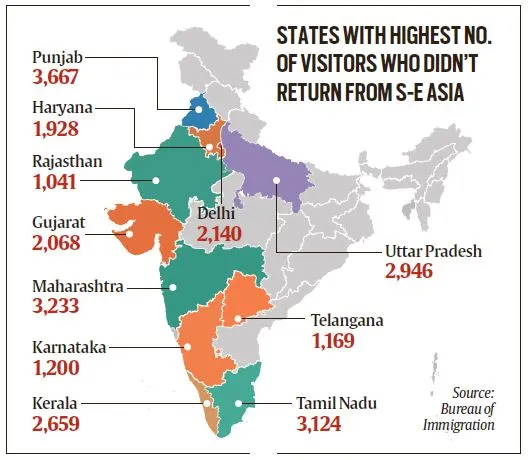
Cyber slavery refers to the exploitation of individuals through digital means, where they are subjected to forced labor, trafficking, or coercion in the online space. This form of modern slavery often involves:
-
Human Trafficking: Victims are lured through false job offers or manipulated into providing personal information online, leading to exploitation in various forms, including forced sex work or labor.
-
Digital Exploitation: This can include situations where individuals are controlled or monitored through technology, making it difficult for them to escape their circumstances. Cybersecurity vulnerabilities may allow traffickers to manipulate or control their victims remotely.
-
Online Platforms: Social media and job-search websites can be used by traffickers to recruit and exploit victims. The anonymity and reach of the internet can facilitate these crimes.
-
Vulnerable Populations: Young people, particularly those in lower socio-economic conditions, are often targeted due to their lack of resources and support, making them more susceptible to exploitation
Cyber slavery is a significant issue that intersects with broader concerns of human rights, labor rights, and digital ethics. Organizations and governments are increasingly recognizing the need for stronger regulations and protections against such practices. Efforts include:
- Raising awareness about the signs of cyber slavery.
- Implementing stricter regulations on online platforms to prevent exploitation.
- Providing support services for victims
|
Answer (D)
In India, cyber insurance for individuals typically covers several benefits in addition to compensation for the loss of funds. Based on the options provided:
|
Types:
- Rotational Landslides: Occur when a mass of earth rotates around a pivot point.
- Translational Landslides: Involve the sliding of material down a flat or gently inclined surface.
- Rockfalls: Involve the sudden fall of rock from a steep slope or cliff
- India has several mountainous regions, particularly in the Himalayas, Western Ghats, and Northeast India. These areas are characterized by steep slopes, which are more susceptible to landslides.
- Regions such as the Himalayas are tectonically active. Earthquakes can trigger landslides, making these areas particularly vulnerable
- The Indian monsoon brings significant rainfall, especially in regions like the Western Ghats and Northeast India. Intense and prolonged rainfall can saturate soils, increasing the likelihood of landslides
- Human activities, such as deforestation, mining, and urbanization, disrupt the stability of slopes. The removal of vegetation reduces soil cohesion, making landslides more likely.
Regions at Risk
- Himalayan States: States like Uttarakhand, Himachal Pradesh, and Jammu & Kashmir frequently experience landslides due to their steep terrain and heavy monsoonal rains.
- Northeast India: States such as Sikkim, Arunachal Pradesh, and Meghalaya are also prone to landslides, particularly during the monsoon season.
- Western Ghats: This region faces landslide risks, particularly in Kerala and Karnataka, especially during heavy rainfall.
1. Which of the following statements in respect of landslides are correct? (NDA 2022)
Select the correct answer using the code given below.
A. 1 and 2
B. 2 and 3
C. 1 and 3
D. 1, 2 and 3
|
Answer (B)
|
Israel kills another Hezbollah leader in Lebanon, strikes Houthis in Yemen
For Preliminary Examination: Current events of national and international importance
For Mains Examination: GS II - International relations
Context:
The Israeli military said on Sunday it has killed another high-ranking Hezbollah official in an airstrike as the Lebanese militant group was reeling from a string of devastating blows and the killing of its overall leader, Hassan Nasrallah. It also launched strikes at Houthi targets in Yemen after the militants fired missiles at Israel over the past two days, marking a fresh exchange in another front of the regional conflict
Read about:
Who are Houthis?
What is the Israel-Hezbollah conflict?
Key takeaways:
- The military announced the death of Nabil Kaouk, the deputy head of Hezbollah's Central Council, on Saturday. Hezbollah confirmed this news, marking him as the seventh senior Hezbollah official killed in Israeli airstrikes within a week. The Israeli military conducted another targeted attack on Beirut later that same day.
- Earlier, Hezbollah acknowledged that Ali Karaki, another senior commander, was killed in a strike that also resulted in the death of Nasrallah. Israel reports that at least 20 additional Hezbollah militants died in this particular strike.
- This month, Hezbollah was also the target of a sophisticated operation that compromised its communication devices, which was widely attributed to Israeli actions. A series of Israeli airstrikes across various regions of Lebanon have resulted in over 1,030 fatalities, including 156 women and 87 children, in less than two weeks, according to Lebanon’s Health Ministry. Hundreds of thousands have been displaced from their homes due to the recent attacks.
- In a statement, the Israeli military indicated that numerous aircraft, including fighter jets, targeted power facilities and a seaport at Ras Issa and Hodeidah ports. Local residents reported that these strikes caused widespread power outages in Hodeidah. The Houthi militants have repeatedly launched missiles and drones at Israel, claiming their actions are in solidarity with the Palestinians. — The death of Nasrallah is expected to significantly alter the geopolitical landscape in the region. Iran, which has supported and armed Hezbollah as part of its “Axis of Resistance,” has vowed to retaliate for what it calls the loss of a “martyr.”
- Nations such as Saudi Arabia and the UAE are closely monitoring the forthcoming actions of Iran and Israel, weighing the potential benefits of a more stable region, including expanded economic opportunities beyond oil, against the increasing costs associated with escalating tensions. — Yemen is strategically situated at the crossroads of the Red Sea and Gulf of Aden, controlling the vital Bab al-Mandab strait.
- The Houthis are a large clan associated with the Zaidi Shia sect, primarily based in Yemen’s northwestern Saada province, comprising around 35% of the Yemeni population.
- The Zaidis governed Yemen for over a millennium until their overthrow in 1962, which sparked a civil war lasting until 1970. The Houthi clan began revitalizing the Zaidi tradition in the 1980s, opposing the growing influence of state-funded Salafists.
- Hezbollah, or "Party of God," is a Shiite militant group formed by Iran's Revolutionary Guards in 1982 in response to the Israeli invasion of Lebanon that same year
Follow Up Question
1.Recently Hodeidah was in the news, it is located in which country?
(a) Israel
(b) Yemen
(c) Lebanon
(d) Jordan
|
Answer (b)
Hodeidah is located in Yemen. It is a strategic port city on the Red Sea and has been a focal point in the ongoing conflict in Yemen, particularly due to its importance for humanitarian aid and military operations. Recent news has highlighted its significance amid various military actions in the region
|
| Subject | Topic | Description |
| History | Modern Indian History | Company rule and Crown rule 1773 - 1947 |
| History | Modern Indian History | Fall of Mughals |
| History | Modern Indian History | Establishment of British rule in India |
| History | Modern Indian History | Economic Policies of the British |
|
UPSC EXAM NOTES will be conducting both Prelims and Mains exams every Sunday as part of the Integrated Mains and Prelims (IMPM) Program. This program provides a comprehensive approach to UPSC exam preparation, ensuring that candidates are well-prepared for both stages of the exam. Program Highlights:
Duration: The IMPM plan is a one-year program, ensuring continuous and structured preparation over 12 months. With regular testing and consistent study guidance, this program is designed to maximize your chances of success in the UPSC exams |
