
INTEGRATED MAINS AND PRELIMS MENTORSHIP (IMPM) 2025 Daily KEY
| Exclusive for Subscribers Daily: Project Cheetah and Supercomputer for the UPSC Exam? Why are topics like PARAM Rudra and Nanotechnology important for both preliminary and main exams? Discover more insights in the UPSC Exam Notes for September 28, 2024 |
🚨 UPSC EXAM NOTES presents the July edition of our comprehensive monthly guide. Access it to enhance your preparation. We value your input - share your thoughts and recommendations in the comments section or via email at Support@upscexamnotes.com 🚨
Critical Topics and Their Significance for the UPSC CSE Examination on September 28, 2024
Daily Insights and Initiatives for UPSC Exam Notes: Comprehensive explanations and high-quality material provided regularly for students
For Preliminary Examination: Current events of national and international importance
For Mains Examination: GS III - Science & Technology
Context:
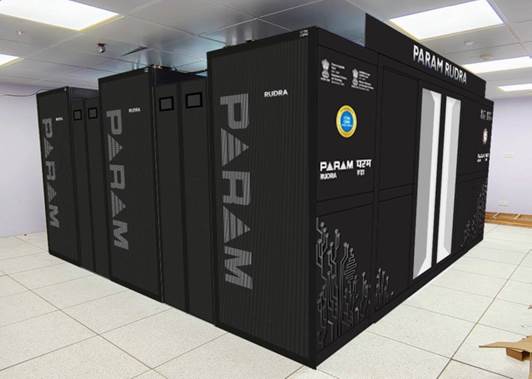
The inauguration of the PARAM Rudra supercomputer at the S.N. Bose National Centre for Basic Sciences (SNBNCBS) in Kolkata by the Prime Minister Shri Narendra Modi brings high performance computing facilities to the Eastern Region, benefitting around 10-12 institutions and thousands of researchers working in this region
Read about:
What is Supercomputer?
Significance of PARAM Rudra
Key takeaways:
- Developed as part of the National Supercomputing Mission (NSM), the PARAM Rudra series, under the leadership of the Ministry of Electronics and IT (MeitY) and the Department of Science and Technology (DST), is set to transform research in areas like advanced materials, high-energy physics, earth sciences, and cosmology. With installations in Pune and Delhi, this series represents a major leap forward in India's scientific and technological capabilities.
- The PARAM Rudra supercomputer at the S.N. Bose Centre, an autonomous institute under DST, will provide critical high-performance computing (HPC) resources to institutions in Eastern India.
- This facility will enable collaboration among researchers from institutions such as Bose Institute, Saha Institute of Nuclear Physics (SINP), Indian Institute of Chemical Biology (IICB), and IISER Kolkata, allowing scientists to perform complex simulations and calculations more efficiently, thereby accelerating the resolution of intricate scientific challenges.
- The 838 TFLOPS system is set to significantly boost research across a range of scientific fields by offering advanced HPC capabilities.
- In materials science, it will accelerate high-throughput computational materials design, expediting the discovery and development of new materials. In Earth science, it will support computational modeling of planetary and Earth materials, combining first-principles calculations with LHDAC (Laser Heated Diamond Anvil Cell) experiments.
- In biological sciences, machine learning will be leveraged to study biomolecular functions, aiding in disease research and treatment development. In chemical science, the supercomputer will help explore molecular electronic structures, advancing quantum chemistry research and improving the understanding of chemical reactivity.
- Additionally, the system will be essential for high-energy astrophysics research, offering insights into the universe's fundamental properties and enabling studies on dense matter, as seen in the ALICE experiment at CERN. It will also facilitate modeling the universe's structure and dynamics, including the interplay of gravitational waves, high-energy photons, and astrophysical neutrinos.
- The benefits of PARAM Rudra extend beyond scientific research. As noted by the Prime Minister, these high-performance computing technologies will bolster India’s global competitiveness in fields like space exploration and semiconductor manufacturing, while also impacting daily life.
- These capabilities are expected to play a pivotal role in disaster management, economic growth, and enhancing business operations, contributing to India’s progress in Industry 4.0.
- Moreover, PARAM Rudra will significantly enhance India's weather and climate prediction abilities, further showcasing its broad utility.
- The PARAM Rudra supercomputer reflects India's dedication to achieving self-reliance in HPC. By investing in such cutting-edge technologies, the country is equipping its scientific community with the tools to drive innovation and contribute globally.
- The inauguration of this supercomputer marks a key milestone in India's scientific journey, where advanced computational power will not only fuel research but also improve the lives of its citizens.
- As India continues to prioritize technological progress, the PARAM Rudra series will play an integral role in shaping the nation's future in science, industry, and beyond
Follow Up Question
1.Which of the following statements regarding supercomputers in India is/are correct?
- The National Supercomputing Mission (NSM) was launched to enhance India's capacity in high-performance computing.
- PARAM Rudra is a supercomputer developed by the Indian Space Research Organisation (ISRO) for space exploration.
- The Centre for Development of Advanced Computing (C-DAC) is the implementing agency for supercomputer development under NSM.
Select the correct answer using the code given below:
a) 1 and 2 only
b) 2 and 3 only
c) 1 and 3 only
d) 1, 2, and 3
|
Answer (c)
|
- A recent breakthrough in understanding how tiny molecular units self-assemble into complex structures offers potential for the creation of innovative materials that could transform industries such as electronics and healthcare.
- Supramolecular self-assembly is a process where small molecules automatically organize into larger, structured forms without external guidance. Mastering this process is essential for designing new organic materials that can be used in nanodevices—miniature machines that can perform tasks at the molecular level.
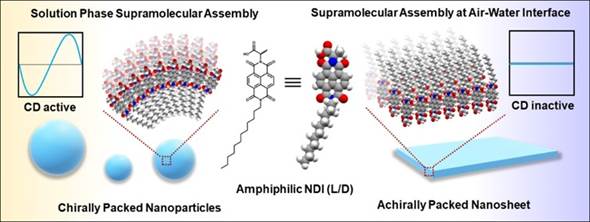
- Researchers from the Centre for Nano and Soft Matter Sciences (CeNS), Bengaluru, in collaboration with the Jawaharlal Nehru Centre for Advanced Scientific Research (JNCASR), Bengaluru—both autonomous institutes under the Department of Science and Technology (DST)—investigated the self-assembly behavior of chiral amphiphilic naphthalene diimide derivatives (NDI-L and NDI-D). They explored two assembly methods: Solution Phase Assembly and Air-Water Interface Assembly.
- In the Solution Phase Assembly, the molecules in a liquid formed spherical nanoparticles, exhibiting unique optical properties like strong mirror-imaged circular dichroism (CD) signals, which are essential for materials that precisely interact with light.
- In contrast, the Air-Water Interface Assembly, where molecules organized at the air-water boundary, resulted in flat, two-dimensional layers with uneven edges. These layers lacked the optical properties seen in the solution-assembled nanoparticles, highlighting that the assembly environment significantly impacts the final structure and properties.
- This discovery, published in ACS Applied Nano Materials, presents exciting possibilities for creating materials with custom properties. In biomedicine, such materials could enhance drug delivery systems by targeting specific body regions, while in electronics, they could enable the development of faster, more efficient devices
|
Answer (D)
|
- Shared Heritage: India and Myanmar share deep historical, cultural, and ethnic links. The two countries have common historical narratives and cultural exchanges, particularly in the regions bordering each other.
- Buddhism: The influence of Buddhism, which originated in India, is significant in Myanmar, and cultural exchanges have occurred over centuries.
- Strategic Importance: Myanmar's geographical position as a neighbor to India is critical for India's Look East and Act East policies, aimed at enhancing connectivity and trade with Southeast Asia.
- Border Security: India shares a 1,643 km long border with Myanmar. Security concerns, including insurgent groups operating along the border, influence bilateral relations.
- Trade: India and Myanmar have been enhancing trade relations, with the establishment of various trade agreements. India is one of Myanmar's largest trading partners, focusing on sectors like pharmaceuticals, agricultural products, and construction materials.
- Infrastructure Projects: India is involved in various infrastructure projects in Myanmar, including the India-Myanmar-Thailand Trilateral Highway, which aims to enhance connectivity and trade among the three countries
- Democracy and Governance: India has historically supported democratic processes in Myanmar, though the political landscape has been complicated by military coups and governance challenges in Myanmar.
- Diplomatic Engagement: High-level visits and diplomatic engagements occur regularly to strengthen bilateral ties, address mutual concerns, and promote cooperation in various sectors.
- Counterinsurgency: Both countries collaborate on security matters, including counterinsurgency operations against militant groups operating across their borders.
- Regional Stability: India is keen on ensuring regional stability and combating issues such as drug trafficking and human trafficking, which are prevalent in border areas
- The meeting focused on identifying potential areas of collaboration to promote mutual growth. Both parties discussed key sectors such as shipping, textiles, health, the Indian Pharmacopoeia, power, transport and connectivity, ICT, the 5G telecom stack, and the MSME sector as significant opportunities for partnership.
- The conversation also highlighted how this cooperation could yield long-term advantages, enabling both countries to achieve their objectives more efficiently while fostering a spirit of mutual support and collaboration. Additionally, India expressed its support for the establishment of the Rupee-Kyat trade settlement mechanism, anticipating an increase in bilateral trade with Myanmar using local currencies once implemented.
- The meeting emphasized the importance of swiftly completing the review of the ASEAN-India Trade in Goods Agreement (AITIGA) to simplify the agreement and make it more beneficial, user-friendly, and conducive to trade for businesses.
- Myanmar ranks as India's seventh-largest trading partner within ASEAN, with total bilateral trade amounting to $1.75 billion in 2023-24
|
Answer (D)
Golden Quadrilateral Project network connects Srinagar in the north to Kanyakumari in the south, and Silchar in the east to Porbandar in the west. Hence statement 1 is incorrect. Trilateral Highway connects Moreh in Manipur and Mae Sot in Thailand via Myanmar. Hence statement 2 is incorrect. A major part of the Trilateral Highway is the road network in Myanmar. Many of the original alignments of the TLH have been recently completed or upgraded — the bypass road connecting Myawaddy and Kawkaleik (Thailand) and the second friendship bridge connecting Myawaddy and Mae Sot being the most important. Bangladesh-China-India-Myanmar Economic Corridor connects Kolkata with Kunming in China. Hence statement 3 is incorrect. The foundation of the Bangladesh-China-India-Myanmar Economic Corridor (BCIM) had been set with the assumption that the project would be activated at the intergovernmental level known as Track I to promote trade and connectivity from Kunming to Kolkata
|
- Extinction: The Asiatic cheetah was last sighted in India in 1947. The species was declared extinct due to habitat loss, hunting, and decline in prey.
- Conservation Efforts: Recognizing the ecological importance of cheetahs, the Indian government initiated efforts to reintroduce this species to restore biodiversity.
- Reintroduction of Cheetahs: The primary goal of Project Cheetah is to reintroduce the African cheetah (Acinonyx jubatus) to select habitats in India, particularly in the Kuno National Park in Madhya Pradesh.
- Biodiversity Restoration: The project aims to enhance biodiversity and restore the natural ecosystem by reestablishing a top predator
- Selection of Sites: Kuno National Park was identified as a suitable habitat for the cheetah reintroduction due to its grassland ecosystem and availability of prey.
- Importing Cheetahs: The project involves the importation of cheetahs from African countries, such as Namibia and South Africa.
- Monitoring and Research: Post-reintroduction, the cheetahs will be closely monitored using GPS collars to track their movements, health, and adaptation to the new environment
- Official Launch: The project was officially launched in September 2022, when a group of cheetahs was brought from Namibia and released into Kuno National Park.
- Community Involvement: Efforts are also being made to involve local communities in conservation efforts and raise awareness about the importance of protecting the cheetah and its habitat.
- Location: Kuno National Park is situated in the Sheopur district of Madhya Pradesh, approximately 60 km from the town of Gwalior.
- Area: The park covers an area of about 344 square kilometers, featuring diverse landscapes, including grasslands, dry deciduous forests, and riverine ecosystems.
Biodiversity
- Flora: The park is home to various plant species, including sal, dhonk, and other deciduous trees, along with diverse grasses and shrubs that support the local fauna.
- Fauna: Kuno National Park is inhabited by numerous animal species, including:
- Prey Species: Chital (spotted deer), sambar, and nilgai, which are important for the food chain.
- Carnivores: The park has populations of leopards, wild boars, and the recently reintroduced cheetah.
|
Answer (B)
There has been a proposal to translocate some Asiatic lions from their natural habitat in the Gir National Park of Gujarat to the Kuno Palpur Wildlife Sanctuary in Madhya Pradesh to establish a second population of these lions and help in their conservation
|
| Subject | Topic | Description |
| History | Modern Indian History | Company rule and Crown rule 1773 - 1947 |
| History | Modern Indian History | Fall of Mughals |
| History | Modern Indian History | Establishment of British rule in India |
| History | Modern Indian History | Economic Policies of the British |
|
UPSC EXAM NOTES will be conducting both Prelims and Mains exams every Sunday as part of the Integrated Mains and Prelims (IMPM) Program. This program provides a comprehensive approach to UPSC exam preparation, ensuring that candidates are well-prepared for both stages of the exam. Program Highlights:
Duration: The IMPM plan is a one-year program, ensuring continuous and structured preparation over 12 months. With regular testing and consistent study guidance, this program is designed to maximize your chances of success in the UPSC exams |
