
INTEGRATED MAINS AND PRELIMS MENTORSHIP (IMPM) 2025 Daily KEY
| Exclusive for Subscribers Daily: National Disaster Management Authority (NDMA) and greenhouse gas (GHG) for the UPSC Exam? Why are topics like Delimitation Commission important for both preliminary and main exams? Discover more insights in the UPSC Exam Notes for October 30, 2024 |
🚨 UPSC EXAM NOTES presents the October edition of our comprehensive monthly guide. Access it to enhance your preparation. We value your input - share your thoughts and recommendations in the comments section or via email at Support@upscexamnotes.com 🚨
Critical Topics and Their Significance for the UPSC CSE Examination on October 30, 2024
Daily Insights and Initiatives for UPSC Exam Notes: Comprehensive explanations and high-quality material provided regularly for students
National Disaster Management Authority (NDMA)
For Preliminary Examination: Current events of national and international importance
For Mains Examination: GS III - Disaster Management
Context:
Union Home Secretary Govind Mohan addresses the 20th Formation Day function of National Disaster Management Authority (NDMA) in New Delhi
Read about:
What is National Disaster Management Authority (NDMA)?
Disaster Management in India
Key takeaways:
The National Disaster Management Authority (NDMA) is an apex statutory body in India, established under the Disaster Management Act, 2005, to coordinate disaster response, preparedness, and mitigation efforts across the country. The Prime Minister of India is the ex-officio chairperson of NDMA, while the organization works in collaboration with state and local governments, as well as various stakeholders, to develop policies, plans, and frameworks for disaster risk reduction.
Key Roles and Responsibilities
- Policy Formulation: NDMA formulates policies, plans, and guidelines for effective disaster management at all levels.
- Disaster Preparedness: It works on disaster preparedness plans, including training, capacity-building programs, and awareness campaigns.
- Coordination of Relief Efforts: NDMA coordinates the activities of government agencies and other stakeholders during disaster situations to ensure a quick response and efficient relief efforts.
- Guideline Development: It issues guidelines for various stakeholders to minimize disaster impacts on infrastructure and communities.
- Capacity Building: NDMA organizes regular training sessions and mock drills for responders and community members.
- Risk Reduction and Mitigation: It leads efforts in reducing vulnerabilities and enhancing resilience in areas prone to natural and man-made hazards
NDMA’s Initiatives
Some significant initiatives and programs launched by NDMA include:
- National Cyclone Risk Mitigation Project (NCRMP): To minimize risks associated with cyclones.
- Earthquake Safety Awareness Programs: NDMA raises awareness and prepares guidelines on earthquake preparedness.
- School Safety Program: Aims to ensure schools are equipped to manage disasters.
- Capacity Building: Training for response teams, first responders, and community members for specific disaster scenarios.
For Preliminary Examination: Current events of national and international importance
-
Global average concentrations of greenhouse gases—carbon dioxide, methane, and nitrous oxide—reached record levels in 2023, with COâ‚‚ hitting 420 ppm.
-
According to the World Meteorological Organization (WMO), Earth last experienced similar COâ‚‚ levels 3-5 million years ago when global temperatures were 2-3°C higher, and sea levels were elevated by 10-20 meters.
-
The rise in COâ‚‚ from 2022 to 2023 was slightly greater than the increase between 2021 and 2022, yet somewhat below the decade-long average annual rate, partly due to natural fluctuations.
-
The WMO's annual Greenhouse Gas Bulletin highlighted that COâ‚‚ emissions from large vegetation fires and a reduced carbon uptake by forests, alongside persistent fossil fuel emissions from human activities, drove the COâ‚‚ rise in 2023.
-
The El Niño phenomenon, which brings warmer temperatures and reduced rainfall, especially in South Asia, contributed to extreme temperatures, dry vegetation, and wildfires, releasing additional greenhouse gases.
-
From 1990 to 2023, the warming impact of long-lasting greenhouse gases rose by 51.5%, with COâ‚‚ contributing approximately 81% of this increase, as noted by the National Oceanic and Atmospheric Administration's Annual Greenhouse Gas Index in the WMO report.
-
The WMO warned that due to COâ‚‚’s extended lifespan in the atmosphere, even with swift reductions in emissions through net-zero targets, current temperature levels will persist for decades.
-
Additionally, methane, which experienced the highest three-year increase from 2020 to 2022, saw emissions rise from natural wetlands, influenced by warmer temperatures and wetter conditions during La Niña from 2020 to 2022, according to observations and model projections
1.What is the ‘Greenhouse Gas Protocol’? (UPSC CSE, 2016)
a) It is an international accounting tool for government and business leaders to understand, quantify and manage greenhouse gas emissions.
b) It is an initiative of the United Nations to offer financial incentives to developing countries to reduce greenhouse gas emissions and to adopt eco-friendly technologies.
c) It is an intergovernmental agreement ratified by all the member countries of the United Nations to reduce greenhouse gas emissions to specified levels by the year 2022.
d) It is one of the multilateral REDD+ initiatives hosted by the World Bank.
|
Answer (a)
It is an international accounting tool for government and business leaders to understand, quantify and manage greenhouse gas emissions. The Greenhouse Gas Protocol is a widely used framework that helps governments and businesses measure and manage their greenhouse gas emissions. It provides standardized methods to measure emissions, allowing organizations to track and manage their environmental impact effectively |
Census next year, delimitation soon after, as Govt plans for next LS polls with new seats
For Preliminary Examination: Current events of national and international importance
For Mains Examination: GS II - Census, Delimitation Commission
Context:
The government is set to conduct the much-delayed Census next year, and to complete the process by 2026, with suggestions being taken on whether caste enumeration would be part of the exercise, as per sources
Read about:
What are the main objectives for conducting the next census?
How could the upcoming census affect political representation in various states?
Key takeaways:
-
In 2002, the NDA government led by Atal Bihari Vajpayee postponed delimitation for 25 years through the 84th Amendment, stating it would occur only after the release of Census data from the first count conducted after 2026, effectively making delimitation possible after the 2031 Census. However, sources indicate that the government now aims to initiate the delimitation process by 2027 and complete it within a year, allowing the 2029 Lok Sabha elections to take place following delimitation and the enactment of the women’s reservation Bill.
-
To address concerns in southern India over delimitation, the government is reportedly considering adjustments to the population-area formula. A viable approach for the caste count is still under discussion.
-
Delimitation raises its own issues, particularly with the South’s apprehension about a possible decrease in its political representation in Parliament, as northern states with larger populations could gain additional seats.
-
Constitutional amendments necessary for delimitation would require revisions to Article 81 (outlining Lok Sabha composition), Article 170 (for Legislative Assemblies), Article 82, Article 55 (related to the presidential election process and the population-based value of each vote in the electoral college), as well as Articles 330 and 332 (addressing seat reservations in the Lok Sabha and Legislative Assemblies)
The Delimitation Commission in India is a statutory body tasked with redrawing the boundaries of electoral constituencies to reflect changes in population distribution. Its primary goal is to ensure equitable representation by adjusting the number and boundaries of parliamentary and legislative assembly seats based on the latest Census data. The commission's work is critical to maintain the principle of "one person, one vote."
Delimitation has historically been conducted after every Census. However, the 84th Constitutional Amendment in 2002 froze the delimitation process until after the 2026 Census. The goal was to balance population growth disparities across states without affecting representation in Parliament. Current discussions suggest that the delimitation process may resume post-2026, in time for potential application in the 2029 general elections.
The Delimitation Commission plays a crucial role in ensuring balanced political representation across India, accommodating shifts in population, and upholding democratic fairness by periodically recalibrating electoral boundaries
Follow Up Question
|
Answer (d)
|
REPLICAS OF KONARK WHEELS AT RASHTRAPATI BHAVAN
For Preliminary Examination: Current events of national and international importance
For Mains Examination: GS I - Ancient Indian History, Art & Culture
Context:
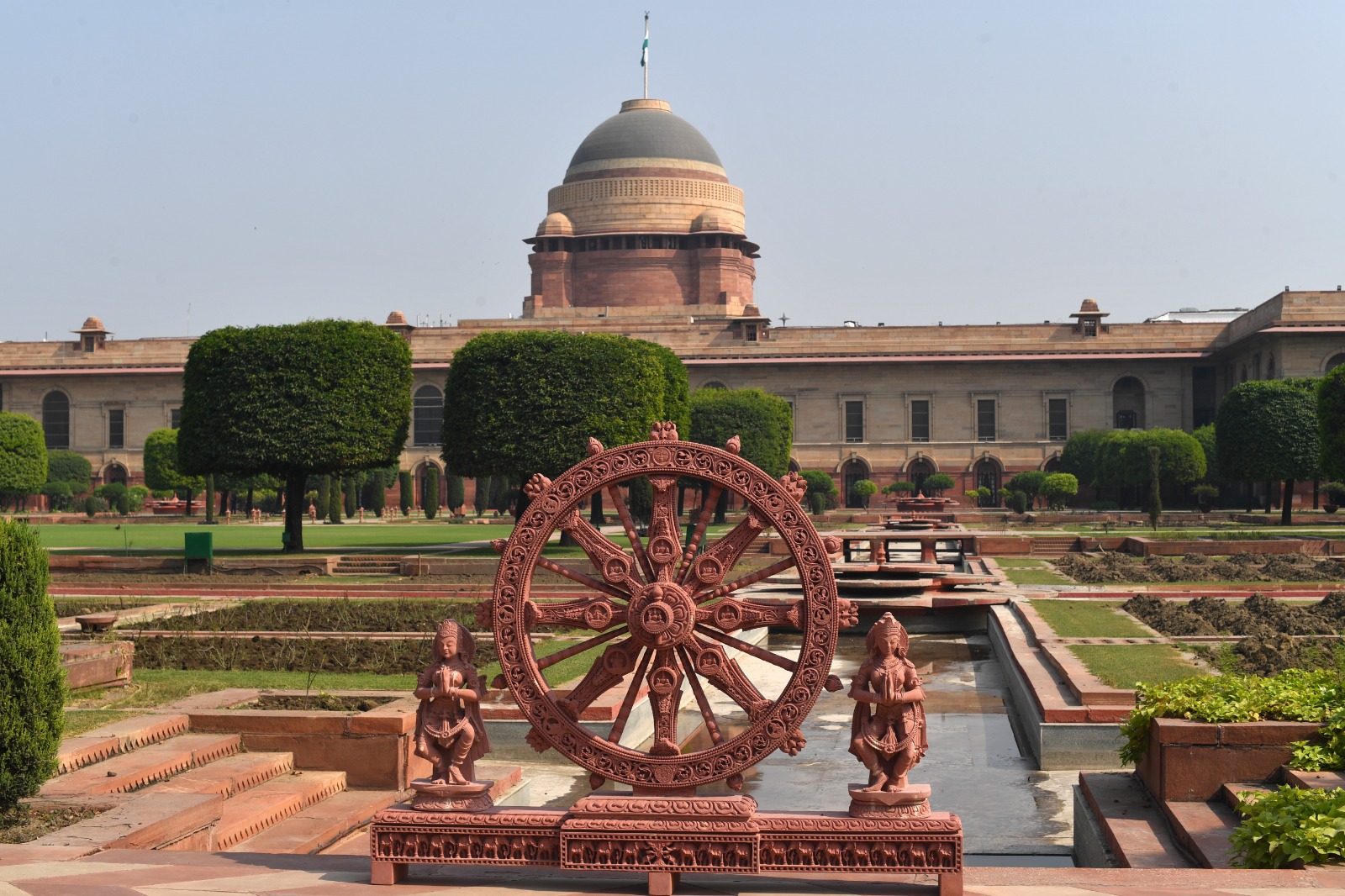
Four replicas of the Konark wheels, made of sandstone, have been installed at Rashtrapati Bhavan Cultural Centre and Amrit Udyan. Installation of Konark wheels aims to showcase and promote rich heritage of the country among visitors.
Read about:
Konark Wheel
Gupta dynasty and their Contribution towards Art & Culture
Key takeaways:
The Konark Wheel is an iconic symbol of India's architectural and cultural heritage, found on the walls of the Sun Temple in Konark, Odisha. Built in the 13th century by King Narasimhadeva I of the Eastern Ganga Dynasty, this UNESCO World Heritage Site is dedicated to the Sun God, Surya. The wheel is part of the temple's intricate design, with the chariot-shaped structure of the temple depicting Surya's chariot, drawn by seven horses and equipped with 24 stone wheels on each side.
The Konark Wheel, along with the entire Sun Temple complex, is a testament to India's ancient knowledge in fields like astronomy, art, and spirituality. It continues to attract scholars, artists, and visitors for its aesthetic appeal, historical significance, and architectural mastery
Key Features of the Konark Wheel
-
Symbolism: The 24 wheels represent the 24 hours of the day, emphasizing the concept of time and the cycle of life. The wheel is also considered symbolic of progress, continuity, and the cyclical nature of time, resonating with the principles of cosmic and spiritual order.
-
Architectural Design: Each wheel has intricate carvings, including spokes and hub designs, representing different artistic and cultural motifs of the time. The detailing also includes figurines and floral patterns, showcasing the artistry of the craftsmen of that era.
-
Time-Telling Aspect: The wheels are often thought to function as ancient sundials. The positioning of the spokes and shadows they cast were used to estimate the time of day.
-
National Emblem Connection: The Konark Wheel is also depicted on India’s national flag, symbolizing justice, dynamism, and righteousness.
1.Which of the following statements regarding the Konark Wheel is/are correct?
- The Konark Wheel is a part of the Sun Temple in Konark, Odisha, built in the 13th century.
- The 24 wheels of the Konark temple symbolize the 24 hours of the day and are designed to function as ancient sundials.
- The Konark Wheel is also depicted on India's national emblem as a symbol of justice and righteousness.
Select the correct answer using the codes given below:
(a) 1 and 2 only
(b) 2 and 3 only
(c) 1 and 3 only
(d) 1, 2, and 3
|
Answer (a)
|
Make in India Initiative: A Comprehensive Overview
Launch and Objective:
- Launched: September 25, 2014, by the Government of India.
- Objective: To transform India into a global manufacturing hub, enhance investment, foster innovation, and generate employment.
Key Sectors Covered: Initially, 25 sectors were identified, such as:
- Automobiles
- Pharmaceuticals
- Textiles and Garments
- Chemicals
- Information Technology and Business Process Management
- Food Processing
- Renewable Energy
- Railways
- Ports and Shipping
- Aviation, etc.
Key Features:
- Ease of Doing Business: Simplifying regulations, fast-tracking approvals, and reducing red tape to improve India's rank in the Ease of Doing Business Index.
- FDI Reforms: Liberalizing Foreign Direct Investment (FDI) norms in various sectors like defense, railways, and construction.
- Skill Development: Focusing on skill enhancement through programs such as the Skill India initiative to create a skilled workforce.
- Infrastructure Development: Strengthening infrastructure with initiatives like industrial corridors and smart cities to support manufacturing.
Achievements:
- Improved Ease of Doing Business: India's ranking improved from 142 in 2014 to 63 in 2019.
- FDI Inflows: The country witnessed record FDI inflows, making it a top destination for investment.
- Growth in Manufacturing: Several sectors, such as electronics and automotive, saw significant growth due to the initiative.
1.What is/are the recent policy initiative(s)of Government of India to promote the growth of manufacturing sector? (2012)
- Setting up of National Investment and Manufacturing Zones
- Providing the benefit of ‘single window clearance’
- Establishing the Technology Acquisition and Development Fund
Select the correct answer using the codes given below:
(a) 1 only
(b) 2 and 3 only
(c) 1 and 3 only
(d) 1, 2 and 3
|
Answer (d)
|
The Union Ministry of Labour and Employment is in the process of drafting a national law aimed at integrating gig workers into social security systems, providing them with benefits like health insurance and retirement savings. The government is likely to require aggregators to contribute 1%-2% of their revenue to create a social security fund that would offer these benefits. Additionally, there are plans to revise the definitions of gig and migrant workers to ensure they are more inclusive and reflective of the current employment landscape.
The proposed legislation intends to establish a welfare board model, which would create a fund specifically for the social security of gig workers. It would mandate the registration of all gig workers and require aggregators to provide a 14-day notice period with valid reasons prior to termination, while promoting transparency in automated systems. New dispute resolution mechanisms will also be implemented to safeguard the rights of gig workers.
The Labour Minister indicated that aggregator companies employing gig and platform workers would be encouraged to take the lead in registering their workers on the designated portal. Workers registered on the Labour Ministry’s e-Shram portal will have access to life and accidental insurance, along with additional benefits.
Labour Codes
- In this context, it's worth noting that India established four new labour codes in 2019 and 2020. These codes aim to simplify and rationalize existing labour laws by merging 29 central labour laws into four broad categories: wage, social security, industrial relations, and occupational safety and health. Among these, the Social Security Code of 2020 is the only one that specifically mentions gig and platform workers.
- Under this code, gig and platform workers are classified as a subset of informal sector workers. Consequently, the code provides for the creation of social security schemes for gig and platform workers by the central government. Furthermore, similar to informal workers, gig workers are required to self-register on the e-Shram portal.
Definition of Workers
- The issue arises from how gig workers are defined in the Social Security Code 2020, which places them outside the conventional employer-employee relationship. This is problematic because many gig employers, including some well-known companies, function as formal entities within the formal sector. The exclusion of gig workers from traditional employment frameworks is at the heart of the problem.
- This intentional strategy by "aggregators" seeks to obscure employment relationships in gig and platform economies, thereby circumventing the application of existing labour laws. In a gig economy, employment relationships remain ambiguous, with workers often categorized as independent contractors.
- This confusion about employment relationships leads to the erroneous belief that gig workers are independent workers. The Social Security Code 2020 perpetuates this misconception by categorizing gig workers as part of the informal sector without clarifying the actual employment relationship within the gig economy.
- Additionally, there is a significant disparity in entitlements between institutional social security and social security schemes. For instance, formal workers are entitled to 26 weeks of paid maternity leave under the Maternity Benefit Act, 1961, as part of institutional social security coverage.
- In contrast, registered informal workers receive only cash benefits ranging from ₹5,000 to ₹10,000 for maternity support under social security schemes. This stark difference in entitlements highlights the limitations of the Social Security Code 2020, which aims to provide gig workers with access to certain social security schemes but does not extend to institutional social security.
- Furthermore, other institutional protections, such as minimum wage safeguards, are absent for gig workers. Occupational safety and health regulations do not apply to them, and they are excluded from the Industrial Relations Code 2020, which means they lack access to the dispute resolution mechanisms it provides.
- A clear employment relationship is fundamental for protection under labour laws, but this relationship remains undefined in the context of gig work in India. Recent legislation introduced in states like Rajasthan and Karnataka also suffers from this same deficiency.
The Core Issue
- If the Union Ministry of Labour and Employment is genuinely committed to safeguarding the interests of the growing number of gig workers in the country, it must explicitly define the employment relationship within gig and platform work and eliminate the ambiguity created by so-called "aggregators." Recognizing "aggregators" as employers and clarifying the employment relationship in gig work is essential.
- A significant precedent is the 2021 ruling by the U.K. Supreme Court in the Uber case, where Uber was recognized as an employer, and its drivers as "workers," leading to the requirement that Uber comply with existing labour laws.
- Once the employment relationship is clearly defined, gig workers can be integrated into the proposed four labour codes, which would eliminate the need for separate legislation.
- The welfare board model suggested by the Union Ministry of Labour and Employment has had limited success in the past, especially with construction workers who were also categorized as informal despite being employed by formal companies. Clarifying employment relationships in gig work would further facilitate the formalization of workers in this sector.
- Moreover, the overall labour code was designed for simplification and rationalization. Introducing separate laws for specific workforce segments undermines this goal. Recognizing the employment relationship in gig work is crucial; once this issue is resolved, the rest will follow
|
Answer (B)
|
| Subject | Topic | Description |
| History | Modern Indian History | Company rule and Crown rule 1773 - 1947 |
| History | Modern Indian History | Fall of Mughals |
| History | Modern Indian History | Establishment of British rule in India |
| History | Modern Indian History | Economic Policies of the British |
|
UPSC EXAM NOTES will be conducting both Prelims and Mains exams every Sunday as part of the Integrated Mains and Prelims (IMPM) Program. This program provides a comprehensive approach to UPSC exam preparation, ensuring that candidates are well-prepared for both stages of the exam. Program Highlights:
Duration: The IMPM plan is a one-year program, ensuring continuous and structured preparation over 12 months. With regular testing and consistent study guidance, this program is designed to maximize your chances of success in the UPSC exams |
