

INTERCONTINENTAL BALLISTIC MISSILE
- An intercontinental ballistic missile (ICBM) is a long-range missile system designed to deliver nuclear or conventional warheads over very long distances. These missiles are capable of traveling thousands of kilometers, typically between continents, hence the term "intercontinental."
- ICBMs are one of the key components of a country's strategic nuclear arsenal and serve as a deterrent against potential adversaries. They are designed to be launched from land-based silos, mobile platforms, or submarines and can travel at high speeds, often reaching hypersonic velocities during their flight trajectory.
- The basic components of an ICBM system include the missile itself, the launch platform, and a guidance system to ensure precise targeting.
- Once launched, the missile follows a ballistic trajectory, which means it travels into space, then reenters the Earth's atmosphere to reach its target. The accuracy and reliability of ICBMs are of paramount importance in their role as a deterrent.
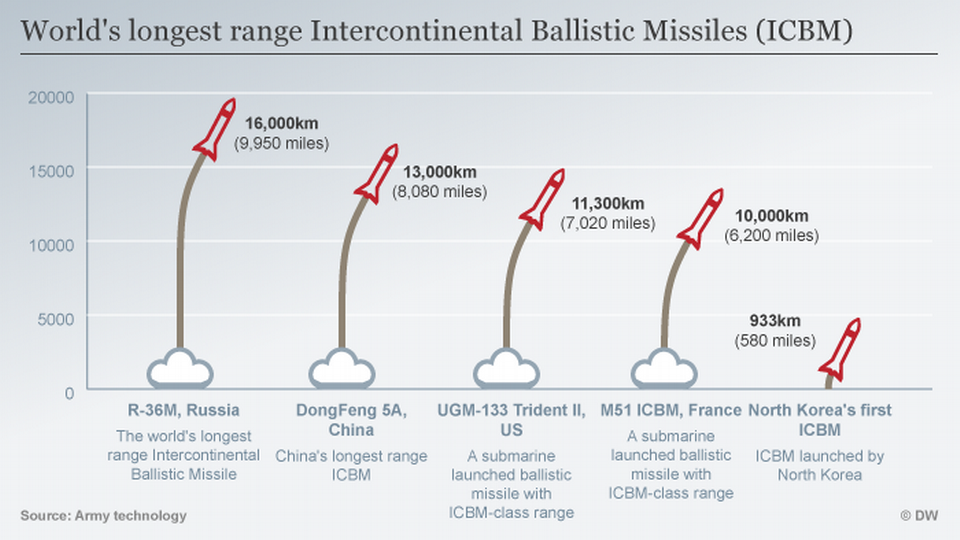
- ICBMs have been a significant part of the nuclear arms race during the Cold War, with the United States and the Soviet Union (and later Russia) developing extensive arsenals of these missiles. Other countries, such as China, France, and the United Kingdom, have also developed their own ICBMs.
- The possession of ICBMs provides a nation with the capability to strike targets on the other side of the globe, making them a critical element in the calculus of international security and arms control.
- A missile is a general term used for any guided weapon that is launched toward a target. Think of it as a broad family of weapons that includes many different types, such as air-to-air missiles, surface-to-air missiles, cruise missiles, anti-ship missiles, and ballistic missiles.
- What makes a missile different from an ordinary rocket or artillery shell is that it has some form of guidance system that helps it reach its target accurately.
- A ballistic missile, on the other hand, is a specific type of missile that follows a unique method of flight. After launch, powerful rocket engines propel it upward at very high speed.
- Once the fuel is exhausted, the engines stop working, and the missile continues its journey mainly under the influence of gravity, following a curved path known as a ballistic trajectory.
- This trajectory is similar to the path followed by a cricket ball thrown into the air, except that a ballistic missile travels much farther and much faster, often reaching the edge of space before descending toward its target.
- To understand the difference more clearly, imagine two ways of traveling from one city to another. In the first method, an aircraft keeps its engine running throughout the journey and can change direction whenever needed.
- This is similar to a cruise missile, which remains powered during most of its flight and continuously adjusts its course. In the second method, a projectile is launched with tremendous force, rises high into the sky, and then falls toward its destination along a predetermined path. This resembles a ballistic missile.
- For example, India's BrahMos is a cruise missile. It flies relatively low, remains powered during flight, and can maneuver to avoid detection. In contrast, Agni-V is a ballistic missile.
- It is launched vertically, climbs to a very high altitude, and then re-enters the atmosphere at extremely high speed before striking its target.
- Therefore, the relationship between the two is simple: a ballistic missile is a type of missile, but not all missiles are ballistic missiles. The key distinction lies in how they travel.
- Ordinary missiles may remain powered and guided throughout their flight, whereas ballistic missiles are powered mainly during the initial launch phase and then follow a gravity-driven ballistic path for most of their journey
Some of the countries known to have ICBMs include:
United States: The United States operates a variety of ICBMs, including the Minuteman III, which is a land-based ICBM, and the Trident II D5, which is a sea-launched ICBM.
Russia: Russia's Strategic Rocket Forces operate a range of ICBMs, including the RS-24 Yars, RS-12M Topol, and RS-28 Sarmat (nicknamed Satan 2).
China: China has developed and deployed ICBMs such as the DF-5, DF-31, and DF-41.
France: France has the M51 SLBM (Submarine-Launched Ballistic Missile) as part of its nuclear deterrent.
United Kingdom: The United Kingdom's nuclear deterrent is based on the Trident II D5 SLBM.
India: India's Agni-V is considered an ICBM, with the ability to reach intercontinental distances.
Pakistan: Pakistan has developed the Shaheen-III missile, which is capable of reaching intercontinental distances.
North Korea: North Korea has claimed to possess ICBMs, with the Hwasong-15 being one of their most advanced and longest-range missiles.
Israel: Israel has not officially confirmed the possession of ICBMs, but it is widely believed to have developed such capabilities as part of its nuclear deterrent.
5.Cruise Missiles and Ballistic Missiles: How Are They Different?
- Although both cruise missiles and ballistic missiles are designed to deliver a warhead to a target, they differ significantly in the way they fly, the technology they use, and the challenges they pose to air-defense systems.
- A ballistic missile is launched using powerful rocket engines that propel it to very high altitudes, sometimes even beyond the Earth's atmosphere.
- Once the rocket fuel is exhausted, the missile follows a curved, gravity-driven path known as a ballistic trajectory.
- It then re-enters the atmosphere and descends toward its target at extremely high speeds. In essence, a ballistic missile behaves somewhat like a stone thrown into the air: after the initial push, gravity largely determines its path.
- A cruise missile, by contrast, behaves more like a pilotless aircraft. After launch, it uses a jet engine or similar propulsion system to remain powered throughout most of its journey.
- Rather than climbing high into the sky, it typically flies at low altitudes, closely following the terrain, and continuously adjusts its course using onboard guidance systems. This allows it to navigate around obstacles and evade enemy radar.
- The difference in flight path is perhaps the most striking distinction. A ballistic missile travels in a high, arching trajectory, whereas a cruise missile flies relatively close to the ground.
- Because of this, cruise missiles are often harder to detect early, as they can remain hidden behind terrain features and below the radar horizon.
- Ballistic missiles, on the other hand, are easier to track during much of their flight because they reach very high altitudes, but they become difficult to intercept due to their tremendous speed during descent.
- Their speeds also differ considerably. Ballistic missiles are generally much faster, often traveling several times the speed of sound and, in some cases, reaching hypersonic velocities. Cruise missiles are usually slower, although some advanced systems can also achieve supersonic or hypersonic speeds.
- India provides good examples of both categories. The BrahMos is a cruise missile that remains powered throughout its flight and flies at low altitudes. In contrast, the Agni-V is a ballistic missile that follows a high-altitude ballistic trajectory before striking its target.
A Simple AnalogyImagine you want to deliver a package to a distant location:
|
- Ballistic Missile Defence (BMD) refers to a country's ability to detect, track, intercept, and destroy incoming ballistic missiles before they reach their targets. In an era when many countries possess ballistic missiles capable of carrying conventional, nuclear, chemical, or biological warheads, BMD has become a critical component of national security.
- The significance of BMD lies in the fact that ballistic missiles are among the fastest and most destructive weapons ever developed.
- Once launched, they can travel hundreds or thousands of kilometers within minutes and strike strategic targets such as cities, military bases, government installations, and critical infrastructure.
- A successful BMD system provides a defensive shield against such attacks by attempting to intercept the missile during different phases of its flight.
- For a country like India, BMD capability is particularly important because it enhances national security in a region where several countries possess ballistic missile arsenals.
- It reduces vulnerability to missile attacks and strengthens deterrence by making it more difficult for an adversary to achieve its objectives through missile strikes.
- Another major significance of BMD is the protection of population centers and strategic assets.
- Large metropolitan areas, military command centers, nuclear facilities, air bases, ports, and industrial hubs are all potential targets during a conflict.
- A functioning BMD system can provide an additional layer of security by intercepting incoming missiles before they reach these critical locations.
- BMD also contributes to strategic stability. If a country has confidence in its ability to defend against limited missile attacks, it gains greater decision-making time during crises and reduces the risk of panic-driven responses. This can help prevent escalation and provide political leaders with more options during emergencies.
- India's BMD programme, developed primarily by Defence Research and Development Organisation (DRDO), is designed as a multi-layered defense system.
- It includes interceptors capable of engaging incoming ballistic missiles both outside the atmosphere (exo-atmospheric interception) and within the atmosphere (endo-atmospheric interception).
- The objective is to create multiple opportunities to destroy an incoming missile before it reaches its target.
- However, BMD is not a perfect shield. Modern ballistic missiles may employ countermeasures such as decoys, maneuverable warheads, or multiple independently targetable reentry vehicles (MIRVs), making interception more challenging. Consequently, BMD is generally viewed as a supplement to deterrence rather than a complete replacement for it.
|
For Prelims: Current events of national importance
For Mains: General Studies-III: Achievements of Indians in science & technology; indigenization of technology and developing new technology.
|
|
Previous Year Questions
1.Consider the following statements : (UPSC CSE 2023)
1. Ballistic missiles are jet-propelled at subsonic speeds throughout their flights, while cruise missiles are rocket-powered only in the initial phase of flight.
2. Agni-V is a medium-range supersonic cruise missile, while BrahMos is a solid-fuelled intercontinental ballistic missile.
Which of the statements given above is/are correct?
A. 1 Only
B. 2 only
C. Both 1 and 2
D. Neither 1 nor 2
Answer (D)
|


