
INTEGRATED MAINS AND PRELIMS MENTORSHIP (IMPM) 2025 Daily KEY
| Exclusive for Subscribers Daily: Monetary Policy Committee (MPC) and Himalayan Range matter for the UPSC Exam? Why are topics like Household Expenditures and Inflation important for both preliminary and main exams? Discover more insights in the UPSC Exam Notes for August 10, 2024 |
🚨 UPSC EXAM NOTES presents the July edition of our comprehensive monthly guide. Access it to enhance your preparation. We value your input - share your thoughts and recommendations in the comments section or via email at Support@upscexamnotes.com 🚨
Critical Topics and Their Significance for the UPSC CSE Examination on August 10, 2024
Daily Insights and Initiatives for UPSC Exam Notes: Comprehensive explanations and high-quality material provided regularly for students
On monetary policy and financial markets
For Preliminary Examination: Current events of national and international Importance
For Mains Examination: GS III - Indian EConomy
Context:
The recent rapid turnarounds in global markets have come on the back of attempts by central banks to combat the problems of inflation and repressed economic activity using the tool of interest rates. It indicates the difficulty in implementing monetary policy in the presence of strong financial markets
Read about:
What is Monetary Policy Committee (MPC) ?
Significance of Monetary Policy Committee (MPC)
Key takeaways:
- Global financial markets may be showing signs of recovery after significant declines in value, but the global economy remains in uncertain territory. Job growth in the U.S. has been weaker than anticipated, posing a threat to the delicate post-pandemic recovery.
- The Bank of Japan's recent decision to raise interest rates after maintaining them at low levels for years has unsettled financial markets, triggering a reversal of equity flows and a downturn in Asian markets.
- These rapid shifts reflect the challenges central banks face in managing inflation and economic activity through interest rates. The current situation highlights the difficulty of implementing monetary policy amid global financial markets characterized by high volatility and swift asset value changes.
- The prevailing approach to monetary policy assumes a trade-off between unemployment and inflation. Central banks raise interest rates to curb inflation, which in turn reduces investment and slows aggregate demand. This decrease in demand for labor diminishes wage pressures, thereby easing inflationary concerns.
- However, there is considerable debate about the effectiveness of traditional monetary policy. Critics argue that using unemployment to combat inflation unfairly burdens workers already struggling with the cost-of-living crisis.
- They suggest that controlling inflation might be more effectively achieved by addressing corporate profit margins and breaking up monopolies.
- Accepting the current consensus on monetary policy, a recent jobs report showing lower-than-expected employment growth led to fears of a recession and a rapid sell-off in equity markets. Concerns about disappointing performances from major tech companies further exacerbated the market decline.
- It is important to note that the economy was not actually in a recession; rather, market expectations of one fueled the sell-off. The increase in unemployment rates triggered the "Sahm rule," which calls for automatic unemployment benefit disbursements when rates surpass a certain threshold. While this rule is linked to recession indicators, it does not confirm one. Nevertheless, the mere prospect of a recession was enough to incite investor panic.
- This illustrates the challenge of conducting monetary policy in the context of a powerful financial sector. The gradual reduction in inflation had been seen as evidence of successful policy, but a single quarter's disappointing employment data led to a swift market reaction that policymakers struggled to manage. The markets anticipated a recession without an actual economic downturn occurring.
- On the other side of the globe, Asian markets were destabilized by the Bank of Japan’s rate hike, which disrupted the “carry trade”—a practice where foreign investors borrow cheaply from Japan to invest elsewhere. This change led to increased selling in other markets as investors sought to manage higher borrowing costs.
- Such dynamics add complexity to policy management. Low Japanese interest rates, intended to counteract a prolonged economic slowdown, inadvertently supported foreign capital flows. This phenomenon shows how domestic policies in one country can have unintended effects on others through global finance.
- Historically, global finance has impacted domestic policies. For instance, low U.S. interest rates post-2008 led to capital flows into markets like India, which reversed when U.S. rates increased, causing pressure on India’s external accounts—a situation known as the "taper tantrum."
- Despite signs of market recovery, vulnerabilities persist, highlighting the destabilizing potential of finance. The rapid trading of financial assets and the ease of crossing national borders complicate the implementation of effective monetary policy. As Keynes noted, “When the capital development of a country becomes a by-product of a casino, the job is likely to be ill-done
Read also
Monetary Policy and Interest rates
Follow Up Question
|
Answer (C)
|
Himalayan towns need a different kind of development
For Preliminary Examination: Current events of national and international importance
For Mains Examination: GS I - Indian Goegraphy, Significance of Himalayan ranges
Context:
The Indian Himalayan Range (IHR), comprising 11 States and two Union Territories, had a decadal urban growth rate of more than 40% from 2011 to 2021. Towns have expanded, and more urban settlements are developing. However, Himalayan towns require a different definition of urbanisation
Read about:
What is the Himalayan range?
Significance of Himalayan ranges
Key takeaways:
- Many towns in the Himalayan region, including state capitals, struggle with various civic issues. Cities such as Srinagar, Guwahati, Shillong, and Shimla, along with smaller towns, face significant difficulties in managing sanitation, waste (both solid and liquid), and water resources.
- Planning institutions in these regions often fall short because they adopt models suited for flatter areas and lack the capacity to implement them effectively. Additionally, city governments are significantly under-resourced, with a shortage of about 75% of required personnel. For example, in the Kashmir Valley, apart from the Srinagar Municipal Corporation, there are only 15 executive officers overseeing more than 40 urban local bodies.
- Urban sprawl continues to encroach on village common lands, with cities like Srinagar and Guwahati exemplifying this trend. This expansion leads to the degradation of open spaces, forests, and watersheds. Between 2000 and 2020, Srinagar saw a 75.58% increase in built-up areas, while its water bodies diminished by nearly 25%, from 19.36 square kilometers to 14.44 square kilometers.
- This expansion has resulted in built-up real estate increasing from 34.53 square kilometers to 60.63 square kilometers, representing a rise from 13.35% to 23.44% of the total municipal area. Approximately 90% of liquid waste is discharged into water bodies untreated.
- The Indian Himalayan Region (IHR) is experiencing mounting pressures from urbanization and development, exacerbated by high-intensity tourism, unsustainable infrastructure, and resource exploitation, as well as climate change impacts such as altered precipitation patterns and rising temperatures.
- These factors contribute to water shortages, deforestation, land degradation, biodiversity loss, and increased pollution, including plastic waste. Such pressures threaten to disrupt local communities and their environments.
- Tourism in the IHR has grown and diversified over recent decades, with an expected average annual growth rate of 7.9% from 2013 to 2023. However, current tourism practices often replace environmentally friendly infrastructure with unsuitable and unattractive constructions, poorly designed roads, and inadequate waste management systems, which further harm natural resources and biodiversity. Emphasizing ecotourism—tourism that is environmentally responsible—is essential for ensuring long-term sustainability.
- Planning institutions in IHR cities still rely on land-use models that need updating. Comprehensive mapping that identifies geological and hydrological vulnerabilities is necessary, as climate-related disasters frequently damage infrastructure built without such assessments. Therefore, planning should be more inclusive and follow a bottom-up approach.
- Relying on consultant-driven urban planning should be reconsidered in favor of designs focused on climate resilience. Additionally, IHR cities struggle to generate the necessary funds for infrastructure.
- The Finance Commission should address this by including a dedicated section on urban financing for the IHR. The current intergovernmental transfers to urban local bodies are only 0.5% of GDP; this should be increased to at least 1%.
- Himalayan towns need to engage in broader discussions on sustainability, focusing on robust, eco-centric planning processes that involve public participation
1.When you travel in Himalayas, you will see the following: (UPSC CSE 2012)
- Deep gorges
- U-turn river courses
- Parallel mountain ranges
- Steep gradients causing land sliding
Which of the above can be said to be the evidence for Himalayas being young fold mountains?
(a) 1 and 2 only
(b) 1, 2 and 4 only
(c) 3 and 4 only
(d) 1, 2, 3 and 4
|
Answer (d)
|
- Governor Das emphasized the importance of addressing food inflation due to its significant share in the consumption basket. Following the RBI's Monetary Policy Committee (MPC) decision to keep the Repo rate steady at 6.5% for the ninth consecutive time, he noted that persistent food inflation remains a key concern. The central bank maintained its projections for retail inflation at 4.5% and real GDP growth at 7.2% for the 2024-25 period.
- With food items accounting for about 46% of the consumer price index (CPI) basket, they contributed over 75% of headline inflation in May and June. Das highlighted that despite a notable decrease in core inflation, complacency is not an option.
- The MPC has decided to keep its monetary policy on course, carefully monitoring inflation trends and associated risks. Given the robust and steady GDP growth, the policy must continue to focus on curbing inflation, aiming to stabilize it at the 4% target over the long term.
- Under the flexible inflation-targeting framework, the RBI is tasked with keeping CPI within the 2-6% range and aims to reduce inflation to a durable 4%. Headline CPI inflation increased to 5.1% in June 2024 from 4.8% in May, primarily due to higher food prices, although core inflation fell to historic lows in May and June.
- The RBI has maintained its CPI inflation forecast for FY25 at 4.5%, but has adjusted its projections for retail inflation in Q2 and Q3 FY25 to 4.4% and 4.7%, respectively, up from earlier estimates of 3.8% and 4.6%. The MPC must remain vigilant against persistent high food inflation to avoid spillovers or secondary effects and to uphold the credibility of its monetary policy
Causes: Several factors can contribute to food inflation, including:
- Supply Chain Disruptions: Issues like poor harvests, transportation bottlenecks, or natural disasters can reduce the supply of food, leading to higher prices.
- Demand-Supply Imbalance: Increased demand for food or reduced production can drive up prices.
- Production Costs: Rising costs for inputs such as labor, fertilizers, and fuel can increase food prices.
- Climate Change: Extreme weather conditions and changing climate patterns can impact agricultural output and food prices.
- Global Market Trends: Changes in global commodity prices, trade policies, and international market conditions can affect local food prices.
|
Answer (C)
|
A Finance Bill is a legislative measure that is introduced in the Parliament of India to implement and give effect to the financial proposals of the government for a particular fiscal year. It encompasses a range of financial and fiscal measures and is essential for the functioning of the government’s economic and budgetary policies. Here’s an overview:
-
Purpose: The Finance Bill primarily deals with taxation and revenue-related matters. It includes provisions for new taxes, modifications in existing tax laws, changes in tax rates, and other financial measures that require legislative approval.
-
Types:
- Annual Finance Bill: Presented annually with the Union Budget, this bill incorporates changes to tax laws and other financial provisions proposed in the budget.
- Supplementary Finance Bill: Introduced to address any additional financial requirements or modifications to the existing Finance Bill during the fiscal year.
An Appropriation Bill is a legislative measure that authorizes the government to allocate and spend funds for various public purposes. It is essential for the execution of the budget and ensures that government expenditures are legally sanctioned. Here’s a detailed explanation:
-
Purpose: The Appropriation Bill provides legal authority for the government to use funds from the treasury to meet its expenditure needs. It specifies the amounts allocated for different departments and purposes as outlined in the budget.
-
Process:
- Introduction: The Appropriation Bill is introduced in Parliament after the Union Budget is presented. It follows the presentation of the budget and is usually introduced by the Finance Minister.
- Debate and Approval: The bill is debated and must be passed by both houses of Parliament (Lok Sabha and Rajya Sabha). This process involves discussions on the allocation of funds and any amendments proposed.
- Presidential Assent: After passing both houses, the bill is sent to the President for assent. Once the President approves it, it becomes law
|
Answer (C)
C. A money Bill is concerned with the appropriation of money out of the Contingency Fund of India Here's why each statement is correct or not:
|
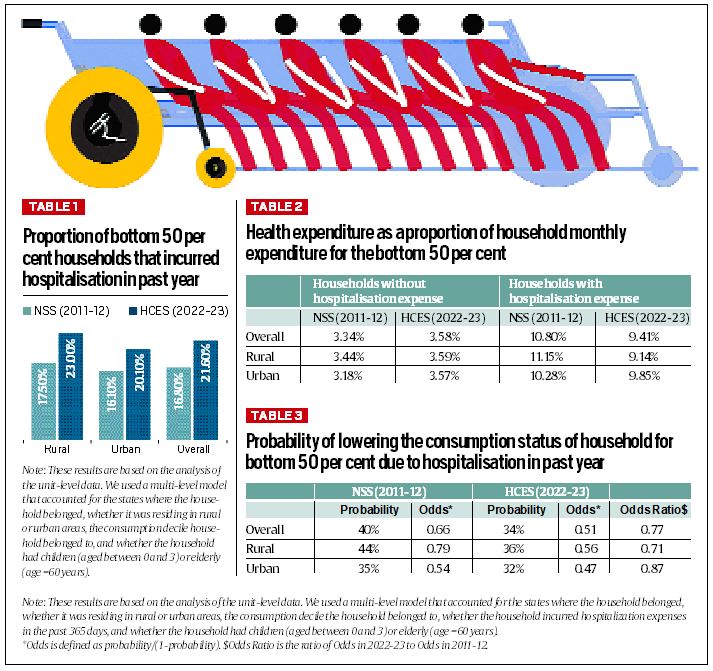
Measurement: Poverty is often measured using various indicators:
- Income Poverty: Defined by income thresholds or poverty lines indicating the minimum income required to meet basic needs.
- Multidimensional Poverty: Considers factors beyond income, such as education, health, and living conditions, to provide a more comprehensive view of deprivation
-
Economic Factors:
- Unemployment and Underemployment: Limited job opportunities and inadequate employment quality contribute to low income and economic insecurity.
- Income Inequality: Disparities in income distribution result in significant wealth gaps, with a concentration of wealth in the hands of a few while many remain impoverished.
-
Educational Deficits:
- Lack of Access to Quality Education: Inadequate educational facilities, especially in rural areas, limit access to quality education and skills training, affecting employment opportunities and earning potential.
- High Dropout Rates: Many children from poor families are forced to drop out of school to support their families, perpetuating the cycle of poverty.
-
Health Issues:
- Poor Healthcare Access: Limited access to healthcare services and high medical costs can lead to significant financial strain on poor families, exacerbating poverty.
- Malnutrition and Disease: High rates of malnutrition and communicable diseases reduce productivity and increase economic vulnerability.
-
Social Inequality:
- Caste and Social Discrimination: Discrimination based on caste, gender, and ethnicity can limit access to resources, education, and employment opportunities for marginalized groups.
- Gender Inequality: Women often face additional barriers in education, employment, and access to resources, contributing to higher poverty rates among women.
|
Answer (B)
In India, official poverty lines can differ across states primarily due to variations in price levels. The cost of living, which includes the prices of goods and services, can vary significantly from one state to another. As a result, poverty lines are adjusted to reflect these differences to ensure that the measure of poverty remains relevant to the local economic conditions and cost of living in each state. This adjustment helps in setting poverty thresholds that are more accurate and reflective of the actual living standards required in different regions
|
| Subject | Topic | Description |
| Polity | Indian Constitution | Non Constitutional bodies |
| History | Ancient History | Prehistoric times |
| Economy | NCERT Class 9 | Poverty as a Challenge |
| Geography | NCERT Class 9 | India Size and Location |
|
UPSC EXAM NOTES will be conducting both Prelims and Mains exams every Sunday as part of the Integrated Mains and Prelims (IMPM) Program. This program provides a comprehensive approach to UPSC exam preparation, ensuring that candidates are well-prepared for both stages of the exam. Program Highlights:
Duration: The IMPM plan is a one-year program, ensuring continuous and structured preparation over 12 months. With regular testing and consistent study guidance, this program is designed to maximize your chances of success in the UPSC exams |
