
INTEGRATED MAINS AND PRELIMS MENTORSHIP (IMPM) 2025 Daily KEY
| Exclusive for Subscribers Daily: INS Arighat for the UPSC Exam? Why are topics like Air Quality Index (AQI) and Freebies, Science & technology agreement important for both preliminary and main exams? Discover more insights in the UPSC Exam Notes for January 11, 2025 |
🚨 UPSC EXAM NOTES presents the July edition of our comprehensive monthly guide. Access it to enhance your preparation. We value your input - share your thoughts and recommendations in the comments section or via email at Support@upscexamnotes.com 🚨
Critical Topics and Their Significance for the UPSC CSE Examination on January 11, 2025
Daily Insights and Initiatives for UPSC Exam Notes: Comprehensive explanations and high-quality material provided regularly for students
INS Arighaat: India’s second nuclear sub
For Preliminary Examination: Current events of national and international importance
For Mains Examination: GS III - Science & technology
Context:
Induction of INS Arighaat, India’s second nuclear-powered ballistic missile submarine of the Arihant class, significantly boosts India’s nuclear deterrence capabilities, and strengthens its nuclear triad
Read about:
What is INS Arighaat?
India's Nuclear Submarines
Key takeaways:
INS Arighaat is India’s second nuclear-powered ballistic missile submarine, reinforcing the nation's maritime strategic deterrence. As a critical element of India's nuclear triad, Arighaat is equipped with advanced technology and indigenously developed missiles, enhancing India's capability to launch nuclear strikes from the sea. The submarine's nuclear propulsion system allows it to remain submerged for extended periods, ensuring stealth and operational superiority. The commissioning of INS Arighaat marks a significant step in India's defense capabilities, showcasing the country's growing expertise in naval and nuclear technologies
INS Arihant
INS Arihant is India's first indigenously built nuclear-powered ballistic missile submarine, serving as a cornerstone of the nation's nuclear triad. Commissioned in 2016, it provides India with the capability to launch nuclear strikes from the sea, significantly enhancing its strategic deterrence. Powered by a pressurized light-water nuclear reactor, INS Arihant can remain submerged for extended durations, ensuring greater stealth and survivability. The submarine is armed with nuclear-capable missiles, such as the K-15, and represents a major milestone in India's naval and defense capabilities, reinforcing its position as a key player in global maritime security
Indian Submarines
- India's submarine fleet is a vital component of its naval power, comprising both nuclear-powered and conventional submarines. The fleet includes advanced nuclear ballistic missile submarines like INS Arihant and INS Arighaat, which form a critical part of India's nuclear triad, ensuring the capability to launch nuclear strikes from the sea. Additionally, India operates 16 conventional submarines, including the Kilo-class (Sindhughosh), Shishumar-class, and Kalvari-class, which provide versatile operational capabilities for defense and deterrence.
- The Kilo-class submarines, acquired from the USSR starting in the mid-1980s, and the Shishumar-class submarines, developed in partnership with Germany, are key assets in India's underwater fleet.
- The Kalvari-class submarines, built domestically in collaboration with France's Naval Group, represent India's growing expertise in submarine construction.
- With ongoing advancements and the construction of new, larger SSBNs, India's submarine force continues to evolve, playing a crucial role in safeguarding the nation's maritime interests and ensuring regional stability
1.Which one of the following is the best description of ‘INS Astradharini’, that was in the news recently? (UPSC 2016)
(a) Amphibious warfare ship
(b) Nuclear-powered submarine
(c) Torpedo launch and recovery vessel
(d) Nuclear-powered aircraft carrier
|
Answer (c)
INS Astradharini is classified as a torpedo launch and recovery vessel. It is designed to support the Indian Navy in testing and recovering torpedoes, which are crucial for naval operations and training. This vessel plays a key role in the maintenance and development of torpedo systems, ensuring that the Indian Navy’s torpedoes are effectively tested and handled. Unlike amphibious warfare ships, nuclear-powered submarines, or nuclear-powered aircraft carriers, INS Astradharini is specialized for torpedo-related functions and does not serve broader roles in amphibious warfare, nuclear propulsion, or carrier operations
|
- The Commission for Air Quality Management in NCR and Adjoining Areas (CAQM), established in 2021, has implemented a range of policy measures and on-ground initiatives to reduce air pollution in Delhi-NCR.
- These efforts, combined with consistent and collaborative actions by all stakeholders, have significantly contributed to improving air quality in 2024.
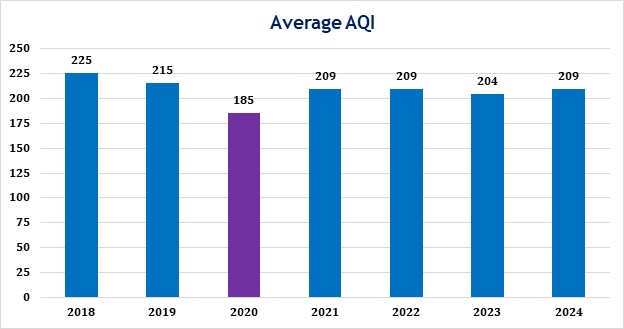
- This improvement is reflected in the record 209 days during the year when the Air Quality Index (AQI) was below 200, indicating "Good" to "Moderate" air quality.
- Excluding the exceptional year of 2020, which experienced minimal human activity due to COVID-19 lockdowns, 2024 saw the highest number of "Good to Moderate" air quality days.
- Delhi recorded its best average AQI for February and December in 2024 since 2018, along with the best average AQI for August during the same period (excluding 2020). Additionally, March and April in 2024 saw the second-best daily average AQI since 2018, again barring the impact of the pandemic year.
- However, certain adverse conditions in 2024 affected air quality. Unusually still winds in January led to an average AQI of 355, the highest for January between 2018 and 2024.
- Prolonged dry spells and strong winds from April to June, particularly in May, contributed to the transport of dust and particulate matter from nearby regions and across borders, resulting in the worst average AQI for May during this timeframe.
- Despite these challenges, 2024 achieved the highest number of "Good to Moderate" AQI days and the fewest "Poor to Severe" days since 2018 (excluding 2020).
- Farm burning incidents during the paddy harvesting season also declined significantly, with Punjab reporting 10,909 fires, Haryana 1,406, and a total of 12,750 across NCR areas, including parts of Uttar Pradesh, Rajasthan, and Delhi
Comparative AQI Category status for Delhi
|
AQI Category |
No. of days |
||||||
|
2018 |
2019 |
2020 |
2021 |
2022 |
2023 |
2024 |
|
|
Good to Moderate (<200) |
159 |
182 |
227 |
197 |
163 |
206 |
209 |
|
Poor to Severe (201 – 400+) |
206 |
183 |
139 |
168 |
202 |
159 |
157 |
- Carbon dioxide
- Carbon monoxide
- Nitrogen dioxide
- Sulfur dioxide
- Methane
Select the correct answer using the code given below:
A. 1, 2 and 3 only
B. 2, 3 and 4 only
C. 1, 4 and 5 only
D. 1, 2, 3, 4 and 5
|
Answer (B)
The Air Quality Index (AQI) in India is calculated based on the concentrations of specific pollutants that have direct impacts on human health. These pollutants are:
Analysis of the Options:
|
- The term ‘freebie’ is defined in the dictionary as an item or service given without any charge. In a June 2022 bulletin, the Reserve Bank of India (RBI) provided its definition of the term 'freebies' as a type of public welfare program offered at no cost. The RBI emphasizes that freebies should be distinguished from public or merit goods, such as education and healthcare, which are government expenditures providing broader and long-term benefits.
- However, distinguishing between welfare or 'merit' goods and freebies, also known as ‘non-merit’ goods, is a complex task. Scholars have highlighted the importance of merit goods, like subsidized or free food, education, housing, and healthcare, in accelerating human development and contributing to national economic growth.
- N.K. Singh, the former chairman of the 15th Finance Commission, has raised concerns about the potential dangers of adopting competitive freebie politics. This concern is supported by an in-depth analysis outlining seven distinct reasons.
- One of the primary concerns is that the provision of freebies disrupts the basic structure of macroeconomic stability, as the political practice of offering free goods or services leads to inefficient resource allocation
- In India, one of the oldest national cash transfer programs is the National Social Assistance Programme (NSAP), which offers pensions to the elderly, widowed, and disabled individuals who cannot engage in economic activities. However, cash transfers have now become a favored solution to address a wide range of issues.
- For political parties, cash transfers have become the go-to remedy for a variety of problems, from women’s empowerment and agrarian distress to unemployment and poverty alleviation. The effectiveness of these transfers in solving the actual issues is often secondary to their political benefits.
- The success of ruling parties in states like Maharashtra and Jharkhand can be attributed to cash transfer schemes targeting women, which were launched just before elections. These initiatives contributed to the re-election of the incumbent governments in state legislative elections.
- While women have emerged as a key political constituency, the practice of using cash to tackle difficult problems has become widely accepted. States such as Telangana and Odisha successfully used cash transfers to address agrarian distress, a strategy later adopted by the central government through the expansion of the PM-KISAN scheme to all farmers ahead of the 2019 general elections.
- Now, several states are using cash transfers as a means to address the unemployment issue, with some promising or already implementing schemes for the unemployed.
- Although it may be premature to assess the short-term impact of these cash transfers, the core concern lies not in the success of individual schemes, but in the broader assumption that cash transfers can solve all societal problems
- India ranks poorly in global gender empowerment indices. According to the 2023 Global Gender Gap report by the World Economic Forum, India was placed at 129 out of 146 countries.
- Despite experiencing significant economic growth, India is one of the few countries to see a decline in women’s participation in the workforce during the first two decades of the 21st century.
- Direct cash and in-kind transfers to women enable them to overcome various barriers, such as accessing education and job opportunities, while also helping them live with dignity.
- Another critical factor in assessing direct transfers should be their impact on the state’s financial health.
- The Delhi Model stands out due to its financial management, as Delhi has maintained a revenue surplus in its budget for the past decade, and its debt-to-GDP ratio has decreased from 7% to 4%, one of the lowest in any Indian state.
- Critics of such transfers often overlook the real "freebies." Over the last decade, Indian banks have written off nearly Rs 15 lakh crore in bad loans to wealthy corporations, with few repercussions for over 12,000 willful defaulters
- The Directive Principles of State Policy, outlined in Part IV of the Indian Constitution, underscore India’s commitment to being a welfare state. Specifically, Article 38 of the Constitution states that the State must work to promote the well-being of the people by ensuring a social order where justice—social, economic, and political—guides all national institutions.
- The State is also tasked with minimizing income inequality and working to eliminate disparities in status, facilities, and opportunities, not just among individuals, but also among different groups of people across various regions or professions.
- The establishment of a welfare state is a deliberate policy choice that involves using public resources to enhance the quality of life for all citizens, including those unable to access even the basic necessities of life
(a) Mid-Day Meal Scheme
(b) Public Distribution System (PDS)
(c) Pradhan Mantri Kisan Samman Nidhi (PM-KISAN)
(d) Mahatma Gandhi National Rural Employment Guarantee Scheme (MGNREGS)
|
Answer (c)
|
- On December 13, 2024, the U.S. and China extended their science and technology cooperation agreement for five years, also introducing amendments. This renewal signifies the continued importance of scientific collaboration between these major powers.
- Initiated in 1979, the agreement has been renewed periodically and expanded in scope. It's overseen by a joint commission with designated co-chairs and executive agencies from both countries. Numerous sub-agreements cover diverse areas, from agriculture to nuclear fusion.
- Bilateral science and technology agreements foster cooperation beyond government institutions, facilitating joint research, researcher exchange, and institutional partnerships.
- While such agreements are common, their success hinges on both countries' commitment and capacity to actively pursue collaborative endeavors. The U.S.-China agreement stands out as a particularly impactful example.
- The renewed agreement reflects growing U.S. concerns about China's technological advancement and intellectual property rights.
- To address these concerns, the amended agreement limits collaboration to intergovernmental basic research within specific areas of mutual benefit, excluding cooperation in critical and emerging technologies.
- Despite these limitations, the U.S. recognizes the agreement's value. It allows for continued dialogue and cooperation, enabling the U.S. to influence China's scientific trajectory while maintaining a degree of leverage.
- Moreover, the agreement has significantly benefited the U.S., contributing to advancements in various scientific fields and fostering educational exchanges.
- This agreement underscores the crucial role of capacity-building and sustained R&D investment in maximizing the benefits of international scientific collaborations. It highlights how such agreements can catalyze transformative change, even as they navigate complex geopolitical realities.
|
Answer (C)
|
- According to the Constitution, health and law enforcement are under state jurisdiction, making it the primary duty of state governments or Union Territory administrations to address and prevent violent incidents.
- The central government has acknowledged that it does not maintain comprehensive records of healthcare worker fatalities resulting from patient family attacks.
- Workplace violence against medical professionals has been a longstanding issue in India. A notable incident occurred in 1973 when a nurse at a Mumbai hospital was assaulted, leaving her in a vegetative state for over four decades until her death in 2015.
- Despite this, healthcare workers continue to advocate for basic safety measures in hospitals, including better lighting, increased security personnel, and surveillance systems.
- Protesters in Delhi highlight the inadequate safety conditions in medical institutions, citing poorly lit areas, insufficient security, and the physical distance between departments.
- They emphasize the urgent need for improved working conditions and safety measures to protect healthcare workers, particularly those working night shifts.
- Medical professionals are calling for systemic reforms and a central protection act for doctors. They point to examples from other countries, such as the UK's zero-tolerance policy on violence in the NHS and stricter legal consequences for assaults on healthcare workers in some US states.
- The Indian Medical Association (IMA) has submitted demands to the central government, including enhanced security protocols and the designation of healthcare facilities as safe zones.
- In response to these concerns, the Ministry of Health and Family Welfare has mandated that institutional FIRs be filed within six hours of any violent incident against healthcare workers.
- Additionally, the National Medical Commission has instructed medical colleges to develop policies for a safe work environment and to promptly investigate and report any incidents of violence against medical students
1.Which of the following statements regarding the safety of doctors in India is/are correct?
- Violence against healthcare workers in India is not a new phenomenon, with incidents being reported as early as the 1970s.
- The Union government centrally maintains records of the number of medical professionals who have lost their lives due to violence by patients or their families.
- The National Medical Commission (NMC) has directed all medical colleges to develop a policy ensuring a safe work environment for all staff members.
Select the correct answer using the codes given below:
a) 1 and 2 only
b) 1 and 3 only
c) 2 and 3 only
d) 1, 2, and 3
|
Answer (b)
|
How does La Niña affect India’s climate?
For Preliminary Examination: El Nino, La Nina, Southern Oscillations
For Mains Examination: GS I - World Geography
Context:
La Niña conditions have finally surfaced in the Pacific Ocean, the US-based National Oceanic and Atmospheric Administration (NOAA) declared on Thursday (January 9).
Read about:
La Nina
El Nino
Key takeaways:
What is La Niña?
- La Niña is one phase of the El Niño Southern Oscillation (ENSO) phenomenon, characterized by cooler-than-average sea surface temperatures in the Pacific Ocean between Indonesia and South America.
- Its opposite phase, El Niño, involves warming of this same region. Both phases play a major role in influencing global weather systems and atmospheric circulation.
- During La Niña years, India typically experiences normal to above-normal monsoon rainfall, while it triggers droughts in Africa and intensifies hurricanes in the Atlantic. In contrast, El Niño leads to extreme heat and droughts in India but causes increased rainfall in parts of the southern United States.
- The current decade began with an unusual sequence of three consecutive La Niña events (2020–2022), known as the Triple Dip La Niña, which was followed by an El Niño in 2023. Scientists suggest that climate change might increase the frequency and severity of both La Niña and El Niño events, as rising sea and land temperatures disturb the Pacific Ocean’s equilibrium. This could also amplify extreme La Niña conditions, potentially resulting in harsher winters in India.
Will La Niña develop this winter?
- The situation in 2024 is unusual, as La Niña has not materialized as expected. Historically, La Niña tends to develop during the pre-monsoon or monsoon seasons and has only formed twice between October and December since 1950.
- While global forecasts had anticipated its arrival during the recent monsoon season, current predictions indicate only a 57% chance of it forming by December 2024. Even if it develops, it is likely to remain weak, though it could still influence global weather conditions.
- The declaration of La Niña or El Niño relies on various meteorological indices. One key measure, the Oceanic Niño Index (ONI), compares the three-month average sea surface temperature in the East-Central Tropical Pacific against a 30-year average.
- When the temperature deviation is +0.5°C or above, it indicates El Niño; a deviation of –0.5°C or below signals La Niña.
- Currently, the ONI stands at approximately –0.3°C. For an event to be officially recognized, these thresholds must be consistently exceeded for at least five consecutive months.
What is the meteorological situation?
- Southern Indian cities like Bengaluru and Hyderabad are experiencing colder-than-usual winters this year, while northern India is facing a delayed winter accompanied by above-normal temperatures.
- Although some reports attribute the southern chill to La Niña, current ONI values do not confirm this. If La Niña had already set in, northern India would likely be experiencing significantly colder weather.
- A 35-year analysis by the Council on Energy, Environment, and Water in New Delhi found that La Niña winters are associated with colder nighttime temperatures compared to El Niño, but daytime temperatures tend to be warmer.
- Meteorological factors such as wind speed and the planetary boundary layer height (PBLH) — the lowest layer of the atmosphere influenced by interactions with the Earth’s surface — also change during ENSO phases, which can affect air quality.
- The research revealed that wind speeds are generally higher throughout the day during La Niña winters, which helps reduce air pollution by dispersing pollutants. At the same time, the average PBLH tends to be slightly lower during La Niña events, which can trap pollutants closer to the ground.
- If La Niña develops, colder temperatures in northern India may increase biomass burning for heating, worsening pollution levels. However, stronger winds could offset this by dispersing pollutants, potentially improving air quality overall.
La Niña and the Indian Monsoons
- Summers during El Niño events are typically more severe, as demonstrated in April this year when India faced record-breaking heat waves. If La Niña develops and continues into the summer of 2025, it may bring some relief from extreme heat.
- Historically, El Niño disrupts monsoons, with India recording below-average rainfall in at least half of all El Niño years since 1871. However, rainfall patterns have shown some changes since the 1980s.
- For instance, both northern and southern India have experienced reduced rainfall during intense El Niño events, while central India has remained relatively unaffected. On the other hand, La Niña supports stronger monsoon conditions, as seen in the “normal” or “above-normal” rainfall during the La Niña years of 2020, 2021, and 2022. In contrast, 2023 — an El Niño year — saw “below-normal” rainfall across the country.
- Thus, the formation of La Niña this year or in early 2025, if it persists into the monsoon season, would be a welcome development, offering the potential for improved rainfall and a reprieve from extreme summer heat
Follow Up Question
1.Consider the following statements regarding El Niño and La Niña:
- El Niño is associated with the warming of sea surface temperatures in the central and eastern Pacific Ocean.
- La Niña leads to a stronger-than-normal monsoon season in India.
- El Niño events often result in increased hurricane activity over the Atlantic Ocean.
Which of the statements given above are correct?
(a) 1 and 2 only
(b) 1 and 3 only
(c) 2 and 3 only
(d) 1, 2, and 3
|
Answer (a)
Given the analysis:
Therefore, the correct answer is (a) 1 and 2 only |
| Subject | Topic | Description |
| History | Modern Indian History | Important Personalities |
| History | Modern Indian History | Independence and Partition |
| History | Modern Indian History | Constitutional Development in India |
| History | Modern Indian History | Peasants, Tribal and other movements |
|
UPSC EXAM NOTES will be conducting both Prelims and Mains exams every Sunday as part of the Integrated Mains and Prelims (IMPM) Program. This program provides a comprehensive approach to UPSC exam preparation, ensuring that candidates are well-prepared for both stages of the exam. Program Highlights:
Duration: The IMPM plan is a one-year program, ensuring continuous and structured preparation over 12 months. With regular testing and consistent study guidance, this program is designed to maximize your chances of success in the UPSC exams |
