
INTEGRATED MAINS AND PRELIMS MENTORSHIP (IMPM) 2025 Daily KEY
| Exclusive for Subscribers Daily: Internet shutdown and Industry emissions for the UPSC Exam? Why are topics like Commission for Air Quality Management in NCR and Adjoining Areas (CAQM) , International Big Cat Alliance (IBCA) important for both preliminary and main exams? Discover more insights in the UPSC Exam Notes for February 25, 2025 |
🚨 UPSC EXAM NOTES presents the February edition of our comprehensive monthly guide. Access it to enhance your preparation. We value your input - share your thoughts and recommendations in the comments section or via email at Support@upscexamnotes.com 🚨
Critical Topics and Their Significance for the UPSC CSE Examination on February 25, 2025
Daily Insights and Initiatives for UPSC Exam Notes: Comprehensive explanations and high-quality material provided regularly for students
Internet shutdowns highest in 2024 globally, India tops in government-ordered curbs
For Preliminary Examination: Current events of naional and international importance
For Mains Examination: GS II - Governance
Context:
India did not impose the highest number of Internet shutdowns last year, with Myanmar seeing one additional disruption in 2024, according to a report by the advocacy body Access Now. However, the number of shutdowns imposed by the government in charge — the Union and State governments here — is still higher in India

Source: The Hindu
Read about:
Impact of British-Era Law on Internet Shutdowns in India
Is the Right to the Internet is a Fundamental right?
Key takeaways:
- India did not record the highest number of Internet shutdowns last year, as Myanmar experienced one more disruption in 2024, according to a report by the advocacy group Access Now. However, the combined number of shutdowns enforced by the Union and State governments in India remained higher.
- The frequency of Internet shutdowns in India decreased in 2024 compared to the previous year. The report highlighted that people across 16 States and Union Territories faced shutdowns, with officials in Manipur (21), Haryana (12), and Jammu & Kashmir (12) implementing the highest number of restrictions.
- Among the 84 shutdowns in India, 41 were linked to protests, while 23 were attributed to communal violence.
- On a global scale, Internet shutdowns reached an all-time high in 2024. A total of 296 shutdowns were recorded worldwide, with India accounting for 28% of them through its 84 restrictions.
- Myanmar imposed 85 shutdowns, while various entities enforced 11 others: China implemented two in Myanmar, Thailand enforced four, and the exiled National Unity Government (NUG), Myanmar National Democratic Alliance Army (MNDAA), and Ta’ang National Liberation Army (TNLA) each imposed one in their respective territories. The origin of two additional shutdowns remained unknown, according to the report.
- Examination-related Internet restrictions have been a key concern for critics of such measures. In 2024, India implemented five shutdowns ahead of major exams.
- One of these occurred during the General Graduate Level Combined Competitive Examinations in Jharkhand, lasting five and a half hours on the morning of September 22.
- Similarly, Assam enforced Internet shutdowns across multiple districts in the same month for government job examinations
The Right to the Internet is not explicitly recognized as a Fundamental Right under the Indian Constitution. However, the Supreme Court of India has affirmed that access to the internet is an important aspect of fundamental rights, particularly under Article 19(1)(a) (Right to Freedom of Speech and Expression) and Article 21 (Right to Life and Personal Liberty).
Key Judicial Rulings
-
Anuradha Bhasin v. Union of India (2020)
- The Supreme Court ruled that the internet is essential for exercising freedom of speech and expression under Article 19(1)(a) and for carrying out trade and business under Article 19(1)(g).
- The court held that any restrictions on internet access must be reasonable, proportionate, and subject to judicial review.
-
Faheema Shirin v. State of Kerala (2019)
- The Kerala High Court declared that the right to access the internet forms part of the right to education and the right to privacy under Article 21.
- The ruling was significant in recognizing the internet as a necessity for education and personal development.
1.When the alarm of your smartphone rings in the morning, you wake up and tap it to stop the alarm, which causes your geyser to be switched on automatically. The smart mirror in your bathroom shows the day’s weather and also indicates the level of water in your overhead tank. After you take some groceries from your refrigerator for making breakfast, it recognises the shortage of stock in it and places an order for the supply of fresh grocery items. When you step out of your house and lock the door, all lights, fans, geysers and AC machines get switched off automatically. On your way to the office, your car warns you about traffic congestion ahead and suggests an alternative route, and if you are late for a meeting, it sends a- message to your office accordingly.
In the context of emerging communication technologies, which one of the following terms best applies to the above scenario? (UPSC Prelims 2018)
(a) Border Gateway Protocol
(b) Internet of Things
(c) Internet Protocol
(d) Virtual Private Network
|
Answer (b)
The scenario describes a network of interconnected devices that communicate and operate automatically based on real-time data, which is the core concept of the Internet of Things (IoT). IoT enables devices such as smartphones, home appliances, cars, and sensors to connect to the internet and interact with each other to enhance automation and convenience. Why not the other options?
|
- The Union government is set to announce emissions intensity targets for nine industrial sectors by the end of February, marking a significant step in implementing India’s carbon trading framework.
- Once these targets are established, industries will have a year to adopt necessary compliance measures to reduce emissions, with carbon credit trading expected to commence by October 2026
- Although the BEE introduced a carbon credit trading scheme in June 2023 and issued notifications in March 2024 outlining the industries required to participate, specific emissions intensity targets have yet to be determined. Without these targets, generating and trading carbon credits remains unfeasible.
- India’s carbon market provides a structured approach to lowering, offsetting, or preventing greenhouse gas (GHG) emissions within the economy. It does so by assigning a monetary value to emission reductions, enabling the trading of carbon credit certificates.
- Globally, different types of carbon markets exist. In European emissions trading systems, each carbon credit signifies a metric ton of carbon dioxide prevented from being released into the atmosphere.
- The value of these credits fluctuates based on whether companies comply with government-imposed emission limits or choose to purchase credits from firms that have reduced emissions beyond their required levels. These credits can be traded similarly to stocks.
- In contrast, India's approach does not mandate industries to directly cut emissions. Instead, companies must improve the efficiency of their production processes—for instance, reducing the amount of coal used to produce a kilogram of steel or capturing and reusing heat generated in the process.
- Emissions intensity refers to the volume of greenhouse gases emitted per unit of production. The nine industrial sectors in India that must adhere to emissions intensity targets include iron and steel, aluminium, chlor-alkali, cement, fertilizers, pulp and paper, petrochemicals, petroleum refineries, and textiles
- Carbon dioxide
- Carbon monoxide
- Nitrogen dioxide
- Sulfur dioxide
- Methane
Select the correct answer using the code given below:
A. 1, 2 and 3 only
B. 2, 3 and 4 only
C. 1, 4 and 5 only
D. 1, 2, 3, 4 and 5
|
Answer (B)
The Air Quality Index (AQI) in India is calculated based on the concentrations of the following eight pollutants:
|
What makes the Panchayat Devolution Index important?
For Preliminary Examination: 72nd and 73rd Amendment of Indian Constitution
For Mains Examination: GS II - Indian Polity & Governance
Context:
Recently published government report reveals the challenges confronting panchayats in India and analyses how each state has performed when it comes to the devolution of powers to these bodies. Here's all you need to know. Also, go 'Beyond the Nugget' to know about the history of Panchayati Raj institutions in India
-
As of 2024, India has 2.62 lakh panchayats, marking an increase from 2.48 lakh in 2013-14. Uttar Pradesh, Maharashtra, and Madhya Pradesh continue to have the highest number of panchayats in both periods.
-
A study conducted by the Indian Institute of Public Administration (IIPA) examined 172 panchayats across 68 districts to evaluate the performance of the panchayat system. The assessment was based on six key parameters: framework, functions, finances, functionaries, capacity building, and accountability. Using this data, the IIPA developed the Panchayat Devolution Index.
-
The index assigns scores to states on a 0 to 100 scale. Karnataka, Kerala, and Tamil Nadu secured the highest rankings, whereas Uttar Pradesh and Bihar demonstrated the most notable improvements.
-
According to the latest rankings, Manipur, Arunachal Pradesh, and Jharkhand received the lowest scores. Over the past decade, Manipur, Arunachal Pradesh, and Haryana have witnessed the most significant declines in performance. Among the top 10 states, Maharashtra, which ranks fourth overall, is the only state to experience a drop in its score.
-
In 2013-14, the highest-ranking states included Maharashtra, Kerala, Karnataka, Tamil Nadu, and Chhattisgarh. Since then, 18 states and Union Territories have shown improvement, while 11 states have seen a decline in their scores.
-
Women’s Representation: While most states have implemented a 50% reservation for women in panchayats, seven states and Union Territories still fall short of this benchmark. These include Madhya Pradesh, Haryana, Punjab, and Tripura.
-
Representation of SCs, STs, and OBCs: Although there is no nationwide formal reservation for Scheduled Castes (SCs), Scheduled Tribes (STs), and Other Backward Classes (OBCs) in panchayats, certain states have demonstrated significant participation from these communities.
Punjab has the highest proportion of SC representatives at 36.34%.
Chhattisgarh leads in ST representation, with 41.04%.
Bihar has the highest OBC representation, at 39.02%.
The national average for these groups stands at 18.03% for SCs, 16.22% for STs, and 19.15% for OBCs. -
Key Challenges: Studies indicate that funding and infrastructure limitations remain major obstacles to the effective functioning of panchayats
|
Answer (B)
Statement 1: The minimum age prescribed for any person to be a member of a Panchayat is 25 years.Incorrect
Statement 2: A Panchayat reconstituted after premature dissolution continues only for the remainder period.Correct
Conclusion:Since only Statement 2 is correct, the correct answer is: |
- The Commission for Air Quality Management in NCR and Adjoining Areas (CAQM), established in 2021, has implemented a range of policy measures and on-ground initiatives to reduce air pollution in Delhi-NCR.
- These efforts, combined with consistent and collaborative actions by all stakeholders, have significantly contributed to improving air quality in 2024.
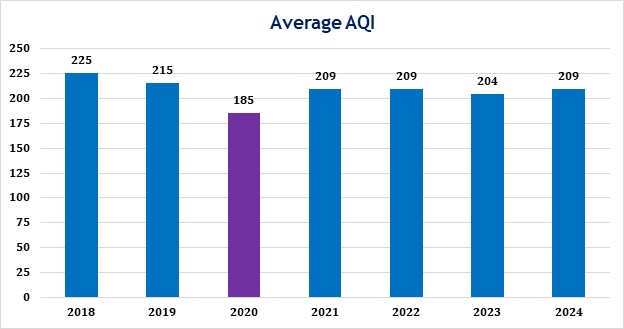
- This improvement is reflected in the record 209 days during the year when the Air Quality Index (AQI) was below 200, indicating "Good" to "Moderate" air quality.
- Excluding the exceptional year of 2020, which experienced minimal human activity due to COVID-19 lockdowns, 2024 saw the highest number of "Good to Moderate" air quality days.
- Delhi recorded its best average AQI for February and December in 2024 since 2018, along with the best average AQI for August during the same period (excluding 2020). Additionally, March and April in 2024 saw the second-best daily average AQI since 2018, again barring the impact of the pandemic year.
- However, certain adverse conditions in 2024 affected air quality. Unusually still winds in January led to an average AQI of 355, the highest for January between 2018 and 2024.
- Prolonged dry spells and strong winds from April to June, particularly in May, contributed to the transport of dust and particulate matter from nearby regions and across borders, resulting in the worst average AQI for May during this timeframe.
- Despite these challenges, 2024 achieved the highest number of "Good to Moderate" AQI days and the fewest "Poor to Severe" days since 2018 (excluding 2020).
- Farm burning incidents during the paddy harvesting season also declined significantly, with Punjab reporting 10,909 fires, Haryana 1,406, and a total of 12,750 across NCR areas, including parts of Uttar Pradesh, Rajasthan, and Delhi
Comparative AQI Category status for Delhi
|
AQI Category |
No. of days |
||||||
|
2018 |
2019 |
2020 |
2021 |
2022 |
2023 |
2024 |
|
|
Good to Moderate (<200) |
159 |
182 |
227 |
197 |
163 |
206 |
209 |
|
Poor to Severe (201 – 400+) |
206 |
183 |
139 |
168 |
202 |
159 |
157 |
- Carbon dioxide
- Carbon monoxide
- Nitrogen dioxide
- Sulfur dioxide
- Methane
Select the correct answer using the code given below:
A. 1, 2 and 3 only
B. 2, 3 and 4 only
C. 1, 4 and 5 only
D. 1, 2, 3, 4 and 5
|
Answer (B)
The Air Quality Index (AQI) in India is calculated based on the concentrations of specific pollutants that have direct impacts on human health. These pollutants are:
Analysis of the Options:
|
International Big Cat Alliance and India
For Preliminary Examination: Current events of national and international importance
For Mains Examination: GS III - Environment & Ecology
Context:
India recently joined the International Big Cat Alliance (IBCA). In this Wildlife Week, let's learn about Big Cats, their habitats, the significant steps taken by the government for their conservation, and more
Read about:
What is International Big Cat Alliance (IBCA)?
What is Project Cheetah?
Key takeaways:
As India observes Wildlife Week 2024, it’s essential to highlight a significant development regarding the country’s wildlife. In September of this year, India officially became a member of the International Big Cat Alliance (IBCA). The IBCA was established last year to commemorate the 50th anniversary of Project Tiger, and its mission is to promote awareness about the conservation of seven big cat species.
India is home to five of these seven big cats: the tiger, lion, leopard, snow leopard, and cheetah, with the puma and jaguar being the exceptions. This raises several questions: What defines these big cats, how do they differ from one another, and what are their habitats? What are their population figures, and what significant actions has the government taken for their conservation? Here’s a comprehensive overview of the seven big cats.
Tiger (Panthera Tigris)
The tiger has two recognized subspecies: Panthera tigris tigris (the continental tiger) and Panthera tigris sondaica (the Sunda tiger). Tigers primarily rely on their sight and hearing for hunting rather than smell, usually stalking their prey alone. According to the World Wildlife Fund, a tiger can consume more than 80 pounds of meat in a single meal.
As reported in the fifth cycle of the All India Tiger Estimation 2022, India has approximately 3,167 tigers, representing over 70% of the world’s wild tiger population.
Conservation Efforts
-
Indian Board for Wildlife (IBWL): The International Union for Conservation of Nature has endorsed the board’s recommendation to prohibit the export of wild cat skins, including those of tigers.
-
Project Tiger: Launched in 1973, this centrally sponsored initiative was established in nine reserves across states like Assam, Bihar, Karnataka, Madhya Pradesh, Odisha, Maharashtra, Uttar Pradesh, Rajasthan, and West Bengal.
-
National Tiger Conservation Authority: Following amendments to the Wildlife (Protection) Act in 2006, the Wildlife Crime Control Bureau and the National Tiger Conservation Authority (NTCA) were set up as statutory bodies based on the Tiger Task Force report.
-
Bilateral Cooperation: India has been working with neighboring nations to strengthen transboundary conservation efforts, such as with Bangladesh to support tiger conservation in the Sundarbans. A Memorandum of Understanding was signed between India and Cambodia focusing on “Cooperation in biodiversity conservation and sustainable wildlife management recovery strategies for tigers and their habitats,” as stated on the Ministry of External Affairs website.
-
Conservation Assured Tiger Standards (CA|TS) Accreditation: This international accreditation framework evaluates management practices in tiger reserves to ensure compliance with strict conservation standards.
-
International Big Cats Alliance (IBCA): Launched by Prime Minister Narendra Modi in 2023, the IBCA aims to enhance the protection of seven big cats: the tiger, leopard, snow leopard, lion, cheetah, puma, and jaguar. The initiative was announced during a program celebrating 50 years of Project Tiger and seeks to foster connections with various countries that share habitats with these big cats, enhancing international cooperation and conservation efforts for these magnificent animals
1.Consider the following: (2012)
- Black-necked crane
- Cheetah
- Flying squirrel
- Snow leopard
Which of the above are naturally found in India?
(a) 1, 2 and 3 only
(b) 1, 3 and 4 only
(c) 2 and 4 only
(d) 1, 2, 3 and 4
|
Answer (b)
Thus, the species that are currently naturally found in India are the Black-necked crane, Flying squirrel, and Snow leopard |
- The concept of conducting simultaneous elections for the Lok Sabha, State Assemblies, and local bodies was first introduced by the Prime Minister a few years ago, likely inspired by his experience with the continuous cycle of campaigning due to frequent Assembly and local elections across different parts of the country.
- This led to the establishment of a high-level committee on simultaneous elections, chaired by former President of India Ram Nath Kovind.
- The committee also included members such as Home Minister Amit Shah, former Leader of the Opposition in the Rajya Sabha Ghulam Nabi Azad, ex-Chairman of the Fifteenth Finance Commission N.K. Singh, former Secretary-General of the Lok Sabha Subhash C. Kashyap, senior advocate Harish Salve, and former Chief Vigilance Commissioner Sanjay Kothari. Arjun Ram Meghwal, Minister of State (Independent Charge) for the Ministry of Law and Justice, was a special invitee.
- The committee submitted its report to the President of India in March, making its recommendations available before the 2024 general elections. The idea of 'simultaneous elections' also featured in the Bharatiya Janata Party's (BJP) election manifesto. However, since the ruling party did not secure a majority, it's challenging to claim that the idea has widespread voter approval.
- Despite this, it is remarkable that the committee managed to produce an extensive 18,626-page report in a relatively short period, focusing on an issue of national significance.
- With the Union Cabinet’s approval, the 'one nation, one election' initiative is now close to being implemented. The plan is to first conduct Lok Sabha and Assembly elections together, followed by local body elections within 100 days of the general election.
Constitutional Amendments and Challenges
- To implement simultaneous elections, several amendments to the Constitution are required. A significant amendment involves altering the fixed tenure of State Assemblies, as they would need to align their term with that of the Lok Sabha. Currently, Article 172 provides Assemblies a fixed five-year term, which would change under this proposal.
- Once the amendment bill is introduced in the 18th Lok Sabha, it must undergo a general debate, after which it will require approval by a special majority (at least two-thirds of the members present and voting, as well as a majority of the total membership).
- If all 543 members are present, 362 votes are needed. Since the ruling National Democratic Alliance (NDA) currently has around 292 members, achieving this majority will be difficult without support from the Opposition, which is largely against the 'one nation, one election' concept. Therefore, without bipartisan support, the bill's progress is uncertain.
Arguments for Simultaneous Elections
The high-level committee provided two primary reasons for recommending simultaneous elections. The first is the potential savings, as elections conducted every five years would reduce the costs associated with frequent polls. However, this argument requires scrutiny, as the Election Commission of India (ECI) is allocated funds by Parliament to conduct elections, and the actual expenditure is not as large as perceived. In addition, state governments bear logistical costs, but the overall spending by the Union and state governments is not excessively high.
The considerable expenses incurred by political parties during campaigns wouldn't necessarily be redirected towards infrastructure projects if elections were held less frequently. Additionally, simultaneous elections were conducted between 1951-52 and 1967, but there's no evidence that political parties used the savings to build infrastructure
|
Answer (B)
When the President of India invokes Article 356 (President's Rule) in a state, the state's legislative powers are transferred to the Parliament. This means that the Parliament, or an authority designated by it, exercises the legislative functions of that state. The State Assembly is not automatically dissolved; it may either be suspended or dissolved depending on the decision taken. Additionally, Article 19 is not suspended, and the President does not make laws directly for the state
|
- A marine heatwave (MHW) is an extreme climatic phenomenon that occurs when the sea surface temperature in a specific region rises by 3 to 4 degrees Celsius above the average for a minimum of five days.
- These events can persist for extended periods, ranging from weeks to months or even years, as noted by the National Oceanic and Atmospheric Administration (NOAA), a US government agency.
- The impact of MHWs on marine ecosystems can be devastating. For instance, the 2010-11 marine heatwave in Western Australia led to the large-scale death of fish and other aquatic organisms, disrupting the local marine environment.
- Additionally, this event severely damaged kelp forests, which typically thrive in colder waters and serve as a crucial habitat and food source for various marine species.
- One of the significant consequences of marine heatwaves is coral bleaching, a phenomenon that weakens corals, reduces their ability to reproduce, and increases their susceptibility to diseases. Since coral reefs support thousands of marine organisms, their deterioration poses a serious threat to biodiversity.
- According to an analysis by the non-profit Climate Central, the intensity of MHWs continues to rise, with sea surface temperatures (SST) in certain areas exceeding the average by at least 2 degrees Celsius for the season.
- Western Australia is currently experiencing its second-most severe marine heatwave on record, surpassed only by the 2010-11 event, when temperatures rose 5 degrees Celsius above normal, particularly during February and March, as reported by the University of Western Australia.
- Over the last few decades, MHWs have become more frequent, intense, and longer-lasting. A 2018 study published in Nature titled "Marine Heatwaves under Global Warming" highlighted a twofold increase in MHW occurrences between 1982 and 2016.
- Similarly, a 2021 report by the International Union for Conservation of Nature (IUCN) found that the frequency of MHWs had surged by 50% in the previous decade.
- These heatwaves can extend for weeks or even years, affecting localized coastal zones as well as multiple ocean basins. They have been observed in both shallow and deep waters, across all latitudes, and in diverse marine ecosystems worldwide
|
Answer (B)
|
| Subject | Topic | Description |
| Polity | Fundamental Duties | Fundamental Duties |
| Environment & Ecology | Biodiversity in India | Biodiversity |
| History | Modern Indian History | Constitutional Development in India |
| History | Modern Indian History | Peasants, Tribal and other movements |
|
UPSC EXAM NOTES will be conducting both Prelims and Mains exams every Sunday as part of the Integrated Mains and Prelims (IMPM) Program. This program provides a comprehensive approach to UPSC exam preparation, ensuring that candidates are well-prepared for both stages of the exam. Program Highlights:
Duration: The IMPM plan is a one-year program, ensuring continuous and structured preparation over 12 months. With regular testing and consistent study guidance, this program is designed to maximize your chances of success in the UPSC exams |
