
INTEGRATED MAINS AND PRELIMS MENTORSHIP (IMPM) 2025 Daily KEY
| Exclusive for Subscribers Daily: River linking Project and Unemployment for the UPSC Exam? Why are topics like Air Quality Index (AQI) and low Earth orbit (LEO), India-Maldives Relations important for both preliminary and main exams? Discover more insights in the UPSC Exam Notes for February 15, 2025 |
🚨 UPSC EXAM NOTES presents the February edition of our comprehensive monthly guide. Access it to enhance your preparation. We value your input - share your thoughts and recommendations in the comments section or via email at Support@upscexamnotes.com 🚨
Critical Topics and Their Significance for the UPSC CSE Examination on February 15, 2025
Daily Insights and Initiatives for UPSC Exam Notes: Comprehensive explanations and high-quality material provided regularly for students
River interlinking, the fount of environmental disaster
For Preliminary Examination: Current events of national and international importance
For Mains Examination: GS III - Environment & ecology
Context:
On December 25, 2024, Prime Minister Narendra Modi laid the foundation stone for the Ken-Betwa River Link Project, which aims to solve the water scarcity in the Bundelkhand region that covers parts of Uttar Pradesh and Madhya Pradesh. The project also includes the construction of a dam located within the Panna Tiger Reserve, raising concerns about its submergence. Upon completion, this project will link the supposed water surplus Ken river with the Betwa in drought-stricken Bundelkhand — an area that had 58% forest cover in 1938
Read about:
Ken-Betwa River linking model
Panna Tiger reserve
Key Takeaways:
- This ₹45,000 crore project was initiated despite opposition from experts, including members of an empowered committee appointed by the Supreme Court of India, and bypassing laws that impose strict conditions on hydroelectric power projects. The idea of large-scale technological interventions to solve water-related challenges has gained traction. Politicians are increasingly promoting river interlinking as a geoengineering solution to India's ongoing water scarcity.
- The concept of inter-basin water transfer was first proposed 130 years ago by Sir Arthur Cotton, who designed irrigation dams in the Godavari and Krishna river valleys. This idea was later refined by M. Visvesvaraya, an early figure in Indian engineering, and further expanded by K.L. Rao and Captain Dinshaw J. Dastur in the 1970s and 1980s. Initially called the ‘National Water Grid’, the idea later evolved into the ‘River-Interlinking Project’ (ILR), which aims to transfer surplus water from the Ganga and Brahmaputra rivers to water-deficient regions in central and southern India.
- The National Water Development Agency (NWDA) was set up in 1982 to carry out surveys, investigations, and prepare feasibility reports for the National Perspective Plan. The NWDA identified 30 potential links for further study, divided into 14 Himalayan and 16 Peninsular river links. These links are expected to help mitigate floods and droughts, improve rural income, and address agricultural water scarcity.
- The project’s estimated cost of ₹5.5 lakh crore does not account for social, environmental, or operational expenses, and the burden of these costs will ultimately fall on the public. The idea of linking rivers to connect surplus rivers with water-deficient ones is flawed, as it ignores the massive environmental costs and the eventual destruction of rivers and delta ecosystems.
- Human-induced disruptions in natural hydrographic systems will devastate ecological niches, leading to severe consequences for long-term societal well-being, which will be a grave disservice to future generations.
- Additionally, the impacts of climate change on rainfall and river flows could worsen the situation. It remains unclear how the country’s commitment to mitigating climate change aligns with its plans to manipulate rivers.
- Policymakers fail to understand that there is no “free” surplus water in rivers. Simple calculations that suggest tapping water “lost to the sea” overlook the eco-hydrological realities of the issue. Proponents of these projects disregard the river as an integral part of the drainage basin, including the deltaic plains and its interaction with the sea.
- The ecosystem services provided by free-flowing rivers include the flushing of silt from riverbeds into coastal waters to form deltas. Floodwater is not simply ‘surplus’; it plays a crucial role in land fertility, groundwater recharge, and maintaining biodiversity, which sustains the livelihoods of millions of marginalized people.
- Diverting river water can starve deltaic regions of water, disrupting the balance of saltwater from the sea. This shift damages the delta ecosystem. The Indus Delta offers a poignant example. In her book Empires of the Indus: The Story of a River (2008), Alice Albinia describes how the Indus Delta, once the richest in Pakistan, was impoverished after the British constructed barrages, a practice continued by Pakistan after 1947.
- India has its own examples of such damage, with the downstream regions of the Narmada River suffering since the Sardar Sarovar dam was completed.
- Global examples of river channelization have also shown disastrous results. In Florida, the channelization of the Kissimmee River in 1954 to reduce flooding led to an environmental catastrophe, with the loss of wetlands, and significant resources are now being invested to restore its natural state. Similarly, the Aral Sea, once one of the largest lakes in the world, has become a desert after irrigation projects diverted the rivers that fed it, a legacy of the Soviet Union's geoengineering projects
The underlying causes of India’s water crisis
- India's water crisis is worsening, primarily due to ineffective water management, harmful environmental practices, unclear laws, and corruption. To address this, a national water policy should adopt an integrated approach to watershed management, with active involvement from local communities in monitoring the hydrological cycle.
- Collaboration with hydrologists, engineers, and biologists is necessary. The policy should prioritize effective aquifer management by regulating water consumption. Farmers must be involved in developing strategies for more efficient irrigation practices.
- The government has limited authority over wastewater management and should focus on creating innovative water reuse programs. Additionally, a thorough, interdisciplinary study of river basins is crucial before embarking on large-scale water transfer initiatives
- The Ken and Betwa rivers are two important rivers in central India that play a significant role in the region’s water supply, agriculture, and ecology.
- The Ken River originates from the Vindhya Range in Madhya Pradesh, flowing primarily through the state before it merges with the Yamuna River in Uttar Pradesh. It is a tributary of the Yamuna and stretches across a distance of approximately 427 kilometers.
- The Ken River basin is critical for the areas it flows through, as it supports agriculture, irrigation, and local water needs.
- The river also has historical significance, as the Ken valley and its surrounding areas are home to many cultural and religious sites. The river's water has been used for irrigation for centuries, though it faces challenges such as water scarcity and pollution due to industrial activities and growing urbanization in its catchment area.
- The Betwa River, also originating in the Vindhya Range, flows through the states of Madhya Pradesh and Uttar Pradesh. The Betwa spans about 590 kilometers and is another important tributary of the Yamuna.
- The river is vital for the regions it flows through, serving agricultural needs, drinking water supply, and generating hydropower. The Betwa, like the Ken, faces issues such as over-extraction of water and pollution from industrial and agricultural runoff.
- The river basin is home to several communities that depend on it for sustenance and livelihoods. Both rivers are integral to the local ecosystem, supporting biodiversity, though they are increasingly under pressure from human activity and climate change.
- The Ken and Betwa rivers have been at the center of debates about interlinking rivers in India. The government proposed a project to connect the Ken and Betwa rivers through a series of dams and canals in an effort to address water scarcity in the drought-prone Bundelkhand region.
- While proponents argue that the project could provide much-needed water for irrigation and drinking, critics highlight the potential environmental consequences, such as disrupting ecosystems and affecting the flow of water to downstream areas.
- In summary, the Ken and Betwa rivers are crucial water resources for central India, supporting agriculture, drinking water supplies, and local communities. However, their future is uncertain due to the challenges posed by over-exploitation, pollution, and large-scale infrastructure projects like river interlinking
1.Which of the following statements is/are correct regarding the Ken and Betwa rivers?
- The Ken River is a tributary of the Yamuna and flows primarily through Madhya Pradesh and Uttar Pradesh.
- The Betwa River is one of the major tributaries of the Ganga.
- The proposed interlinking of the Ken and Betwa rivers aims to address water scarcity in the Bundelkhand region.
- Both rivers face challenges related to pollution and over-extraction of water.
Select the correct answer from the options below:
A) 1 and 3 only
B) 1, 3, and 4 only
C) 1, 2, and 3 only
D) 2 and 4 only
|
Answer (B)
|
Were 8 crore new jobs created in three years?
For Preliminary Examination: Unemployment, Types of Unemployment
For Mains Examination: GS III - Indian Economy
Context:
Prime Minister Modi, based on the India-KLEMS database, claimed that India created “eight crore new jobs in the last three to four years”. However, analysts are questioning the methodology used to estimate these numbers. They argue that little meaningful employment was created in these years
Read about:
What is Unemployment?
Types of Unemployment
Key takeaways:
- India-KLEMS utilizes employment data from the PLFS, but instead of using the absolute number of workers, it relies on the Worker Population Ratio (WPR), which the PLFS provides as the proportion of workers in the population.
- To calculate the total number of workers, the WPR is multiplied by the total population. The challenge arises here because India does not have an official population figure after 2011.
- Demographers typically estimate population figures for years between censuses by interpolating data from the most recent Census. However, India-KLEMS took a different approach by using population estimates from the Economic Survey (ES) 2021-22 for the years 2017-18, 2018-19, and 2019-20.
- The ES projected population by assuming that the growth rates from 2001 to 2011 remained constant after 2011. These population projections were then multiplied by the WPR to estimate the number of workers for those years.
- For the years 2020-21 to 2023-24, India-KLEMS switched to a different source and method, using population projections from 2011-2036 published by the Ministry of Health & Family Welfare (MoHFW) in 2020.
- These projections were based on 2011 Census data and were adjusted annually using demographic models that included Total Fertility Rates (TFR) and mortality rates reported in the 2017 Sample Registration System (SRS).
- The question arises as to why India-KLEMS did not consistently use the MoHFW projections for all years after 2017-18. It seems that while the RBI updates the series with new estimates after 2022, it does not revise or update earlier estimates.
- There are two significant concerns here. First, the population projections from both the ES and MoHFW fail to account for the significant decline in fertility rates in India over the past decade.
- The standard replacement TFR is typically 2.1 children per woman, but recent National Family Health Survey (NFHS) data show that India’s TFR had dropped to 2.0 by 2019-21. Additionally, a 2024 study in The Lancet projected that TFR values in India and Bangladesh would fall below 1.75 by 2027. These declines in TFR were not factored into the population projections by either the ES or MoHFW.
- Second, the population projections from both the ES and MoHFW do not differentiate between rural and urban areas. As a result, India-KLEMS managers used national sex-wise population data, assumed uniform growth rates for rural and urban populations, and derived separate projections for each.
- However, it is well-known that rural populations in India are growing more slowly than urban populations. Assuming the same growth rates for both likely leads to an overestimation of the rural population.
- Due to these two issues, the population figures used to multiply the WPR in India-KLEMS, and the resulting estimates of the number of workers, are likely overestimated
- In the past three to four years, the claim of job creation has come under scrutiny, with analysts raising concerns about the methodology used to estimate these figures. They argue that there was minimal meaningful employment generated during this period.
- Employment, or the lack thereof, has been a hotly debated topic among economists and policymakers in India recently.
- According to this database, the total number of workers in India increased from 56.6 crore in 2020-21 to 64.3 crore in 2023-24, indicating a net increase of 7.8 crore workers. Following this claim, the research team at the State Bank of India (SBI) released a report that appeared to validate these figures, showing a correlation between the number of workers in the India-KLEMS database and the NSSO's Annual Survey of Unincorporated Sector Enterprises (ASUSE), 2022-2023.
- What was surprising about these claims was the reported increase in the number of workers during and after the COVID-19 pandemic. The International Labour Organization (ILO) reported that the employment-to-population ratio between 2019 and 2023 remained stagnant or even declined in regions such as East Asia, Southeast Asia, and the Pacific. Given these global trends, analysts have expressed significant methodological and empirical doubts about the India-KLEMS database, suggesting that India's employment growth figures may be outliers.
- The India-KLEMS project originated as an academic initiative funded by the RBI in 2009, and since 2022, the RBI has hosted the database. KLEMS stands for Capital (K), Labour (L), Energy (E), Material (M), and Services (S), representing a framework for measuring industry-level "total factor productivity" (TFP), which is seen by mainstream economists as an indicator of the efficiency of all inputs in producing a unit of output.
- It is important to note that the primary purpose of the KLEMS framework is not to generate employment data. Instead, employment figures serve as inputs within the database's modeling framework. Additionally, the RBI does not directly collect data on employment or any other inputs used in the India-KLEMS database. Instead, it sources sectoral data on employment, input usage, and output from official sources such as the Central Statistics Office, Census of India, Annual Survey of Industries, and Periodic Labour Force Surveys (PLFS). It is therefore surprising that data sourced by the RBI from these official channels, intended for TFP estimation, are being portrayed as "RBI jobs data" to make political statements about employment generation in the economy.
- India-KLEMS derives its employment data from the PLFS, but it does not use absolute figures for the number of workers. The PLFS only provides the Worker Population Ratio (WPR), or the proportion of workers in the population. To estimate the number of workers, the WPR is multiplied by the total population. The problem arises because there is no official population figure for India after 2011.
- To estimate population figures for the years between censuses, demographers typically interpolate numbers from the last available Census. However, India-KLEMS took a different approach by using population estimates from the Economic Survey (ES) 2021-22 for the years 2017-18, 2018-19, and 2019-20. The ES assumed that population growth rates from 2001 to 2011 remained constant after 2011, and these projections were then used to estimate the number of workers by multiplying them with the WPR.
|
Answer (B)
Thus, the correct answer is B. 1 and 2 only |
- The Commission for Air Quality Management in NCR and Adjoining Areas (CAQM), established in 2021, has implemented a range of policy measures and on-ground initiatives to reduce air pollution in Delhi-NCR.
- These efforts, combined with consistent and collaborative actions by all stakeholders, have significantly contributed to improving air quality in 2024.
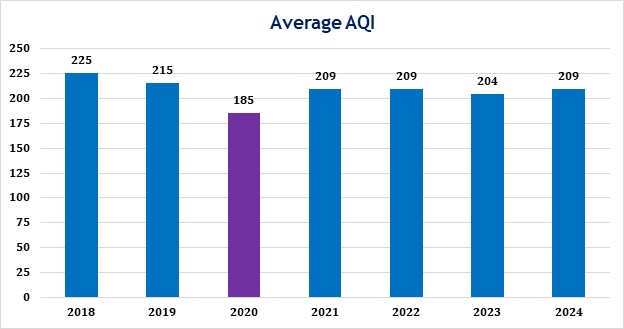
- This improvement is reflected in the record 209 days during the year when the Air Quality Index (AQI) was below 200, indicating "Good" to "Moderate" air quality.
- Excluding the exceptional year of 2020, which experienced minimal human activity due to COVID-19 lockdowns, 2024 saw the highest number of "Good to Moderate" air quality days.
- Delhi recorded its best average AQI for February and December in 2024 since 2018, along with the best average AQI for August during the same period (excluding 2020). Additionally, March and April in 2024 saw the second-best daily average AQI since 2018, again barring the impact of the pandemic year.
- However, certain adverse conditions in 2024 affected air quality. Unusually still winds in January led to an average AQI of 355, the highest for January between 2018 and 2024.
- Prolonged dry spells and strong winds from April to June, particularly in May, contributed to the transport of dust and particulate matter from nearby regions and across borders, resulting in the worst average AQI for May during this timeframe.
- Despite these challenges, 2024 achieved the highest number of "Good to Moderate" AQI days and the fewest "Poor to Severe" days since 2018 (excluding 2020).
- Farm burning incidents during the paddy harvesting season also declined significantly, with Punjab reporting 10,909 fires, Haryana 1,406, and a total of 12,750 across NCR areas, including parts of Uttar Pradesh, Rajasthan, and Delhi
Comparative AQI Category status for Delhi
|
AQI Category |
No. of days |
||||||
|
2018 |
2019 |
2020 |
2021 |
2022 |
2023 |
2024 |
|
|
Good to Moderate (<200) |
159 |
182 |
227 |
197 |
163 |
206 |
209 |
|
Poor to Severe (201 – 400+) |
206 |
183 |
139 |
168 |
202 |
159 |
157 |
- Carbon dioxide
- Carbon monoxide
- Nitrogen dioxide
- Sulfur dioxide
- Methane
Select the correct answer using the code given below:
A. 1, 2 and 3 only
B. 2, 3 and 4 only
C. 1, 4 and 5 only
D. 1, 2, 3, 4 and 5
|
Answer (B)
The Air Quality Index (AQI) in India is calculated based on the concentrations of specific pollutants that have direct impacts on human health. These pollutants are:
Analysis of the Options:
|
-
Satellite Constellation:
- Starlink uses a network of low Earth orbit (LEO) satellites, which orbit closer to the Earth (at altitudes of approximately 550 km to 1,200 km) compared to traditional geostationary satellites.
- The proximity to Earth reduces latency, enabling faster internet speeds suitable for streaming, gaming, and video calls.
-
Global Coverage:
- Starlink's primary goal is to bridge the digital divide by providing internet access in areas where terrestrial broadband infrastructure is unavailable or unreliable.
- As the constellation grows, the coverage area expands globally.
-
High-Speed Internet:
- Starlink offers speeds ranging from 50 Mbps to 250 Mbps, with latency between 20 ms and 40 ms, depending on the location and network load.
- Future upgrades aim to further increase speeds and lower latency.
-
User Equipment:
- Subscribers receive a Starlink kit, which includes a satellite dish (often called a "Dishy"), a Wi-Fi router, and cables for installation.
- The dish automatically aligns itself to connect to the satellites.
1.Consider the following statements regarding Starlink:
- Starlink is a satellite-based broadband service developed by Blue Origin.
- It operates using satellites in low Earth orbit (LEO).
- Starlink's primary objective is to provide high-speed internet to underserved and remote areas globally.
Which of the statements given above is/are correct?
A. 1 and 2 only
B. 2 and 3 only
C. 1 and 3 only
D. 1, 2, and 3
|
Answer (B)
Therefore, statements 2 and 3 are correct, while statement 1 is incorrect. |
-
India has entered its demographic prime, with 67.3% of the population aged 15-59. This demographic advantage is expected to last for three more decades.
-
By 2030, the working-age population in India will rise to 68.9%, with a median age of 28.4 years and a dependency ratio of just 31.2%. With 1.04 billion people in the working-age group, India will have the largest workforce globally.
-
After 2030, India’s population will start ageing, with a declining workforce and an increasing elderly population. Without adequate skills, assets, and healthcare, an ageing population could pose a significant challenge for the country.
-
Research indicates that 90% of brain development occurs before the age of five, laying the foundation for physical, mental, and emotional growth.
-
A significant concern is that 88.7% of children under the age of two do not receive an adequate diet, adversely affecting optimal brain development.
-
National surveys consistently report dietary deficiencies in India. Poor nutrition, health issues, and high morbidity rates hinder children and adolescents from reaching their full cognitive and physical potential, which impacts their ability to access education and acquire skills needed for emerging job markets.
-
According to NFHS-5, only 41% of women and 50.2% of men aged 15-49 have completed at least 10 years of schooling. Additionally, 57% of women and 25% of men in this demographic are anaemic, and 18.7% of women and 16.2% of men have a Body Mass Index (BMI) below normal. This highlights the skills gap and explains the persistently high unemployment rates among educated youth despite various skill development initiatives.
-
The current adolescent demographic (15-19 years) will drive India’s workforce for the next 30 years. However, only 34% of girls and 35.9% of boys aged 15-24 have completed 12 years of education. Furthermore, 59% of girls and 31% of boys in this age group are anaemic, and only 54.9% of girls and 52.6% of boys have a normal BMI.
-
The 2023 Annual Status of Education Report (ASER) for rural areas revealed that only 77% of 17-18-year-olds could read a Class 2-level textbook, and just 35% could perform basic division. The report also noted minimal improvement in learning outcomes across Grades V to VIII.
-
NFHS-5 data indicates that 35.5% of children under five are stunted, 19.3% are wasted, 32.1% are underweight, and 67.1% of children aged 6-59 months are anaemic. Among the two poorest quintiles, these figures are nearly 50% higher. Alarmingly, only 11.3% of children aged 6-23 months receive a minimally adequate diet, a slight improvement from 9.6% in NFHS-4. The future of India’s demographic dividend over the next three decades depends heavily on addressing these issues
(a) Its high population in the age group below 15 years
(b) Its high population in the age group of 15-64 year
(c) Its high population in the age group above 65 years
(d) Its high total population
|
Answer (b)
India is considered to have a "Demographic Dividend" because a significant proportion of its population is in the working-age group (15-64 years). This demographic advantage can lead to economic growth, provided there are sufficient employment opportunities, skill development, and infrastructure to support this large working-age population
|

- The Western Ghats, also known as the Sahyadri Hills, are a mountain range that stretches along the western coast of India, passing through six states: Gujarat, Maharashtra, Goa, Karnataka, Kerala, and Tamil Nadu.
- This range is renowned for its remarkable biodiversity and unique ecosystems, making it one of the world’s most ecologically significant regions.
- The Western Ghats are home to a rich variety of flora and fauna, many of which are endemic to the region, and have earned recognition as a UNESCO World Heritage Site for their environmental importance.
- Historically, the Western Ghats were celebrated for their breathtaking natural beauty. The region is dotted with lush green forests, cascading waterfalls, and a diverse range of plant and animal life.
- The region’s varied climate and topography support a wide array of ecosystems, from tropical rainforests in the lower elevations to montane grasslands and shola forests at higher altitudes. The Western Ghats also play a critical role in regulating the monsoon weather system and maintaining water sources for much of peninsular India.
- However, despite its ecological significance, the Western Ghats face numerous challenges. Climate change has altered weather patterns, affecting the region's delicate balance.
- Deforestation due to industrialization, urbanization, and agriculture has led to the loss of vital habitats.
- Traditional communities, particularly tribal populations, who have depended on the forests for their livelihoods, are facing the decline of their way of life as their lands are encroached upon.
- Additionally, urban sprawl and infrastructure development continue to put pressure on the ecosystem. These combined threats have left the Western Ghats in a vulnerable state, requiring urgent attention and conservation efforts to preserve its unique biodiversity and cultural heritage
- The Western Ghats are not just an ecological treasure trove, but also a living archive of culture, memory, and resilience for the diverse communities that have called this region home for centuries.
- This mountain range, with its sweeping landscapes and deep forests, has nurtured a unique blend of traditions, practices, and beliefs that are intricately tied to the land. The indigenous and local communities of the Western Ghats have developed a deep connection with their environment, relying on it not only for sustenance but for cultural identity.
- For these communities, the Western Ghats are much more than a geographical feature; they are a repository of cultural practices passed down through generations.
- From the rituals associated with sacred groves, to the traditional agricultural practices that harmonize with the natural rhythms of the region, the Ghats serve as a living testament to the sustainable relationship between people and nature. The wisdom embedded in these practices offers valuable insights into living in harmony with the environment, even in the face of modern challenges.
- Moreover, the Western Ghats also represent resilience. Communities living in the region have endured countless adversities—be it the ravages of natural disasters, political upheaval, or external pressures like land encroachment and development.
- Despite these challenges, these communities have continued to safeguard their traditional knowledge and cultural heritage, ensuring its transmission to future generations.
- The rich oral traditions, folk art, music, and dance of the Western Ghats further reflect this resilience, offering glimpses into the memories and experiences of those who have lived in these mountains for generations.
- In the face of climate change, deforestation, and modernization, the cultural heritage of the Western Ghats remains a source of strength and pride for the people who live there.
- The region’s preservation as a living archive of culture, memory, and resilience is not just an environmental concern—it is a vital effort to protect the ways of life that have sustained generations of people and the ecosystem for centuries.
- This ongoing connection between nature and culture in the Western Ghats highlights the importance of preserving both natural and cultural heritage, ensuring that the mountains continue to thrive as a symbol of both ecological and human resilience
1.Which of the following statements in respect of landslides are correct? (NDA 2022)
Select the correct answer using the code given below.
A. 1 and 2
B. 2 and 3
C. 1 and 3
D. 1, 2 and 3
|
Answer (B)
|
| Subject | Topic | Description |
| Polity | Fundamental Duties | Fundamental Duties |
| Environment & Ecology | Biodiversity in India | Biodiversity |
| History | Modern Indian History | Constitutional Development in India |
| History | Modern Indian History | Peasants, Tribal and other movements |
|
UPSC EXAM NOTES will be conducting both Prelims and Mains exams every Sunday as part of the Integrated Mains and Prelims (IMPM) Program. This program provides a comprehensive approach to UPSC exam preparation, ensuring that candidates are well-prepared for both stages of the exam. Program Highlights:
Duration: The IMPM plan is a one-year program, ensuring continuous and structured preparation over 12 months. With regular testing and consistent study guidance, this program is designed to maximize your chances of success in the UPSC exams |
