
FLASH FLOODS
2. What is a Flood
- Flood is an overflow of a large amount of water beyond its normal limits, especially over what is normally dry land.
- Flooding is an overflowing of water onto land that is normally dry.
- Floods can happen during heavy rains, when ocean waves come on shore, when the snow melts quickly, or when dams or levees break.
- Damaging flooding may happen with only a few inches of water, or it may cover a house to the rooftop.
- Floods can occur within minutes or over a long period, and may last days, weeks, or longer.
- Floods are the most widespread of all weather-related natural disasters.
3. Common causes of floods can be divided into the factors triggering them.
These factors include -
- Meteorological factors
- Physical factors
- Human factors
3.1 Meteorological Factors
The natural causes of floods are discussed below -
- Heavy Rainfall: The season of monsoon
- Cloud Burst: Cloud Burst occurs due to intense precipitation in a short duration which can sometimes be accompanied by hail and storms and can cause a flood.
- Climate Change: According to the International Panel for Climate Change, the rainfall intensity, duration and frequency are going to increase in the future.
- Skewed Rainfall Pattern: 80% of the precipitation takes place in the monsoon months
- Trans-National Rivers: The fact that some of the rivers (like the Brahmaputra, many tributaries of Ganga) causing damage in India to originate in neighbouring countries, adds another complex dimension to the problem
- Cyclone & Heavy rainfall
3.2. Physical Factors.
- Insufficient Drainage Management: Improper planning of the drainage system of an area can cause excess water due to heavy rainfall to get stuck and lead to a flood.
- Catchment Area: Catchment area is an area from where the rainfall water flows into a river. This can be a lake or reservoir. During monsoon, when excess water exceeds the limited holding capacity of the catchment area, it leads to floods.
3.3. Human Factor
- Siltation: Siltation refers to the flow of silt and sediments in the riverbed. As particles remain suspended in the river and accumulated in the riverbed, it disrupts the flow of the river, causing a flood.
- Improper Agricultural Practices: If farmers are not cautious of the effects of farming practices meaning if they leave the waste material in the river or cannot handle water management properly, it can lead to a flood.
- Deforestation: Deforestation is one of the major human causes of floods. Trees act like a sponge that helps to hold soil and water and prevent flooding. As trees are being cut down at a fast pace to make way for urbanisation to grow, more water runs towards a river during heavy rainfall. As a result, a flood occurs.
- Collapse of Dams: Dams are built to store water and provide water to people. As dams are human-made, these can be worn out and subsequently collapse causing floods. Also, if heavy rainfall sustains for a long time, State Governments often declare to open dam gates which can lead to a dangerous flood.- Temples of Modern India to Water Bombs
- Unplanned Development
- Neglect of Pre-Disaster Planning
4.Types of Flood
- Coastal Floods: Coastal floods occur when strong winds or storms move towards the coast during high tide.
- Flash Floods: Flash floods usually occur in hilly areas in limited space. Here the sudden heavy rainfall or snow thaws are the causes of flooding. The fast-moving torrent of Flash floods can sweep large objects such as cars, rocks and everything that comes in their path.
- River Floods: River floods occur due to the inflow of water from heavy rainfall, snowmelt or powerful storms.
- Pluvial Floods: Pluvial floods occur in areas that cannot hold rainwater and end up forming puddles and ponds. eg- rural areas.
- Urban Floods: When the drainage system of urban areas fails to absorb rainwater.
The impacts of floods affect both individuals and communities and have social-environmental consequences.
- Human Loss and Property Loss: Every year, millions of people become homeless and washed away due to floods.
- Spread of Communicable Diseases: Waterborne diseases like cholera, typhoid fever, hepatitis, and leptospirosis spread in flood-affected areas. Floods also lead to vector-borne diseases, transmitted through parasites and pathogens such as a mosquito. As a result, the health of flood victims deteriorates.
- Destruction of Crops: Every year, floods destroy a large number of crops.
- Loss of Livestock: Like humans, livestock also get displaced during floods and dies due to the loss of their habitats.
- Disruption of Communication Link and Transportation: Flood causes damage to transportation links such as bridges, rail, power plants etc., thus causing communication disruption in those areas.
- Economic and Social Disruption: The economy comes to a standstill as people are forced to move to another place, and revival of this situation takes time.
Approaches to dealing with floods may be any one or a combination of the following available options:
- Attempts to modify the flood
- Attempts to modify the susceptibility to flooding damage
- Attempts to modify the loss burden
- Bearing the loss.
- The main thrust of the flood protection programme undertaken in India so far has been an attempt to modify the flood in the form of physical (structural) measures to prevent the floodwaters from reaching potential damage centres and modify susceptibility to flooding damage through early warning systems.
6.1 Structural measures
The following structural measures are generally adopted for flood protection:
- Embankments, flood walls, sea walls
- Dams and reservoirs
- Natural detention basins
- Channel improvement
- Drainage improvement
- Diversion of flood waters.
6.2 Non-structural measures
Non-structural measures include:
- Flood forecasting and warning
- Floodplain zoning
- Flood fighting
- Floodproofing
- Flood insurance.
7.What are Flash Floods
- Flash floods are the most dangerous kind of floods because they combine the destructive power of a flood with incredible speed.
- Flash floods occur when heavy rainfall exceeds the ability of the ground to absorb it. They also occur when water fills normally dry creeks or streams or enough water accumulates for streams to overtop their banks, causing rapid rises of water in a short amount of time.
- They can happen within minutes of the causative rainfall, limiting the time available to warn and protect the public.
8. Status of Floods in India
8.1 NDRF Report
- 40 million hectares (10% of the land mass) in India are prone to floods.
- On average every year, 5 million hectares of land are affected, 1600 lives are lost and more than Rs. 1,800 crores is incurred.
8.2 Statistics
- Between 1970 and 2004, 3 floods occurred per year on average. However, between 2005 and 2019, the yearly average rose to 11. 19 districts were affected annually on an average until 2005. After 2005, the number jumped to 55.
- 2017 analysis suggests that 4.48 million Indians are exposed to riverine floods, the highest in the world.
9. What areas are at risk from flash floods?
- Densely populated areas are at high risk for flash floods. The construction of buildings, highways, driveways, and parking lots increases runoff by reducing the amount of rain absorbed by the ground. This runoff increases the flash flood potential.
- Areas near rivers are at risk from floods. Embankments, known as levees, are often built along rivers and are used to prevent high water from flooding bordering land.
- Dam failures can send a sudden destructive surge of water downstream.
- Mountains and steep hills produce rapid runoff, which causes streams to rise quickly.
- Saturated soils can also lead to rapid flash flooding.
- Sometimes the thunderstorms that produce heavy rainfall may happen well upstream from the impacted area, making it harder to recognize a dangerous situation.
- Very intense rainfall can produce flooding even on dry soil.
- Additional high-risk locations include recent burn areas in mountains and urban areas from pavement and roofs which enhance runoff.
- Ice jams and snowmelt can help cause flash floods. A deep snowpack increases runoff produced by melting snow. Heavy spring rains falling on melting snowpacks can produce flash flooding.
10. The impact of floods in India


11. Impact of flood on wildlife

12. Government actions regarding flood management
12.1.The National Flood Management Commission
- Launched in 1954
- Different structural and non-structural methods have been applied by various states under it.
- To evolve a scientific, integrated and coordinated approach to flood control
- It recommended Flood plain zoning and management to regulate human activities.
- It was set up to review the impact of the recommendations of Rashtriya Barh Aayog.
- It recommended large flood moderation projects, following up the enactment of flood plain zoning.
12.4.National Water Policy, 2002
- It recommended
- Basin-wise plan for flood control and management.
- Flood control to be given overriding consideration in reservoir regulation policy.
- More emphasis on non-structural measures.
- Strict regulation of settlements and economic activities in flood plains.
12.5. K. Mittal Committee, 2003
Its main recommendations were
- Afforestation and treatment of catchment area, right land-use practices and others.
- In the river itself a construction of suitable hydraulic structures that may trap silt.
- Embankment along the aggrading river should be constructed, only after proper studies are made on its behaviour especially due to sedimentation load and resultant morphological changes.
|
For Prelims: Cloudbursts, flash floods, landslides, Cumulonimbus Clouds, Water Vapour, Floodplain Zoning, Green Infrastructure.
For Mains: 1. What is a cloudburst, and how does it differ from regular rainfall? Explain the causes and meteorological factors that contribute to the occurrence of a cloudburst.
|
Previous year Questions1. Which of the following statements with regard to Cloudburst is/are correct? (UPSC CDS 2017)
1. It is defined as sudden localized very heavy downpour with cloud thunder and lightning.
2. It mostly occurs in the hilly areas.
3. It results in a very high intensity of rainfall, i.e., 250 mm-300 mm in a couple of hours.
4. It occurs only during the daytime.
Select the correct answer using the code given below.
A. 1, 2 and 3
B. 1, 3 and 4
C. 2 and 3 only
D. 2 only
Answer: A
|
WESTERN GHATS

- Experts agree that multiple factors contribute to landslides, both natural and human-induced. Nearly half of Kerala’s land—19,301 sq km or 49.7%—is susceptible to landslides, according to the Geological Survey of India (GSI).
- The region’s heavy rainfall and the steep slopes of the Western Ghats make Wayanad particularly vulnerable, with 31.54% of the district at high risk, as per IIT-Delhi research.
- Human activities have heightened the risk of natural disasters; increased construction and changes in agricultural practices are key contributors.
- Wayanad has seen a tourism boom in recent years, with homestays and monsoon tourism gaining popularity. Ecologist Madhav Gadgil highlights the construction of resorts, artificial lakes, and abandoned quarries as inappropriate developments in this sensitive zone.
- Long-term land use changes, beginning with British-era tea plantations and continuing post-Independence, have also played a role.
- A 2022 study in the International Journal of Environmental Research and Public Health reported a 62% decrease in forest cover and an 1,800% increase in plantation areas from 1950 to 2018. Monocropping has led to the destabilization of topsoil previously held by forest roots.
- Climate change has indirectly contributed by altering rainfall patterns in the state. The warming Arabian Sea fosters deep cloud systems, resulting in intense rainfall over short periods.
- Such events have become more frequent even as the number of rainy days during the monsoon has decreased.
- Despite Wayanad receiving 527 mm of rainfall in 48 hours before the landslide, the district has had normal monsoon rainfall averages, while Kerala has experienced deficits, according to the India Meteorological Department.
- The previously cool, humid environment with consistent drizzles and monsoon rains is now characterized by hotter, drier summers and intense monsoon downpours.
- This shift increases landslide risks, as dry soils absorb less water and heavy rains cause runoff, leading to landslides
- Kerala experiences intense monsoon rains, which can lead to flooding and landslides. The Western Ghats, with their steep slopes, are particularly prone to such events
- The topography of regions like Wayanad, which have a significant slope, makes them highly susceptible to landslides
- Changes in climate patterns have resulted in more intense and concentrated rainfall events, even though the overall number of rainy days has decreased. The warming Arabian Sea has contributed to the formation of deep cloud systems that lead to heavy downpours
- There has been a significant reduction in forest cover due to plantation agriculture and other developmental activities. This loss of vegetation weakens the soil structure, making it more prone to landslides
- Unregulated construction, including resorts, homestays, and other infrastructure, has destabilized the land. Inappropriate development in sensitive zones, such as the construction of artificial lakes and abandonment of quarries, has exacerbated the risk.
- Changes in crop patterns, including the shift to monocropping, have degraded the land. Monocropping loosens the topsoil, which was previously held together by the roots of diverse forest plants
- The rise in tourism, particularly monsoon tourism, has led to increased construction and human activity in vulnerable areas, further destabilizing the environment
- Long-term changes in land use, starting with British-era tea plantations and continuing in the post-independence era, have had a lasting impact on the region's ecological stability
- Ecologically Sensitive Zones (ESZ): The committee proposed classifying the entire Western Ghats into three zones based on their ecological sensitivity:
- ESZ 1: Highest sensitivity areas where stringent regulations should apply.
- ESZ 2: Moderate sensitivity areas with moderate regulations.
- ESZ 3: Lowest sensitivity areas where the least restrictive regulations would apply
- Ban on Certain Activities in ESZ 1: Activities such as mining, quarrying, and large-scale constructions should be banned in ESZ 1. Deforestation and conversion of public lands for private purposes should also be prohibited.
- Regulation of Developmental Activities: Developmental activities in ESZ 2 and ESZ 3 should be carefully regulated to ensure they do not harm the environment. This includes control over tourism, infrastructure projects, and industrial activities
- Protection of Forests: Emphasis on the conservation and regeneration of natural forests. Plantation activities should be eco-friendly, promoting native species.
- Biodiversity Conservation: Measures to protect the rich biodiversity of the Western Ghats, including the establishment of wildlife corridors and conservation areas.
- The Western Ghats are one of the world's eight "hottest hotspots" of biological diversity. They host over 7,400 species of flowering plants, 139 mammal species, 508 bird species, 179 amphibian species, 6,000 insect species, and 290 freshwater fish species, many of which are endemic.
- A significant proportion of the species found in the Western Ghats are endemic, meaning they are not found anywhere else in the world. This includes many unique species of plants, animals, and microorganisms
- The region provides crucial ecosystem services, such as water purification, climate regulation, soil stabilization, and carbon sequestration
- The Western Ghats play a critical role in the Indian monsoon system. They intercept the moisture-laden winds from the southwest, causing heavy rainfall on the western side, which supports lush forests and agriculture
- The forests of the Western Ghats act as a climate buffer, moderating temperatures and maintaining regional climate stability
- The Western Ghats are the source of numerous rivers, including the Godavari, Krishna, and Cauvery, which provide water to millions of people in peninsular India. These rivers are crucial for drinking water, irrigation, and hydropower
- The Western Ghats are home to numerous indigenous communities and tribal groups who have lived in harmony with the environment for centuries. These communities have rich cultural traditions and knowledge systems linked to the forests and biodiversity
- Many areas in the Western Ghats are considered sacred by local communities and host numerous temples, shrines, and pilgrimage sites.
- The Western Ghats support diverse agricultural systems, including spice plantations (pepper, cardamom), tea, coffee, and rubber. These crops are economically significant both domestically and for export
|
For Prelims: Western Ghats, Eastern Ghats, Landslides, Flash floods
For Mains: GS 1 - Indian Geography
|
Previous year questions
|
1. Which of the following statements in respect of landslides are correct? (NDA 2022) 1. These occur only on gentle slopes during rain.
2. They generally occur in clay-rich soil.
3. Earthquakes trigger landslides.
Select the correct answer using the code given below. A. 1 and 2 B. 2 and 3 C. 1 and 3 D. 1, 2 and 3 Answer: (B) For Mains: 1. Describe the various causes and the effects of landslides. Mention the important components of the National Landslide Risk Management Strategy. (250 words) (2021)
|
MONSOON AND FOOD INFLATION
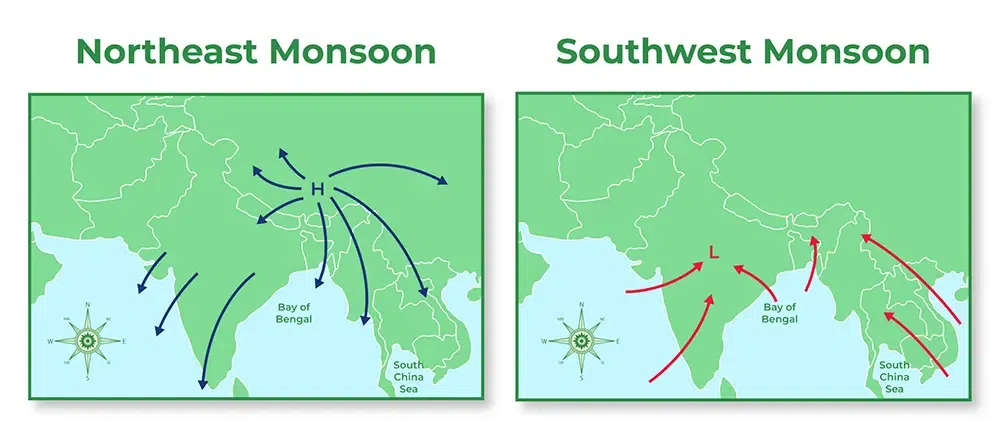
- This is the main monsoon in India. It brings heavy rains to the country from June to September. The southwest monsoon is caused by the difference in temperature between the land and the ocean.
- During the summer, the land heats up more than the ocean, which creates a low-pressure area over the land. This low-pressure area draws in moist air from the southwest Indian Ocean.
- As the moist air rises over the land, it cools and condenses, forming clouds and rain
- The southwest monsoon winds blow from the Indian Ocean, carrying moisture and rain clouds towards the Indian subcontinent.
- The southwest monsoon covers the entire Indian subcontinent, including the west coast, central India, northern plains, and parts of eastern India
- This monsoon brings heavy rainfall to various regions, replenishing water bodies and providing vital irrigation for agriculture
- This monsoon brings rains to India's northeast during the winter months, from October to December.
- The northeast monsoon is caused by the difference in temperature between the land and the ocean.
- During the winter, the land cools down more than the ocean, which creates a high-pressure area over the land.
- This high-pressure area pushes the moist air from the Bay of Bengal towards the land. As the moist air rises over the land, it cools and condenses, forming clouds and rain.
- During this period, the winds blow from the northeast, bringing moisture from the Bay of Bengal towards the southeastern coast of India
- The Northeast Monsoon primarily impacts the eastern coastal regions of India, including Tamil Nadu, Andhra Pradesh, parts of Karnataka, and some northeastern states
- The monsoon’s turnaround has led to a surge in kharif crop plantings – including the area under rice that was lagging behind last year’s levels till mid-July. But the gaps have since been significantly covered, barring in pulses, while forging ahead for rice
- The bulk of kharif sowings happen from mid-June to mid-August. Rainfall in June-July decides how much area is covered.
- August-September rain matters for yields of the crops already sown.
- The same rain helps fill up reservoirs and ponds and recharge groundwater tables, which provide moisture for the subsequent rabi winter-spring crops.
The monsoon has a significant impact on food inflation in India. A good monsoon ensures a good harvest, which leads to lower food prices. Conversely, a poor monsoon can lead to crop failure, which drives up food prices.
The monsoon has a significant impact on food inflation in India. Since a substantial portion of the country's agricultural production is rain-fed, the performance of the monsoon directly affects crop output and, consequently, food prices
Here are some of the ways in which the monsoon can impact food inflation:
- Crop production: The monsoon is essential for crop production in India. A good monsoon ensures that crops have enough water to grow, which leads to a good harvest. A poor monsoon can lead to crop failure, which reduces the supply of food and drives up prices.
- Input costs: The monsoon also affects the cost of inputs such as fertilizers and pesticides. A good monsoon can lead to lower input costs, which can help to keep food prices down. A poor monsoon can lead to higher input costs, which can push up food prices.
- Demand: The monsoon can also affect demand for food. A good monsoon can lead to increased demand for food, as people have more money to spend. A poor monsoon can lead to decreased demand for food, as people have less money to spend.
|
For Prelims: Southwest monsoons, retreat monsoons, inflation, food inflation
For Mains: 1.Discuss the factors influencing the onset and withdrawal of the southwest monsoon in India. How does climate change impact the monsoon pattern and what are its implications?
2.Critically assess the role of monsoon rains in replenishing water resources in India. Discuss the challenges faced in water management during both excess and deficit rainfall periods
|
|
Previous Year Questions
1.La Nina is suspected to have caused recent floods in Australia. How is La Nina different from El Nino? (UPSC CSE 2011 )
(a ) 1 only
(b) 2 only
(c) Both 1 and 2
(d) Neither 1 nor 2
Answer (d)
2. The seasonal reversal of winds is the typical characteristic of (UPSC CSE 2014 ) (a) Equatorial climate
(b) Mediterranean climate
(c) Monsoon climate
(d) All of the above climates
Answer C
3. With reference to ‘Indian Ocean Dipole (IOD)’ sometimes mentioned in the news while forecasting Indian monsoon, which of the following statements is/are correct? (UPSC CSE 2017 )
Select the correct answer using the code given below:
(a) 1 only
(b) 2 only
(c) Both 1 and 2
(d) Neither 1 nor 2
Answer b
Q7. Consider the following statements: (UPSC CSE 2015)
Which of the statements given above is/are correct?
(1) 1 only
(2) 2 only
(3) Both 1 and 2
(4) Neither 1 nor 2
Answer b
1.What characteristics can be assigned to monsoon climate that succeeds in feeding more than 50 percent of the won population residing in Monsoon Asia? (2017 GS1) 2. Discuss the nature and origin of the Indian monsoon and recent techniques of its prediction. (2014 Geography optional) 3. Discuss the mechanism and origin of Monsoon winds & explain the role of EI Nino on Monsoon circulation. (2008 Geography optional) |
FOREIGN CONTRIBUTION REGULATION ACT (FCRA)
1. Context
2. Foreign Contribution Regulation Act
- The law sought to regulate foreign donations to individuals and associations so that they functioned "in a manner consistent with the values of a sovereign democratic republic".
- Foreign funding in India is regulated under the FCRA act. Individuals are permitted to accept foreign contributions without the permission of MHA. However, the monetary limit for acceptance of such foreign contributions shall be less than Rs. 25,000.
- It is implemented by the Ministry of Home Affairs. The FCRA was enacted during the Emergency in 1976 amid apprehensions that foreign powers were interfering in India's affairs by pumping money into the country through independent organizations. These concerns were, in fact, even older- they had been expressed in Parliament as early as 1969.
3. Provisions of the Act
- The FCRA requires every person or NGO wishing to receive foreign donations to be registered under the act, to open a bank account for the receipt of foreign funds in the statute Bank of India, Delhi, and to utilize those funds only for which they have been received, and as stipulated in the act.
- They are also required to file annual returns, and they must not transfer the funds to another NGO.
- The Act prohibits the receipt of foreign funds by candidates for elections, journalists or newspapers and media broadcast companies, judges and government servants, members of the legislature and political parties or their office-bearers, and organizations of a political nature.
4. Key Highlights of the 2020 Amendment
- It bars public servants from receiving foreign contributions. It prohibits the transfer of foreign contributions to any other person.
- Aadhar number is mandatory for all office bearers, directors, or key functionaries of a person receiving foreign contributions, as an identification document.
- The foreign contribution must be received only in an account designated by the bank as an FCRA account in such branches of the State Bank of India, New Delhi.
- No funds other than foreign contributions should be received or deposited in this account.
- It allowed the government to restrict the usage of unutilized foreign contributions. This may be done if, based on an inquiry the government believes that such a person has contravened provisions of the FCRA.
- While NGOs earlier could use up to 50 percent of funds for administrative use, the new amendment restricted this use to 20 percent.
5. Registration under FCRA
- NGOs that want to receive foreign funds must apply online in a prescribed format with the required documentation. FCRA registrations are granted to individuals or associations that have definite cultural, economic, educational, religious, and social programs.
- Following the application, the MHA makes inquiries through the Intelligence Bureau into the antecedents of the applicant and accordingly processes the application. The MHA is required to approve or reject the application within 90 days-failing which is expected to inform the NGO of the reasons for the same.
- Once granted, FCRA registration is valid for five years. NGOs are expected to apply for renewal within six months of the date of expiry of registration. In case of failure to apply for renewal, the registration is deemed to have expired.
6. Who can receive foreign contribution?
Under the Foreign Contribution (Regulation) Act, 2010 (FCRA), only certain persons and organizations are permitted to receive foreign contributions. The Act regulates foreign funding to ensure it is used for legitimate purposes and does not adversely affect national interests.
The following categories can receive foreign contribution:
- Individuals can receive foreign contributions, provided they comply with the provisions of the FCRA. If the contribution is for a definite cultural, educational, economic, religious, or social programme, they generally need FCRA registration or prior permission, unless a statutory exemption applies.
- Associations, NGOs, Trusts, and Societies established for cultural, educational, religious, economic, or social purposes may receive foreign contributions after obtaining either:
- FCRA Registration, or
- Prior Permission from the Ministry of Home Affairs for a specific donor and project.
- Section 8 Companies (non-profit companies registered under the Companies Act, 2013) can also receive foreign contributions after complying with FCRA requirements.
7. Who cannot receive foreign contribution?
Under the Foreign Contribution (Regulation) Act, 2010 (FCRA), Section 3 specifies the categories of persons who are prohibited from accepting foreign contributions.
The following cannot receive foreign contribution:
- Candidates for election.
- Correspondents, columnists, cartoonists, editors, owners, printers, or publishers of a registered newspaper.
- Judges.
- Government servants and employees of any corporation or any other body controlled or owned by the Government.
- Members of any Legislature (Members of Parliament, Members of State Legislatures, etc.).
- Political parties and office-bearers of political parties.
- Organizations of a political nature, as may be specified by the Central Government.
- Associations or companies engaged in the production or broadcast of audio news, audio-visual news, or current affairs programmes through any electronic mode or other mass communication media.
- Correspondents, columnists, cartoonists, editors, owners, or publishers associated with such electronic news or current affairs media.
- A Non-Governmental Organization (NGO) is a voluntary, non-profit organization established by individuals or groups of citizens to work for the welfare of society.
- As the name suggests, an NGO is not a part of the government and functions independently in its decision-making and administration.
- Its primary objective is to serve the public by addressing social, economic, educational, cultural, environmental, religious, or humanitarian issues rather than earning profits.
- Although NGOs operate independently, they may collaborate with governments, international organizations, and private institutions to achieve their objectives.
- There is no single legal definition of an NGO in India. Instead, the term generally refers to organizations that are formed for charitable or developmental purposes and are registered under different laws depending on their organizational structure.
- An NGO may be registered as a Trust, a Society under the Societies Registration Act, 1860, or a Section 8 Company under the Companies Act, 2013.
- Regardless of the form in which they are registered, all NGOs share the common goal of promoting public welfare.
- The need for NGOs arises because governments alone often find it difficult to address every social and developmental challenge.
- India, with its vast population and geographical diversity, faces issues such as poverty, illiteracy, unemployment, malnutrition, environmental degradation, gender inequality, and inadequate healthcare.
- NGOs work alongside the government by reaching vulnerable communities, creating awareness, mobilizing local participation, and implementing developmental programmes at the grassroots level.
- In many cases, NGOs are able to reach remote and marginalized populations more effectively because of their flexibility and close engagement with local communities.
- NGOs undertake a wide range of activities. In the field of education, they establish schools, provide scholarships, and conduct literacy campaigns. In healthcare, they organize medical camps, vaccination drives, and awareness programmes on diseases and sanitation.
- In rural development, they promote sustainable agriculture, livelihood opportunities, and self-help groups. Many NGOs work towards women's empowerment by providing vocational training, legal assistance, and financial literacy.
- Others focus on child welfare, environmental conservation, human rights, disaster relief, skill development, and the protection of vulnerable sections such as tribal communities and persons with disabilities.
- To carry out these activities, NGOs require financial resources. They receive funds from various sources, including donations from individuals, grants from governments, contributions from companies under Corporate Social Responsibility (CSR), membership fees, and support from international organizations.
- If an NGO intends to receive funds from foreign sources, it must comply with the provisions of the Foreign Contribution (Regulation) Act, 2010 (FCRA).
- Under this law, eligible NGOs must obtain FCRA registration or prior permission from the Ministry of Home Affairs before accepting foreign contributions
|
For Prelims: FCRA, Rajiv Gandhi Foundation, Rajiv Gandhi Charitable Trust, NGO, Ministry of Home Affairs (MHA). For Mains: 1. What is the Foreign contribution regulation act and discuss the new restrictions introduced by the Foreign Contribution (Regulation) Amendment Act, 2020. |
|
Previous Year Questions
1.Examine critically the recent changes in the rules governing foreign funding of NGOs under the Foreign Contribution (Regulation) Act (FCRA), 1976. (Please refer GS-II Paper, 2015) |
Source: The Indian Express
VIJAYANAGARA EMPIRE
- The Vijayanagara Empire was a significant medieval South Indian empire that flourished between the 14th and 17th centuries.
- Established in 1336 by Harihara I and his brother Bukka Raya I, the empire's capital was Vijayanagara, located in present-day Hampi, Karnataka, India.
- The empire's rise was a response to the decline of the preceding Hoysala and Kakatiya empires, and it marked a period of cultural, political, and economic renaissance in South India.
In his famous work Manucharitam, Allasani Peddana mentions the four different castes that lived in the society of Vijayanagar.
- Brahmins or Viprulu followed the traditional profession related to teachers and priests. Sometimes, they also performed the duties of administrators. and soldiers. This is confirmed with the help of the narration of Domingo Paes.
- Rajulu or Rachavaru was generally linked with the ruling dynasty. The rulers and generals were actually Sudras but known as rachavaru due to their position. As in the case of other regions of South India, the Kshatriya Varna appears to be absent here.
- Matikaratalu or Vaishyas were merchants who were busy in trade and commerce activities.
- Nalavajativaru or Sudras were largely agriculturists, but some of them carried on several other professions. They were not segregated, although considered inferior.
- Early Vijayanagar rulers were followers of Shaivism and Virupaksha was their family God. After some time they came under the influence of Vaishnavism. But Siva continued to be worshipped by the people.
- Vaishnavism was professed in various forms. Srivaishnavism of Ramanuja was highly popular.
- The Dvaita system associated with Madhava was also practiced by the people.
- Epics and Puranas were famous amongst the masses, especially since they acted as a means of education among women.
- The tradition of dancing girls associated with temples was also in vogue. Many historians interpreted from the account of Paes, that Devadasis held a highly respectable place in society, and were given land grants and maid-servants, etc.
- The condition of the widows was pitiable, but they could remarry.
- The state-supported widow remarriage by not levying any tax on It.
- The prevalence of Sati Pratha in the Vijayanagar Empire is proved from both inscriptions and foreign accounts during the period.
- The Vijayanagar kingdom was one of the richest states then known to the world. Different foreign travellers, who visited the empire in the 15th and 16th Centuries have left glowing accounts of its splendour and wealth.
- Agriculture: It was in a flourishing situation. It was the strategy of rulers to promote agriculture in the different areas of the empire and to boost agricultural production by a clever irrigation policy. Nuniz (Portuguese traveller), speaks of the excavation of canals and the construction of a dam.
- Industries: The agricultural wealth was augmented by various industries, the most important of which were mining and metallurgy, textile sectors, and perfumery. Industries and crafts were regulated by guilds.
- It was common practice for people of the same trade to reside in one and the same quarter of the city.
- Malabar was the most valuable commercial region on the West coast, with its important port region of Cannanore. It had good commercial bonding with Burma, the Malay Archipelago, and China in the East, the islands of the Indian Ocean, and Persia, South Africa, Arabia, Abyssinia and Portugal in the West.
- Important items such as cloth, spices, rice, iron, saltpeter, sugar, etc. were exported. The main imports comprised pearls, copper, coral, mercury, horses, elephants, China silks and velvets.
- Ships were utilized for coastal and overseas trade purposes. Vijayanagara had its own ships; the art of shipbuilding was known, but we do not know if ocean-going ships were built.
- Various accounts of different foreign travellers speak of the high standards of living of the upper and middle classes.
- The splendour of the capital city of Vijayanagara bears testimony to the wealth, which was, however, the domination of only a section of the population of the kingdom.
- The prices of several articles were low and the minimum necessities were probably not beyond the means of the common people of the kingdom.
- But the producers particularly agricultural producers, apparently got inadequate prices for their produce.
- Another main fault of the economic system was that the common people had to bear the brunt of taxation, which was quite heavy and the local authority’s sometimes adopted oppressive methods of collection.
- Ibn Battuta (1333-1347 A.D.)-He was a Moroccan traveller, who came to India during the reign of Muhammad- bin-Tughlaq and visited Vijayanagar during the reign of Harihar I.
- Nicolo Conti (1420-1421 A.D.)-He was a Venetian traveller, who provided a comprehensive account of the Hindu kingdom of Vijayanagar.
- Abdur Razzaq (1443-1444 A. D.) -He was a Persian traveller, who visited the court of the Zamorin at Calicut. He has provided a stunning account of Vijayanagar City while depicting the wealth and luxurious life of the king and the nobles of the Vijayanagara kingdom.
- Duarte Barbosa (1500-1516 A.D.) -He was a Portuguese traveller, who had presented a useful narrative about the government and people of the Vijayanagar kingdom.
- Domingos Paes (1520-1522 A.D) -He was a Portuguese traveller, who came to the court of Krishnadevaraya.
- Fernao Nuniz (1534-1537 A.D) -He was a Portuguese merchant, who described the history of the Vijayanagara empire from its earliest days to the closing years of Achyuta Deva Raya’s reign.
|
For Prelims: Vijayanagara Empire, Harihara I, Bukka Raya I, Hoysala and Kakatiya empire, Manucharitam.
For Mains: 1. Analyse the economic foundations of the Vijayanagara Kingdom and discuss how trade and a monetized economy contributed to the rise and prosperity. (250 words).
|
|
Previous year Questions
1. According to Portuguese writer Nuniz, the women in Vijayanagara Empire were experts in which of the following areas? (UPSC 2021)
1. Wrestling
2. Astrology
3. Accounting
4. Soothsaying
Select the correct answer using the code given below.
A. 1, 2, and 3 only
B. 1, 3, and 4 only
C. 2 and 4 only
D. 1, 2, 3 and 4
Answer: 4
2. With reference to Indian history, consider the following statements: (UPSC 2022)
1. The Dutch established their factories/warehouses on the east coast on lands granted to them by the Gajapati rulers.
2. Alfonso de Albuquerque captured Goa from the Bijapur Sultanate.
3. The English East India Company established a factory at Madras on a plot of land leased from a representative of the Vijayanagara Empire.
Which of the statements given above is correct?
A. 1 and 2 only
B. 2 and 3 only
C. 1 and 3 only
D. 1, 2 and 3
Answer: B
3. Regarding Indian history, which of the following is/are correct? (UPSC 2021)
1. Arcot Nizamat emerged from Hyderabad state.
2. The Kingdom of Mysore emerged from the Vijayanagara Empire.
3. The kingdom of Rohilkhand was formed from the territories conquered by Ahmad Shah Durrani
Select the correct answer using the code given below.
A. Papers 1 and 2
B. 2 only
C. 2 and 3
D. 3 only
Answer: B
|
INDEX OF INDUSTRIAL PRODUCTION (IIP)
1. Context
2. About the Index of Industrial Production (IIP)
- The Index of Industrial Production (IIP) is a macroeconomic indicator that measures the changes in the volume of production of a basket of industrial goods over some time.
- It is a composite index that reflects the performance of the industrial sector of an economy.
- The IIP is compiled and released by the Central Statistical Organisation (CSO) in India.
- The IIP is calculated using a Laspeyres index formula, which means that the weights assigned to different industries are based on their relative importance in a base year. The current base year for the IIP is 2011-12.
- The eight core sector industries represent about 40% of the weight of items that are included in the IIP.
- The eight core industries are Refinery Products, Electricity, Steel, Coal, Crude Oil, Natural Gas, Cement and Fertilizers.
- It covers 407 item groups included into 3 categories viz. Manufacturing, Mining and Electricity.
- The IIP is a useful tool for assessing the health of the industrial sector and the overall economy.
- It is used by policymakers, businesses, and investors to track trends in industrial production and make informed decisions.
3. Significance of IIP
The IIP is a significant economic indicator that provides insights into the following aspects
- The IIP reflects the growth or decline of the industrial sector, which is a major contributor to overall economic growth.
- The IIP measures the level of industrial activity, indicating the production volume of various industries.
- The IIP serves as a guide for policymakers to assess the effectiveness of economic policies and make informed decisions.
- Businesses use the IIP to assess market conditions, make production plans, and evaluate investment opportunities.
- The IIP influences investor sentiment as it reflects the overall health of the industrial sector.
4. Service Sector and IIP
- The IIP does not include the service sector. It focuses on the production of goods in the industrial sector, such as manufacturing, mining, and electricity.
- The service sector is measured by a separate index, the Index of Services Production (ISP).
- The IIP data is released monthly by the Central Statistical Organisation (CSO) in India.
- The data is released with a lag of six weeks, allowing for the collection and compilation of information from various industries.
5. Users of IIP Data
The IIP data is used by a wide range of stakeholders, including:
- Government agencies and central banks use the IIP to assess economic conditions and formulate policies.
- Companies use the IIP to evaluate market trends, make production decisions, and assess investment opportunities.
- Investors use the IIP to gauge the health of the industrial sector and make investment decisions.
- Economic analysts and researchers use the IIP to study economic trends and develop forecasts.
- The IIP is widely reported in the media and is of interest to the general public as an indicator of economic performance.
6. Manufacturing Drives Industrial Production Growth
- Factory output gained on the back of a 9.3 per cent increase in manufacturing, which accounts for 77.6 per cent of the weight of the IIP (Index of Industrial Production).
- Manufacturing output had grown by 5 per cent in July and had contracted by 0.5 per cent in August 2022.
- In absolute terms, it improved to 143.5 in August from 141.8 in July and 131.3 in the year-ago period.
- As per the IIP data, seven of the 23 sectors in manufacturing registered a contraction in August, with furniture, apparel, and computer and electronics among the significant non-performers.
- Among the performing sectors, fabricated metal products, electrical equipment and basic metals fared better.
- Garments and chemicals witnessed negative growth. This can be attributed to lower growth in exports as these two are export-dependent.
- The electronics industry also witnessed negative growth, which again can be linked to existing high stocks and lower export demand.
- In terms of the use-based industries, consumer durables output returned to positive territory for the second time this fiscal with 5.7 per cent growth in August, reflecting a pickup in consumption demand.
- However, it came on the back of a 4.4 per cent contraction in consumer durables output in the year-ago period.
- Primary, infrastructure/ construction, and capital goods recorded double-digit growth rates in August at 12.4 per cent, 14.9 per cent and 12.6 per cent, respectively.
|
For Prelims: The Index of Industrial Production (IIP), Central Statistical Organisation,
For Mains:
1. Discuss the significance of the Index of Industrial Production (IIP) as an economic indicator and its role in assessing the health of the industrial sector and the overall economy. (250 Words)
|
| Previous Year Questions
1. In India, in the overall Index of Industrial Production, the Indices of Eight Core Industries have a combined weight of 37.90%. Which of the following are among those Eight Core Industries? (UPSC CSE 2012)
1. Cement
2. Fertilizers
3. Natural gas
4. Refinery products
5. Textiles
Select the correct answer using the codes given below:
A. 1 and 5 only B. 2, 3 and 4 only C. 1, 2, 3 and 4 only D. 1, 2, 3, 4 and 5
Answer: C
|
INDIANS AND H1-B
- The H-1B visa program for skilled workers was introduced in 1990. These visas are initially issued for three years but can be extended to a maximum of six years.
- Since 2004, the issuance of new H-1B visas has been capped at 85,000 annually, with 20,000 reserved specifically for foreign students who hold master’s degrees or higher from U.S. universities.
- This cap, however, does not apply to certain entities like universities, think tanks, and other non-profit research organizations, allowing additional visas to be issued beyond the limit.
- Applicants for H-1B visas must have a job offer from a U.S.-based sponsor, such as a company or institution. The U.S. government also grants extensions for individuals already working under H-1B visas.
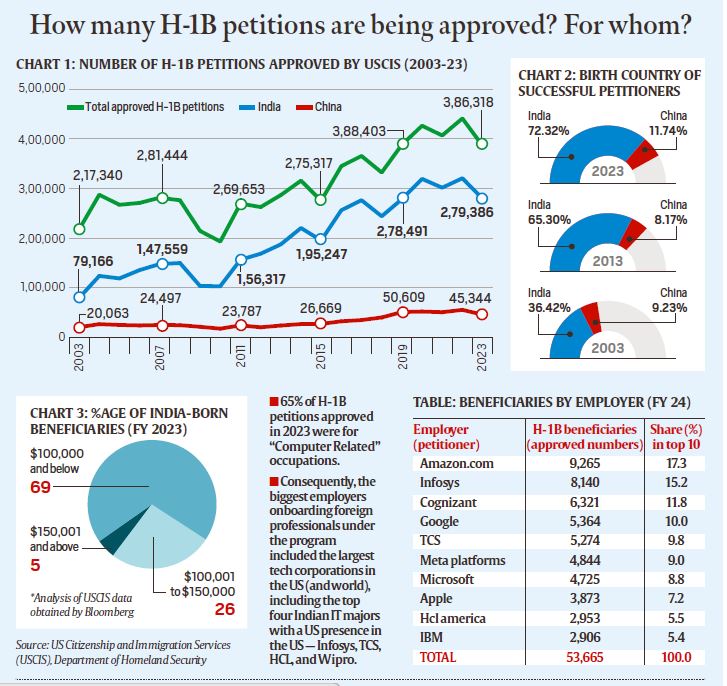
- During the fiscal year 2023 (October 2022 to September 2023), over 386,000 H-1B applications were approved. This figure includes nearly 119,000 new visas and approximately 267,000 extensions.
- The total number of approvals in 2023 reflects a decline from over 474,000 in the previous fiscal year, 2022
- Immigration remains one of the most divisive political topics in the United States. An October YouGov poll revealed that 14.6% of registered voters considered it the most critical issue in the upcoming election, a significant increase from just 2.1% in 2012.
- During election campaigns, much of the anti-immigration discourse centered on low-skilled labor migration. Beyond its inherent racial undertones, this narrative is driven by the perception that such immigration lowers wages and displaces jobs that might otherwise benefit the American working class.
- This demographic has long struggled with challenges like high unemployment, stagnant wages, inflation, a housing crisis, and other economic difficulties.
- Donald Trump effectively leveraged these concerns, pledging to improve conditions for the average American worker by restricting immigration.
- The current debate echoes many of the same themes as Trump’s rhetoric about Mexicans "stealing American jobs," though the focus has shifted to the immigration of skilled workers competing for higher-paying positions
- The H-1B visa program enables U.S. employers to hire foreign workers for roles requiring "a high level of skill" and "at least a bachelor’s degree," as outlined by the U.S. Department of Labor.
- Established in 1990, the program was designed to assist employers in filling roles that demand specialized skills not readily available within the U.S. workforce, allowing qualified foreign individuals to work temporarily in the United States.
- H-1B visas are typically issued for a maximum of six consecutive years. After this period, visa holders must either leave the U.S. for at least 12 months before returning or apply for permanent residency (a Green Card).
- Currently, the program has an annual limit of 65,000 new visas (the regular cap), with an additional 20,000 visas available for applicants holding master’s degrees or higher from U.S. universities. However, not all H-1B applications are subject to this cap, resulting in the total number of approved petitions often exceeding the cap.
- For example, in the fiscal year 2023, the United States Citizenship and Immigration Services (USCIS), under the Department of Homeland Security, approved 118,948 petitions for initial employment and 267,370 petitions for continuing employment.
- Certain applicants, such as those employed by higher education institutions, nonprofit organizations affiliated with such institutions, nonprofit research organizations, or government research entities, are exempt from the annual cap
- Indian nationals are the primary beneficiaries of the H-1B visa program, consistently accounting for over 70% of all approved H-1B petitions annually since 2015, according to U.S. government data. Chinese nationals rank a distant second, making up 12-13% of approvals since 2018.
- This significant representation of Indian professionals has drawn the attention of nativist MAGA Republicans, who have extended their anti-immigration rhetoric from low-skilled labor migration by Mexicans and Central Americans to include Indian workers in the tech industry.
- Their argument revolves around the claim that the H-1B program, originally designed to attract exceptional global talent, is being exploited by tech companies to fill lower- to mid-level positions at wages much lower than those expected by American workers.
- While proponents like Elon Musk argue that H-1B visas address a "permanent shortage of excellent engineering talent," critics counter that the issue is not a lack of skilled American workers but that they are deemed "too expensive to hire" by tech firms.
- This critique is supported by data. An analysis of 60,000 H-1B approvals from USCIS in the 2023 fiscal year, conducted by Bloomberg, revealed that nearly 70% of Indian H-1B recipients earned annual salaries below $100,000.
- For comparison, the median salary for IT professionals in the U.S. was $104,420 in May 2023, as reported by the U.S. Bureau of Labor Statistics. Approximately 25% of H-1B approvals for Indian professionals fell within the $100,000 to $150,000 salary range, while only 5% exceeded $150,000
|
For Prelims: H-1B visa, United States, U.S. Citizenship and Immigration Services, STEM fields, lottery system,
For Mains:
1. What are the implications of the new H-1B visa regime for US-India relations?
Discuss the measures can the Indian government take to support Indian IT workers affected by the new H-1B visa regime. (250 Words)
|
|
Previous Year Questions
1. Consider the following statements: (UPSC 2019)
1. Coal sector was nationalized by the Government of India under Indira Gandhi.
2. Now, coal blocks are allocated on lottery basis.
3. Till recently, India imported coal to meet the shortages of domestic supply, but now India is self-sufficient in coal production.
Which of the statements given above is/are correct?
A. 1 only B. 2 and 3 only C. 3 only D. 1, 2 and 3
Answer: A
2. Which of the following statements about town planning in British India in early 19th century is/are correct? (UPSC CAPF 2018)
1. The funds for town improvement were also raised through public lotteries.
2. The threats of epidemics gave an impetus to town planning in the early decades of 19th century.
Select the correct answer using the code given below
A.1 only B. 2 only C. Both 1 and 2 D. Neither 1 nor 2
Answer: C
|


