
MICRO SMALL MEDIUM ENTERPRISES (MSME)
The definition of MSME varies from country to country. In India, an MSME is defined as a business with:
- Micro enterprise: Up to 10 employees and an investment of up to INR 1 crore (approximately USD 130,000)
- Small enterprise: Up to 50 employees and an investment of up to INR 10 crore (approximately USD 1.3 million)
- Medium enterprise: Up to 200 employees and an investment of up to INR 50 crore (approximately USD 6.5 million)
The importance of MSMEs in an economy includes:
-
Employment Generation: MSMEs are significant contributors to employment, especially in economies with limited opportunities for large-scale industrial employment.
-
Local Economic Development: MSMEs often operate at a local level, contributing to the development of local communities and economies.
-
Innovation and Entrepreneurship: Many innovative ideas and entrepreneurial ventures start as MSMEs. They have the flexibility to adapt quickly to changing market demands and experiment with new business models.
-
Diversity and Resilience: A diverse ecosystem of MSMEs can contribute to a more resilient economy by reducing dependence on a few large corporations.
-
Contributions to GDP: The combined contributions of MSMEs to a country's Gross Domestic Product (GDP) can be significant, even if individual businesses are relatively small.
The new criteria for the classification of micro, small and medium enterprises (MSMEs) in India was notified by the Ministry of Micro, Small and Medium Enterprises (MSME) on June 1, 2020. The new criteria are based on the investment in plant and machinery or equipment and the annual turnover of the enterprise.
The following are the new criteria for the classification of MSMEs:
- Micro enterprise: An enterprise with:
- Investment in plant and machinery or equipment not more than Rs.1 crore (approximately USD 130,000)
- Annual turnover not more than Rs. 5 crore (approximately USD 650,000)
- Small enterprise: An enterprise with:
- Investment in plant and machinery or equipment not more than Rs.10 crore (approximately USD 1.3 million)
- Annual turnover not more than Rs. 50 crore (approximately USD 6.5 million)
- Medium enterprise: An enterprise with:
- Investment in plant and machinery or equipment not more than Rs.50 crore (approximately USD 6.5 million)
- Annual turnover not more than Rs. 250 crore (approximately USD 3.25 million)
Micro, small, and medium enterprises (MSMEs) play a vital role in the Indian economy, accounting for over 90% of all enterprises and employing over 40% of the workforce. However, MSMEs face a number of challenges, including:
- Access to finance: MSMEs often find it difficult to obtain loans from banks and other financial institutions due to their lack of collateral and track record. This can make it difficult for them to expand their businesses or invest in new technologies.
- Lack of skills: MSMEs often lack the skills and knowledge needed to compete in the global market. This can make it difficult for them to develop new products and services, or to adopt new technologies.
- Competition from large businesses: MSMEs often face competition from large businesses, which have more resources and economies of scale. This can make it difficult for MSMEs to compete on price or quality.
- Bureaucracy: MSMEs often face a number of bureaucratic hurdles, such as obtaining licenses and permits. This can be time-consuming and costly, and can discourage entrepreneurs from starting or expanding their businesses.
- Infrastructure constraints: MSMEs often face infrastructure constraints, such as poor roads and electricity supply. This can make it difficult for them to transport their goods and services, or to operate their businesses efficiently.
- Unstable government policies: MSMEs are often affected by unstable government policies, such as changes in tax rates or import duties. This can make it difficult for them to plan for the future and make investment decisions.
Here are some of the prominent schemes and programs for MSMEs by the Union Government of India:
-
Micro Units Development and Refinance Agency (MUDRA) Yojana:
- MUDRA Yojana aims to provide financial support to small and micro enterprises by offering loans through various financial institutions. It consists of three categories: Shishu, Kishor, and Tarun, based on the loan amount.
-
Pradhan Mantri Mudra Yojana (PMMY):
- PMMY is a scheme to provide financial assistance for the establishment, expansion, and modernization of MSMEs. It offers loans without collateral security up to a certain limit.
-
Credit Linked Capital Subsidy Scheme (CLCSS):
- CLCSS provides capital subsidy to MSMEs for technology upgradation, modernization, and replacement of their plant and machinery to improve competitiveness.
-
Zero Defect Zero Effect (ZED) Certification Scheme:
- ZED certification encourages MSMEs to adopt best practices and quality standards to enhance product quality while minimizing environmental impact.
-
Make in India Initiative:
- The Make in India campaign encourages domestic and foreign companies to manufacture products in India, fostering the growth of the manufacturing sector and MSMEs.
-
Stand Up India Scheme:
- This scheme aims to promote entrepreneurship among women and Scheduled Caste/Scheduled Tribe communities by providing loans for starting new enterprises.
-
Technology Upgradation Support for MSMEs (TEQUP):
- TEQUP focuses on supporting MSMEs in adopting modern technology and upgrading their production processes to improve quality and competitiveness.
-
National Manufacturing Competitiveness Programme (NMCP):
- NMCP includes various components such as Lean Manufacturing Competitiveness Scheme, Design Clinic Scheme, and more, aimed at enhancing the competitiveness of the manufacturing sector, including MSMEs.
-
Entrepreneurial and Managerial Development of SMEs (EMD-SME):
- EMD-SME focuses on providing training, capacity-building, and skill development to entrepreneurs and managers of MSMEs.
-
Skill India Initiative:
- While not exclusively for MSMEs, the Skill India program aims to provide skill training to individuals, including those in the MSME sector, to improve employability and entrepreneurship.
-
Export Promotion Capital Goods (EPCG) Scheme:
- The EPCG scheme allows MSMEs to import capital goods for the purpose of upgrading technology and enhancing export competitiveness with certain duty benefits.
-
Udyog Aadhaar Registration:
- The Udyog Aadhaar registration process simplifies the process of registering and obtaining various benefits for MSMEs, such as easier access to credit and government schemes.
Previous year Questions1. Consider the following statements with reference to India: (UPSC 2023)
1. According to the 'Micro, Small and Medium Enterprises Development (MSMED) Act, 2006', the 'medium enterprises' are those with investments in plant and machinery between Rs. 15 crore and Rs. 25 crore.
2. All bank loans to the Micro, Small, and Medium Enterprises qualify under the priority sector.
Which of the statements given above is/are correct?
A. 1 only
B. 2 only
C. Both 1 and 2
D. Neither 1 nor 2
Answer: B
2. Which of the following can aid in furthering the Government's objective of inclusive growth? (UPSC 2011)
1. Promoting Self-Help Groups
2. Promoting Micro, Small and Medium Enterprises
3. Implementing the Right to Education Act
Select the correct answer using the codes given below:
A. 1 only
B. 1 and 2 only
C. 2 and 3 only
D. 1, 2 and 3
Answer: D
|
CRITICAL MINERALS
- Rare Earth Elements (REEs): neodymium, dysprosium, terbium
- Lithium
- Cobalt
- Graphite
- Gallium
- Indium
- Tungsten
- Platinum Group Metals (PGMs)
.jpg)
- Minerals such as copper, lithium, nickel, and cobalt, along with certain rare earth elements, are considered critical due to their essential role in the global transition to greener and cleaner energy sources.
- According to the International Energy Agency (IEA), the demand for lithium surged by 30% in 2023, with nickel, cobalt, graphite, and rare earth elements experiencing growth between 8% and 15%, collectively valued at $325 billion.
- The IEA's Global Critical Minerals Outlook 2024 report indicates that achieving the world's goal of limiting global warming to 1.5 degrees Celsius within a net-zero emissions framework will necessitate a significant increase in demand for these minerals.
- By 2040, copper demand is projected to rise by 50%, nickel, cobalt, and rare earth elements by 100%, graphite by 300%, and lithium by 800%, which is vital for battery production.
- Developing sustainable supply chains for these minerals is therefore crucial. In India, the absence of readily available reserves has led to complete import dependence for minerals such as lithium, cobalt, and nickel.
- Although India possesses natural reserves of several critical minerals, they remain largely unexplored and untapped. For example, despite holding 11% of the world's ilmenite deposits, which is the primary source of titanium dioxide used in numerous applications, India still imports a billion dollars' worth of titanium dioxide annually, as noted by former Mines Secretary Vivek Bharadwaj.
- Additionally, the "lucky" discovery of lithium reserves in the Union Territory of Jammu and Kashmir (J&K) by the Geological Survey of India (GSI) while exploring for limestone has raised hopes for achieving some level of self-sufficiency in lithium. Announced in February as India's first lithium find, these reserves are estimated at 5.9 million tonnes, prompting the government to expedite their extraction.
- Recognizing the risks of relying on a limited number of countries for these minerals and their processing, the central government amended the Mines and Minerals (Development and Regulation) Act, 1957 in August 2023 to allow mining concessions for 24 critical and strategic minerals.
|
For Prelims: Critical minerals, Ministry of Mines, carbon emissions, cleaner energy, lithium, cobalt, nickel, graphite, tin, copper, Selenium, Cadmium, Centre of Excellence on critical minerals, Australia's CSIRO, Geological Survey of India,
For Mains:
1. What are critical minerals? Discuss their significance for a country's economic development and national security. Explain how the identification of critical minerals helps in reducing import dependency and ensuring resource security. (250 Words)
|
|
Previous Year Questions
1. With reference to the mineral resources of India, consider the following pairs: (UPSC 2010)
Mineral 90%Natural sources in
1. Copper Jharkhand
2. Nickel Orissa
3. Tungsten Kerala
Which of the pairs given above is/are correctly matched?
A. 1 and 2 only B. 2 only C. 1 and 3 only D. 1, 2 and 3
Answer: B
2. Recently, there has been a concern over the short supply of a group of elements called 'rare earth metals.' Why? (UPSC 2012)
1. China, which is the largest producer of these elements, has imposed some restrictions on their export.
2. Other than China, Australia, Canada and Chile, these elements are not found in any country. 3. Rare earth metals are essential for the manufacture of various kinds of electronic items and there is a growing demand for these elements.
Which of the statements given above is/are correct?
A. 1 only B. 2 and 3 only C. 1 and 3 only D. 1, 2 and 3
Answer: C
3. In India, what is the role of the Coal Controller's Organization (CCO)? (UPSC 2022)
1. CCO is the major source of Coal Statistics in Government of India.
2. It monitors progress of development of Captive Coal/Lignite blocks.
3. It hears any objection to the Government's notification relating to acquisition of coal-bearing areas.
4. It ensures that coal mining companies deliver the coal to end users in the prescribed time. Select the correct answer using the code given below:
A. 1, 2 and 3 B. 3 and 4 only C. 1 and 2 only D. 1, 2 and 4
Answer: A
4. Which of the following statements best describes the term 'Social Cost of Carbon'? It is a measure, in monetary value, of the (UPSC 2020)
A. long-term damage done by a tonne of CO2 emission in a given year.
B. requirement of fossil fuels for a country to provide goods and services to its citizens, based on the burning of those fuels.
C. efforts put in by a climate refugee to adapt to live in a new place.
D. contribution of an individual person to the carbon footprint on the planet Earth.
Answer: A
5. Direction: It consists of two statements, one labelled as ‘Statement (I)’ and the others as ‘Statement (II)’. You are to examine these two statements carefully and select the answer using the codes given below: (UPSC ESE 2018)
Statement (I): Green energy refers to one which does not harm the ecosystem of planet earth. Statement (II): All renewable energy is green energy.
A. Both Statement (I) and Statement (II) individually true and Statement (II) is the correct explanation of Statement (I)
B. Both statement (I) and Statement (II) are individually true, but Statement (II) is not the correct explanation of Statement (I)
C. Statement (I) is true, but Statement (II) is false
D. Statement (I) is false, but Statement (II) is true
Answer: C
6. Which type of battery is used in the recently launched world's first fully electric cargo ship by change? (Delhi Police Constable 2017)
A. Lead Acid B. Manganese C. Lithium ion D. Nickel metal hydride
Answer: C
7. White gold is an alloy of (UPSC CAPF 2022)
A. gold, nickel and palladium
B. gold, cobalt and palladium
C. gold, titanium and platinum
D. gold, magnesium and palladium
Answer: A
8. Graphene is frequently in news recently. What is its importance? (UPSC 2012)
1. It is a two-dimensional material and has good electrical conductivity.
2. It is one of the thinnest but strongest materials tested so far.
3. It is entirely made of silicon and has high optical transparency.
4. It can be used as 'conducting electrodes' required for touch screens, LCDs and organic LEDs. Which of the statements given above are correct?
A. 1 and 2 only B. 3 and 4 only C. 1, 2 and 4 only D. 1, 2, 3 and 4
Answer: C
9. Graphite and diamonds are__________. (WBCS Prelims 2020)
A. isotopes B. isomers C. isotones D. allotropes
Answer: D
10. Consider the following statements: (UPSC 2020)
1. Coal ash contains arsenic, lead and mercury.
2. Coal-fired power plants release sulphur dioxide and oxides of nitrogen into the environment. 3. High ash content is observed in Indian coal.
Which of the statements given above is/are correct?
A. 1 only B. 2 and 3 only C. 3 only D. 1, 2 and 3
Answer: D
11. Which of the following can be found as pollutants in the drinking water in some parts of India? (UPSC 2013)
1. Arsenic
2. Sorbitol
3. Fluoride
4. Formaldehyde
5. Uranium
Select the correct answer using the codes given below.
A. 1 and 3 only B. 2, 4 and 5 only C. 1, 3 and 5 only D. 1, 2, 3, 4 and 5
Answer: C
12. In the context of solving pollution problems, what is/are the advantage/advantages of the bioremediation technique? (UPSC 2017)
1. It is a technique for cleaning up pollution by enhancing the same biodegradation process that occurs in nature.
2. Any contaminant with heavy metals such as cadmium and lead can be readily and completely treated by bioremediation using microorganisms.
3. Genetic engineering can be used to create microorganisms specifically designed for bioremediation.
Select the correct answer using the code given below:
A. 1 only B. 2 and 3 only C. 1 and 3 only D. 1, 2 and 3
Answer: C
13. Due to improper/indiscriminate disposal of old and used computers or their parts, which of the following are released into the environment as e-waste? (UPSC 2013)
1. Beryllium
2. Cadmium
3. Chromium
4. Heptachlor
5. Mercury
6. Lead
7. Plutonium
Select the correct answer using the codes given below.
A. 1, 3, 4, 6 and 7 only B. 1, 2, 3, 5 and 6 only
C. 2, 4, 5 and 7 only D. 1, 2, 3, 4, 5, 6 and 7
Answer: B
14. When was the Geological Survey of India (GSI) of India founded? (UPRVUNL Staff Nurse 2021)
A. 1851 B. 1951 C. 1871 D. 1931
Answer: A
|
MONETARY POLICY COMMITTEE (MPC)
Monetary policy refers to the actions and strategies undertaken by a country's central bank to control and regulate the supply of money, credit availability, and interest rates in an economy. Its primary goal is to achieve specific economic objectives, such as price stability, full employment, and sustainable economic growth.
Central banks use various tools to implement monetary policy, including:
Interest Rates: Adjusting the interest rates at which banks lend to each other (known as the federal funds rate in the United States) influences borrowing and spending in the economy.
Open Market Operations: Buying or selling government securities in the open market to regulate the money supply. When a central bank buys securities, it injects money into the system, and when it sells them, it reduces the money supply.
Reserve Requirements: Mandating the amount of reserves banks must hold, affecting their ability to lend money.
By influencing the availability and cost of money, central banks aim to stabilize prices, control inflation, encourage or discourage borrowing and spending, and promote economic growth. However, the effectiveness of monetary policy can be influenced by various factors such as global economic conditions, fiscal policies, and market expectations.
3.What is the primary objective of the monetary policy?
The primary objective of monetary policy typically revolves around maintaining price stability or controlling inflation within an economy. Central banks often set an inflation target, aiming to keep it at a moderate and steady level. Stable prices help in fostering confidence in the economy, encouraging investment, and ensuring that the value of money remains relatively constant over time.
However, while controlling inflation is often the primary goal, central banks might also consider other objectives, such as:
Full Employment: Some central banks have a secondary objective of supporting maximum employment or reducing unemployment rates.
Economic Growth: Encouraging sustainable economic growth by managing interest rates and credit availability to stimulate or cool down economic activity.
Exchange Rate Stability: In some cases, maintaining stable exchange rates might be an important consideration, especially for countries with open economies heavily reliant on international trade.
These additional objectives can vary depending on the economic conditions, priorities of the government, and the central bank's mandate. Nonetheless, ensuring price stability is typically the fundamental goal of most monetary policies, as it forms the basis for a healthy and growing economy.
4. Monetary Policy Committee (MPC)
- In line with the amended RBI Act, 1934, Section 45ZB grants authority to the central government to establish a six-member Monetary Policy Committee (MPC) responsible for determining the policy interest rate aimed at achieving the inflation target.
- The inaugural MPC was formed on September 29, 2016. Section 45ZB stipulates that "the Monetary Policy Committee will ascertain the Policy Rate necessary to meet the inflation target" and that "the decisions made by the Monetary Policy Committee will be obligatory for the Bank."
- According to Section 45ZB, the MPC comprises the RBI Governor as the ex officio chairperson, the Deputy Governor overseeing monetary policy, a Bank official nominated by the Central Board, and three individuals appointed by the central government.
- The individuals chosen by the central government must possess "capabilities, ethical standing, expertise, and experience in economics, banking, finance, or monetary policy" (Section 45ZC)
- The Monetary Policy Committee (MPC) plays a crucial role in managing inflation through its decisions on the policy interest rate.
- When inflation is too high, the MPC might decide to increase the policy interest rate. This action aims to make borrowing more expensive, which can reduce spending and investment in the economy.
- As a result, it could help decrease demand for goods and services, potentially curbing inflation.
- Conversely, when inflation is too low or the economy needs a boost, the MPC might decrease the policy interest rate.
- This move makes borrowing cheaper, encouraging businesses and individuals to spend and invest more, thus stimulating economic activity and potentially raising inflation closer to the target level.
- The MPC's goal is to use the policy interest rate as a tool to steer inflation toward a target set by the government or central bank.
- By monitoring economic indicators and assessing the current and expected inflation levels, the MPC makes informed decisions to maintain price stability within the economy
|
For Prelims: Economic and Social Development
For Mains: General Studies III: Indian Economy and issues relating to planning, mobilization, of resources, growth, development and employment.
|
|
Previous Year Questions
1. Consider the following statements: (UPSC 2021)
1. The Governor of the Reserve Bank of India (RBI) is appointed by the Central Government.
2. Certain provisions in the Constitution of India give the Central Government the right to issue directions to the RBI in the public interest.
3. The Governor of the RBI draws his natural power from the RBI Act.
Which of the above statements is/are correct?
A. 1 and 2 only B. 2 and 3 only C. 1 and 3 only D. 1, 2 and 3
Answer: C
2. Concerning the Indian economy, consider the following: (UPSC 2015)
Which of the above is/are component(s) of Monetary Policy? (a) 1 only (b) 2, 3 and 4 (c) 1 and 2 (d) 1, 3 and 4 Answer: C 3. An increase in Bank Rate generally indicates: (UPSC 2013) (a) Market rate of interest is likely to fall. (b) Central bank is no longer making loans to commercial banks. (c) Central bank is following an easy money policy. (d) Central bank is following a tight money policy. Answer: (d) 4. Which of the following statements is/are correct regarding the Monetary Policy Committee (MPC)? (UPSC 2017) 1. It decides the RBI's benchmark interest rates. 2. It is a 12-member body including the Governor of RBI and is reconstituted every year. 3. It functions under the chairmanship of the Union Finance Minister. Select the correct answer using the code given below: A. 1 only B. 1 and 2 only C. 3 only D. 2 and 3 only Answer: A |
SOUTH CHINA SEA
1. Context
2. China's South China Sea Escalation
- Amid the global pandemic, China is intensifying its presence in the South China Sea, particularly focusing on the disputed Spratly Islands and Paracel Islands.
- This move has raised concerns among neighbouring countries, such as Vietnam and the Philippines, who also claim sovereignty over these territories.
- China has unilaterally renamed 80 islands and geographical features in the South China Sea, a controversial action that has drawn criticism from neighbouring nations.
- This renaming effort exacerbates the ongoing territorial dispute and has the potential to strain diplomatic relations in the Asia-Pacific region.
- The Spratly Islands dispute involves China, Taiwan, Vietnam, the Philippines, and Malaysia, all vying for control over this archipelago and its surrounding features.
- Although these islands are largely uninhabited, they are believed to harbour significant untapped natural resources.
- However, due to the dispute, exploration and resource assessment efforts remain limited.
3. Historical Background
- The discovery of oil near the Palawan coast in the 1970s further fueled territorial claims, even though some reports suggest limited oil and gas reserves in the region.
- This historical context underscores the complexity of the Spratly Islands dispute.
- The Paracel Islands dispute is equally complex, with China and Vietnam both laying historical claims to this archipelago.
- Historical texts from various periods, including colonial-era records, have been cited to support these conflicting claims.
- Tensions escalated in 1974 when China took control of the islands, sparking a prolonged dispute involving Vietnam and, later, Taiwan.
 Image Source: Forbes
4. Contemporary Developments
- Since 2012, China, Taiwan, and Vietnam have pursued various strategies to bolster their territorial claims, including constructing government buildings, promoting tourism, reclaiming land, and expanding military presence on these islands.
- China's recent establishment of new administrative districts in both the Spratly and Paracel Islands prompted the Chinese government to rename numerous geographical features.
- This move is reminiscent of a similar initiative in 1983 when China renamed 287 features in the disputed region.
- China's increased military activity and the creation of artificial islands for military and economic purposes in the South China Sea have raised concerns among neighbouring countries and Western powers.
- Recent incidents, such as the sinking of a Vietnamese fishing trawler near the Paracel Islands and the construction of Chinese research stations on disputed Philippine territory, have further inflamed tensions.
5.What is the dispute between the Philippines and China over the South China Sea?
- The dispute between the Philippines and China over the South China Sea primarily revolves around territorial claims, maritime boundaries, and access to resources.
- China claims a significant portion of the South China Sea, demarcated by what's known as the "nine-dash line," a boundary that encompasses about 90% of the sea, overlapping with claims by several other nations, including the Philippines.
- The Philippines contests China's claims, particularly in areas that fall within its Exclusive Economic Zone (EEZ) and territorial waters as defined by the United Nations Convention on the Law of the Sea (UNCLOS).
- Tensions escalated due to China's construction of artificial islands and military installations in disputed waters, which the Philippines and other neighboring countries view as a violation of their sovereignty and a threat to regional stability.
- The Philippines filed a case against China in 2013 with the Permanent Court of Arbitration (PCA) in The Hague, challenging the legality of China's claims based on UNCLOS.
- In 2016, the PCA ruled in favor of the Philippines, declaring that China's claims had no legal basis. However, China has consistently rejected the ruling, asserting historical rights over the South China Sea.
- Despite the ruling, the situation remains contentious, with ongoing diplomatic efforts and occasional confrontations between the two countries' vessels in the region
- The nine-dash line is a demarcation line used by China to outline its territorial claims in the South China Sea. It's a U-shaped boundary that encompasses about 90% of the South China Sea, covering various islands, reefs, atolls, and waters.
- Originally, the nine-dash line was drawn by the Republic of China (ROC, now Taiwan) in the late 1940s to illustrate its territorial claims over the South China Sea. After the Chinese Civil War, when the Communist Party took control of mainland China in 1949, the People's Republic of China (PRC) continued to uphold this demarcation.
- However, the line's legal basis and specifics have been ambiguous. It has never been clearly defined, and China has not provided precise coordinates or explanations for its claim. The line overlaps with the exclusive economic zones (EEZs) and territorial waters of several Southeast Asian nations, including Vietnam, the Philippines, Malaysia, Brunei, and Taiwan. This has led to territorial disputes and heightened tensions in the region.
- The international community, including the United States and many other countries, does not recognize China's nine-dash line claim as valid under international law, particularly the United Nations Convention on the Law of the Sea (UNCLOS), which outlines maritime entitlements and territorial claims based on geographical features and historical rights.
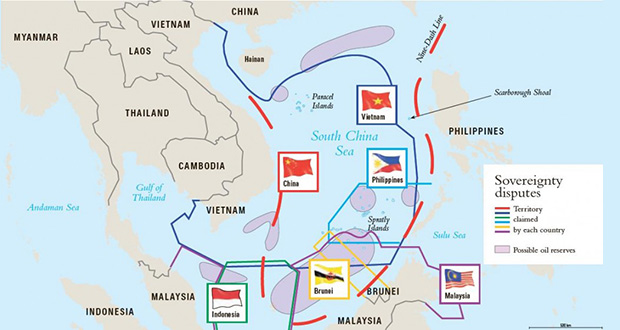
7. Conclusion
- The South China Sea remains a highly volatile region, with the potential for further diplomatic tensions and military escalations.
- The ongoing territorial disputes, fueled by historical claims and concerns over natural resources, pose a significant challenge to stability in the Asia-Pacific region and require careful diplomatic efforts to find peaceful resolutions.
|
For Prelims: South China Sea, Paracel Islands, Spratly Islands,
For Mains:
1. Discuss the historical background of the territorial disputes in the South China Sea. How have historical claims contributed to the complexity of the issue? (250 Words)
|
|
Previous Year Questions
1. The South China Sea Dispute involves which of the following countries? (CDS GK 2019)
1. China
2. Vietnam
3. Malaysia
4. Indonesia
Select the correct answer using the code given below.
A. 1 and 4 B. 1 and 2 only C. 1, 2 and 3 D. 2, 3 and 4
Answer: C
2. Which one of the following statements best reflects the issue with Senkaku Islands, sometimes mentioned in the news? (UPSC CSE 2022)
A. It is generally believed that they are artificial islands made by a country around South China Sea.
B. China and Japan engage in maritime disputes over these islands in East China Sea.
C. A permanent American military base has been set up there to help Taiwan to increase its defence capabilities.
D. Though International Court of Justice declared them as no man's land, some South-East Asian countries claim them.
Answer: B
|
FLASH FLOODS
2. What is a Flood
- Flood is an overflow of a large amount of water beyond its normal limits, especially over what is normally dry land.
- Flooding is an overflowing of water onto land that is normally dry.
- Floods can happen during heavy rains, when ocean waves come on shore, when the snow melts quickly, or when dams or levees break.
- Damaging flooding may happen with only a few inches of water, or it may cover a house to the rooftop.
- Floods can occur within minutes or over a long period, and may last days, weeks, or longer.
- Floods are the most widespread of all weather-related natural disasters.
3. Common causes of floods can be divided into the factors triggering them.
These factors include -
- Meteorological factors
- Physical factors
- Human factors
3.1 Meteorological Factors
The natural causes of floods are discussed below -
- Heavy Rainfall: The season of monsoon
- Cloud Burst: Cloud Burst occurs due to intense precipitation in a short duration which can sometimes be accompanied by hail and storms and can cause a flood.
- Climate Change: According to the International Panel for Climate Change, the rainfall intensity, duration and frequency are going to increase in the future.
- Skewed Rainfall Pattern: 80% of the precipitation takes place in the monsoon months
- Trans-National Rivers: The fact that some of the rivers (like the Brahmaputra, many tributaries of Ganga) causing damage in India to originate in neighbouring countries, adds another complex dimension to the problem
- Cyclone & Heavy rainfall
3.2. Physical Factors.
- Insufficient Drainage Management: Improper planning of the drainage system of an area can cause excess water due to heavy rainfall to get stuck and lead to a flood.
- Catchment Area: Catchment area is an area from where the rainfall water flows into a river. This can be a lake or reservoir. During monsoon, when excess water exceeds the limited holding capacity of the catchment area, it leads to floods.
3.3. Human Factor
- Siltation: Siltation refers to the flow of silt and sediments in the riverbed. As particles remain suspended in the river and accumulated in the riverbed, it disrupts the flow of the river, causing a flood.
- Improper Agricultural Practices: If farmers are not cautious of the effects of farming practices meaning if they leave the waste material in the river or cannot handle water management properly, it can lead to a flood.
- Deforestation: Deforestation is one of the major human causes of floods. Trees act like a sponge that helps to hold soil and water and prevent flooding. As trees are being cut down at a fast pace to make way for urbanisation to grow, more water runs towards a river during heavy rainfall. As a result, a flood occurs.
- Collapse of Dams: Dams are built to store water and provide water to people. As dams are human-made, these can be worn out and subsequently collapse causing floods. Also, if heavy rainfall sustains for a long time, State Governments often declare to open dam gates which can lead to a dangerous flood.- Temples of Modern India to Water Bombs
- Unplanned Development
- Neglect of Pre-Disaster Planning
4.Types of Flood
- Coastal Floods: Coastal floods occur when strong winds or storms move towards the coast during high tide.
- Flash Floods: Flash floods usually occur in hilly areas in limited space. Here the sudden heavy rainfall or snow thaws are the causes of flooding. The fast-moving torrent of Flash floods can sweep large objects such as cars, rocks and everything that comes in their path.
- River Floods: River floods occur due to the inflow of water from heavy rainfall, snowmelt or powerful storms.
- Pluvial Floods: Pluvial floods occur in areas that cannot hold rainwater and end up forming puddles and ponds. eg- rural areas.
- Urban Floods: When the drainage system of urban areas fails to absorb rainwater.
The impacts of floods affect both individuals and communities and have social-environmental consequences.
- Human Loss and Property Loss: Every year, millions of people become homeless and washed away due to floods.
- Spread of Communicable Diseases: Waterborne diseases like cholera, typhoid fever, hepatitis, and leptospirosis spread in flood-affected areas. Floods also lead to vector-borne diseases, transmitted through parasites and pathogens such as a mosquito. As a result, the health of flood victims deteriorates.
- Destruction of Crops: Every year, floods destroy a large number of crops.
- Loss of Livestock: Like humans, livestock also get displaced during floods and dies due to the loss of their habitats.
- Disruption of Communication Link and Transportation: Flood causes damage to transportation links such as bridges, rail, power plants etc., thus causing communication disruption in those areas.
- Economic and Social Disruption: The economy comes to a standstill as people are forced to move to another place, and revival of this situation takes time.
Approaches to dealing with floods may be any one or a combination of the following available options:
- Attempts to modify the flood
- Attempts to modify the susceptibility to flooding damage
- Attempts to modify the loss burden
- Bearing the loss.
- The main thrust of the flood protection programme undertaken in India so far has been an attempt to modify the flood in the form of physical (structural) measures to prevent the floodwaters from reaching potential damage centres and modify susceptibility to flooding damage through early warning systems.
6.1 Structural measures
The following structural measures are generally adopted for flood protection:
- Embankments, flood walls, sea walls
- Dams and reservoirs
- Natural detention basins
- Channel improvement
- Drainage improvement
- Diversion of flood waters.
6.2 Non-structural measures
Non-structural measures include:
- Flood forecasting and warning
- Floodplain zoning
- Flood fighting
- Floodproofing
- Flood insurance.
7.What are Flash Floods
- Flash floods are the most dangerous kind of floods because they combine the destructive power of a flood with incredible speed.
- Flash floods occur when heavy rainfall exceeds the ability of the ground to absorb it. They also occur when water fills normally dry creeks or streams or enough water accumulates for streams to overtop their banks, causing rapid rises of water in a short amount of time.
- They can happen within minutes of the causative rainfall, limiting the time available to warn and protect the public.
8. Status of Floods in India
8.1 NDRF Report
- 40 million hectares (10% of the land mass) in India are prone to floods.
- On average every year, 5 million hectares of land are affected, 1600 lives are lost and more than Rs. 1,800 crores is incurred.
8.2 Statistics
- Between 1970 and 2004, 3 floods occurred per year on average. However, between 2005 and 2019, the yearly average rose to 11. 19 districts were affected annually on an average until 2005. After 2005, the number jumped to 55.
- 2017 analysis suggests that 4.48 million Indians are exposed to riverine floods, the highest in the world.
9. What areas are at risk from flash floods?
- Densely populated areas are at high risk for flash floods. The construction of buildings, highways, driveways, and parking lots increases runoff by reducing the amount of rain absorbed by the ground. This runoff increases the flash flood potential.
- Areas near rivers are at risk from floods. Embankments, known as levees, are often built along rivers and are used to prevent high water from flooding bordering land.
- Dam failures can send a sudden destructive surge of water downstream.
- Mountains and steep hills produce rapid runoff, which causes streams to rise quickly.
- Saturated soils can also lead to rapid flash flooding.
- Sometimes the thunderstorms that produce heavy rainfall may happen well upstream from the impacted area, making it harder to recognize a dangerous situation.
- Very intense rainfall can produce flooding even on dry soil.
- Additional high-risk locations include recent burn areas in mountains and urban areas from pavement and roofs which enhance runoff.
- Ice jams and snowmelt can help cause flash floods. A deep snowpack increases runoff produced by melting snow. Heavy spring rains falling on melting snowpacks can produce flash flooding.
10. The impact of floods in India


11. Impact of flood on wildlife

12. Government actions regarding flood management
12.1.The National Flood Management Commission
- Launched in 1954
- Different structural and non-structural methods have been applied by various states under it.
- To evolve a scientific, integrated and coordinated approach to flood control
- It recommended Flood plain zoning and management to regulate human activities.
- It was set up to review the impact of the recommendations of Rashtriya Barh Aayog.
- It recommended large flood moderation projects, following up the enactment of flood plain zoning.
12.4.National Water Policy, 2002
- It recommended
- Basin-wise plan for flood control and management.
- Flood control to be given overriding consideration in reservoir regulation policy.
- More emphasis on non-structural measures.
- Strict regulation of settlements and economic activities in flood plains.
12.5. K. Mittal Committee, 2003
Its main recommendations were
- Afforestation and treatment of catchment area, right land-use practices and others.
- In the river itself a construction of suitable hydraulic structures that may trap silt.
- Embankment along the aggrading river should be constructed, only after proper studies are made on its behaviour especially due to sedimentation load and resultant morphological changes.
|
For Prelims: Cloudbursts, flash floods, landslides, Cumulonimbus Clouds, Water Vapour, Floodplain Zoning, Green Infrastructure.
For Mains: 1. What is a cloudburst, and how does it differ from regular rainfall? Explain the causes and meteorological factors that contribute to the occurrence of a cloudburst.
|
Previous year Questions1. Which of the following statements with regard to Cloudburst is/are correct? (UPSC CDS 2017)
1. It is defined as sudden localized very heavy downpour with cloud thunder and lightning.
2. It mostly occurs in the hilly areas.
3. It results in a very high intensity of rainfall, i.e., 250 mm-300 mm in a couple of hours.
4. It occurs only during the daytime.
Select the correct answer using the code given below.
A. 1, 2 and 3
B. 1, 3 and 4
C. 2 and 3 only
D. 2 only
Answer: A
|
CHIEF ELECTION COMMISSIONER

- The Chief Election Commissioner (CEC) of India is appointed by the President of India under Article 324(2) of the Constitution of India. Article 324 vests the superintendence, direction, and control of elections to Parliament, State Legislatures, and the offices of the President and Vice-President in the Election Commission of India.
- While the Constitution provides that the Chief Election Commissioner and the other Election Commissioners shall be appointed by the President, it also states that Parliament may enact a law prescribing the manner of their appointment.
- For several decades after the Constitution came into force, there was no specific parliamentary law governing the appointment process. During this period, the President appointed the Chief Election Commissioner on the advice of the Union Council of Ministers.
- To establish a statutory framework, Parliament enacted the Chief Election Commissioner and Other Election Commissioners (Appointment, Conditions of Service and Term of Office) Act, 2023, which came into effect on 2 February 2024.
- Under this Act, the President continues to be the appointing authority, but the appointment is made based on the recommendation of a Selection Committee.
- The committee is chaired by the Prime Minister and includes the Leader of the Opposition in the Lok Sabha (or the leader of the largest opposition party if there is no recognised Leader of the Opposition) and a Union Cabinet Minister nominated by the Prime Minister.
- The committee considers eligible candidates and recommends one name to the President, who then formally appoints the Chief Election Commissioner.
- The constitutional design ensures that although the President makes the formal appointment, the process is carried out within a legal framework established by Parliament.
- This arrangement seeks to maintain transparency and institutional continuity while preserving the independence of the Election Commission, which is entrusted with conducting free and fair elections in the country.
- The Chief Election Commissioner enjoys significant constitutional safeguards to ensure independence from executive influence.
- The CEC holds office for six years or until attaining the age of 65 years, whichever is earlier.
- Moreover, the Chief Election Commissioner can be removed from office only through the same procedure and on the same grounds as a judge of the Supreme Court, making the office one of the most secure constitutional positions in India.
- These safeguards enable the Election Commission to function impartially and uphold the integrity of India's democratic electoral process
- Before the enactment of the Chief Election Commissioner and Other Election Commissioners (Appointment, Conditions of Service and Term of Office) Act, 2023, there was no specific law enacted by Parliament prescribing the procedure for appointing the Chief Election Commissioner (CEC).
- Although Article 324(2) of the Constitution stated that the Chief Election Commissioner and the other Election Commissioners would be appointed by the President of India, it also provided that the appointment would be made subject to the provisions of any law made by Parliament.
- Since no such law existed for more than seven decades, the appointments were made through the executive process.
- In practice, the President appointed the Chief Election Commissioner on the advice of the Union Council of Ministers, headed by the Prime Minister, in accordance with the constitutional principle that the President acts on the aid and advice of the Council of Ministers under Article 74 of the Constitution.
- Typically, the Ministry of Law and Justice initiated the process by identifying eligible candidates, generally from among senior civil servants or serving Election Commissioners.
- The proposal was examined within the government and, after approval by the Prime Minister and the Union Cabinet, it was forwarded to the President for formal appointment.
- This executive-driven process continued from the establishment of the Election Commission in 1950 until 2024.
- Since there was no statutory selection committee or legally prescribed consultation mechanism, the appointments were effectively made by the Union Government through executive decision-making.
- Over the years, concerns were raised that such a system gave the executive significant influence over the appointment of the country's top election officials.
- In March 2023, the Supreme Court, while deciding Anoop Baranwal v. Union of India, observed that Parliament had not enacted the law contemplated under Article 324(2).
- To safeguard the independence of the Election Commission until such a law was enacted, the Court directed that appointments to the posts of the Chief Election Commissioner and Election Commissioners should be made by the President on the recommendation of a committee comprising the Prime Minister, the Leader of the Opposition in the Lok Sabha (or the leader of the largest opposition party), and the Chief Justice of India.
- This arrangement was explicitly described as an interim measure that would remain in force until Parliament enacted a law.
- Subsequently, Parliament passed the Chief Election Commissioner and Other Election Commissioners (Appointment, Conditions of Service and Term of Office) Act, 2023, which came into force on 2 February 2024.
- The Act replaced the Supreme Court's interim mechanism with a statutory Selection Committee consisting of the Prime Minister, the Leader of the Opposition in the Lok Sabha, and a Union Cabinet Minister nominated by the Prime Minister.
- The President continues to be the constitutional appointing authority, but appointments are now made in accordance with the procedure prescribed by this law.
- The other Election Commissioners (ECs) of the Election Commission of India are appointed by the President of India under Article 324(2) of the Constitution of India. The Constitution does not distinguish between the appointment of the Chief Election Commissioner (CEC) and the other Election Commissioners.
- It provides that the President shall appoint the Chief Election Commissioner and such number of other Election Commissioners as may be determined from time to time, subject to any law made by Parliament.
- For many decades after the Constitution came into force, there was no specific law governing the appointment process.
- Consequently, the President appointed the Election Commissioners on the aid and advice of the Union Council of Ministers, following the executive procedure.
- The Ministry of Law and Justice generally initiated the process, identified suitable candidates, and forwarded the proposal through the Prime Minister and the Union Cabinet to the President for formal appointment.
- To provide a statutory framework, Parliament enacted the Chief Election Commissioner and Other Election Commissioners (Appointment, Conditions of Service and Term of Office) Act, 2023, which came into force on 2 February 2024.
- Under this law, the President appoints the Election Commissioners based on the recommendation of a Selection Committee consisting of the Prime Minister as Chairperson, the Leader of the Opposition in the Lok Sabha (or the leader of the largest opposition party if there is no recognised Leader of the Opposition), and a Union Cabinet Minister nominated by the Prime Minister.
- Before the Selection Committee makes its recommendation, a Search Committee, headed by the Cabinet Secretary, prepares a panel of eligible candidates for consideration.
- Once the Selection Committee recommends the names, the President formally appoints the Election Commissioners. Like the Chief Election Commissioner, the Election Commissioners hold office for six years or until they attain the age of 65 years, whichever is earlier.
- Although the Chief Election Commissioner and the Election Commissioners enjoy equal powers in decision-making within the Election Commission, there is an important difference in their constitutional protection.
- The Chief Election Commissioner can be removed only through the same process and on the same grounds as a Judge of the Supreme Court, ensuring a high degree of independence.
- In contrast, an Election Commissioner can be removed by the President only on the recommendation of the Chief Election Commissioner. This safeguard is intended to protect Election Commissioners from arbitrary removal while preserving the institutional independence of the Election Commission
- The Election Commission of India (ECI) is an independent constitutional body established under Article 324 of the Constitution of India.
- It is entrusted with the superintendence, direction, and control of the preparation of electoral rolls and the conduct of elections to Parliament, State Legislatures, and the offices of the President and the Vice-President of India.
- Its primary objective is to ensure that elections in India are conducted in a free, fair, transparent, and credible manner, thereby safeguarding the democratic process.
- One of the Election Commission's most important functions is the preparation, revision, and maintenance of electoral rolls.
- It ensures that every eligible citizen who has attained the age of eighteen years is given the opportunity to register as a voter, while removing duplicate, deceased, or ineligible entries. Accurate electoral rolls are the foundation of free and fair elections, and the Commission regularly updates them before every election.
- The Commission is responsible for conducting elections at the national and state levels. It announces election schedules, issues notifications, oversees the nomination process, scrutinises nomination papers, allots election symbols, arranges polling stations, deploys polling personnel, supervises voting through Electronic Voting Machines (EVMs) and Voter Verifiable Paper Audit Trail (VVPAT) systems, and declares election results.
- Through these responsibilities, it ensures that elections are conducted efficiently, peacefully, and in accordance with the law.
- Another significant function of the Election Commission is the enforcement of the Model Code of Conduct (MCC). Once elections are announced, the MCC comes into force and lays down guidelines for political parties, candidates, ministers, and governments regarding election campaigns, public announcements, transfers of officials, and the use of government resources.
- Although the Model Code of Conduct is not a statutory law, the Commission effectively enforces it to ensure a level playing field and prevent the misuse of official machinery during elections.
- The Election Commission also registers political parties under the provisions of the Representation of the People Act, 1951, and grants recognition to them as National or State Parties based on their electoral performance.
- It also allocates and reserves election symbols for recognised political parties and allots free symbols to registered unrecognised parties and independent candidates. The election symbol system is particularly important in India because it enables voters, including those with limited literacy, to identify candidates easily.
- The Commission exercises quasi-judicial powers in matters relating to political parties and elections.
- It adjudicates disputes concerning the recognition of political parties, decides claims regarding rival factions seeking the same party symbol, and advises the President or the Governors on the disqualification of Members of Parliament or Members of State Legislatures under the Constitution and the Representation of the People Act, wherever such advice is constitutionally required
|
For Prelims: Indian Polity and Governance-Constitution, Political System, Panchayati Raj, Public Policy, Rights Issues, etc.
For Mains: General Studies II: Appointment to various Constitutional posts, powers, functions and responsibilities of various Constitutional Bodies
|
|
Previous Year Questions
Prelims
1) Consider the following statements: (UPSC CSE, 2017) Answer (d) 2) With reference to the Constitution of India, prohibitions or limitations or provisions contained in ordinary laws cannot act as prohibitions or limitations on the constitutional powers under Article 142. It could mean which one of the following? (UPSC CSE, 2019) Answer (b) |


